
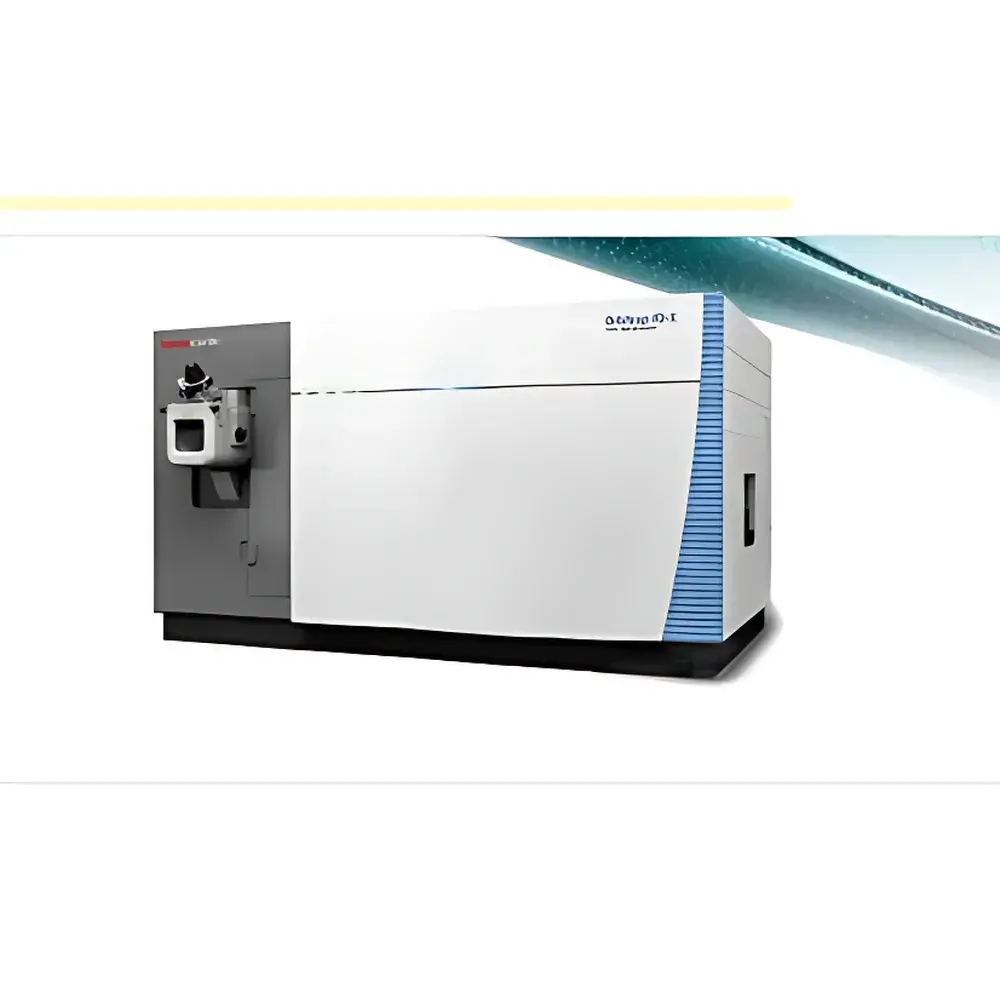
Thermo Fisher Orbitrap IQ-X Tribrid Mass Spectrometer
| Brand | Thermo Fisher |
|---|---|
| Origin | Germany |
| Manufacturer Type | Original Equipment Manufacturer (OEM) |
| Origin Category | Imported |
| Model | Orbitrap IQ-X Tribrid |
| Instrument Type | Orbitrap-based Tribrid Mass Spectrometer |
| Application Specificity | Dedicated for Small Molecule and Biomolecule Characterization |
| Sensitivity | 1,000,000 (1M) at m/z 200 (S/N ≥ 50:1 for reserpine) |
| Resolution | Up to 1,000,000 at m/z 200 (with optional ultra-high-resolution acquisition) |
Overview
The Thermo Fisher Orbitrap IQ-X Tribrid Mass Spectrometer represents the evolution of high-resolution, accurate-mass (HRAM) hybrid instrumentation for comprehensive small molecule identification, structural elucidation, and quantitative analysis in complex matrices. Built upon the proven Tribrid architecture—integrating a dual-pressure linear ion trap (LIT), a high-transmission segmented quadrupole mass filter, and an ultra-high-field Orbitrap mass analyzer—the system enables simultaneous acquisition of complementary fragmentation data (CID, HCD, and optional UVPD) with real-time decision-making and multi-stage MSn sequencing. Its core measurement principle relies on electrostatic trapping and Fourier-transform detection of image currents induced by orbiting ions in the Orbitrap cell, delivering sub-ppm mass accuracy, exceptional dynamic range, and isotopic fidelity essential for confident compound annotation and de novo structure inference.
Key Features
- Tribrid architecture combining quadrupole isolation, dual-pressure LIT for rapid MSn (up to 45 Hz scan rate), and ultra-high-field Orbitrap analyzer with resolution up to 1,000,000 at m/z 200
- Auto-Ready ion source with integrated hardware-level calibration routines ensuring consistent performance across instrument lifetime and minimizing manual intervention
- EASY-IC (Electron-Assisted Internal Calibration) enabling real-time mass recalibration using a secondary ion source; maintains mass accuracy < 1 ppm across consecutive scans without external standards
- Segmented quadrupole with isolation width down to 0.4 Da at m/z 200, enhancing precursor selectivity and transmission efficiency for low-abundance analytes
- Intelligent data acquisition via AcquireX workflow and real-time spectral library matching, enabling automated, unbiased MSn triggering based on intensity, chromatographic elution profile, or spectral similarity
- Integrated UV photodissociation (UVPD) option for alternative fragmentation pathways—particularly valuable for labile post-translational modifications and isomeric differentiation
Sample Compatibility & Compliance
The Orbitrap IQ-X Tribrid is optimized for coupling with ultra-high-performance liquid chromatography (UHPLC) systems and supports diverse sample introduction methods including electrospray ionization (ESI), heated electrospray ionization (H-ESI), and atmospheric pressure chemical ionization (APCI). It accommodates polar, semi-polar, and moderately nonpolar small molecules (MW < 2,000 Da), metabolites, lipids, peptides, and intact proteins. The platform complies with regulatory requirements for analytical method validation under ICH Q2(R2), supports audit trails and electronic signatures per FDA 21 CFR Part 11, and facilitates GLP/GMP-aligned workflows through secure user access control, method versioning, and raw data integrity verification. All calibration and performance verification procedures align with ASTM E2983 and ISO/IEC 17025 standards for mass spectrometric testing laboratories.
Software & Data Management
Instrument control and data acquisition are managed through Thermo Scientific Compound Discoverer and TraceFinder software suites—both built on the same underlying architecture as Thermo’s Chromeleon CDS. Preconfigured experimental templates streamline method development for targeted quantitation, untargeted screening, and structural characterization. MSn spectral trees, in silico fragmentation prediction (using CFM-ID and Mass Frontier engines), and precursor ion fingerprinting enable systematic interpretation of tandem spectra. All raw data files (.raw) are stored in vendor-neutral formats compatible with third-party open-source tools (e.g., OpenMS, MZmine), while metadata—including instrument parameters, calibration logs, and processing history—is embedded and exportable for traceability. Data archiving adheres to FAIR principles (Findable, Accessible, Interoperable, Reusable) and supports integration into enterprise LIMS environments via RESTful API interfaces.
Applications
This system serves as a primary platform for pharmaceutical impurity profiling, environmental contaminant screening (e.g., PFAS, pesticides, pharmaceutical residues), clinical metabolomics, natural product dereplication, forensic toxicology, and biopharmaceutical characterization (e.g., glycan mapping, peptide mapping). Its ability to acquire high-fidelity MS2–MS4 spectra within a single LC run allows for hierarchical structural interrogation—distinguishing positional isomers, identifying unknown adducts, and resolving co-eluting interferences in multiplexed assays. In regulated environments, it supports validated bioanalytical methods for PK/PD studies compliant with USP and EMA Guideline on Bioanalytical Method Validation.
FAQ
What mass accuracy can be achieved during routine operation?
Mass accuracy remains ≤ 1 ppm RMS across all acquisition modes when using EASY-IC calibration, verified daily via standard tuning mix (e.g., Pierce LTQ Calibration Solution).
Is the system compatible with existing Thermo Scientific LC hardware?
Yes—it natively integrates with Vanquish UHPLC, UltiMate 3000, and Accela systems via Thermo Scientific SyncLink interface, supporting both scheduled and unscheduled injection protocols.
How does the dual-pressure LIT improve MSn efficiency?
The dual-pressure design enables rapid ion accumulation at higher pressure (for efficient trapping) and high-fidelity scanning at lower pressure (for improved resolution and duty cycle), resulting in up to 45 MSn events per second without sacrificing sensitivity.
Can the system perform simultaneous quantitative and qualitative analysis?
Yes—parallel reaction monitoring (PRM) and data-independent acquisition (DIA) modes operate concurrently with full-scan HRAM detection, allowing retrospective extraction of quantitative transitions from archival MS2 datasets.
What level of IT infrastructure support is required for deployment?
Minimum recommended configuration includes Windows Server 2019 or later, 64 GB RAM, 2 TB SSD storage for active acquisition, and Gigabit Ethernet connectivity; virtualized deployment is supported under VMware vSphere 7.0+ with validated resource allocation profiles.





