
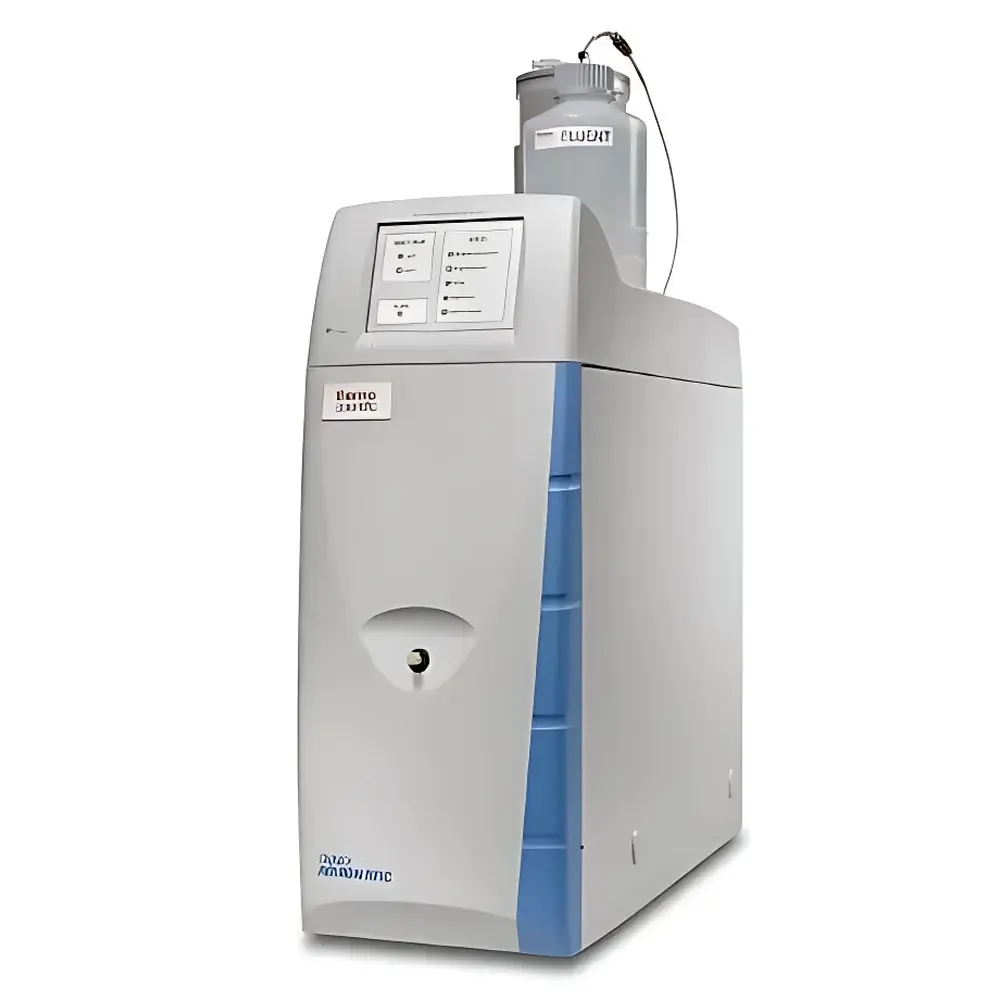
Thermo Fisher Dionex Aquion RFIC Ion Chromatograph
| Brand | Thermo Fisher |
|---|---|
| Origin | Mexico |
| Manufacturer | Thermo Fisher Scientific |
| Origin Category | Imported |
| Model | Aquion RFIC |
| Instrument Type | Laboratory |
| Maximum Pump Pressure | 5000 psi |
| Flow Rate Range | 0.00–5.00 mL/min |
| Eluent Flow Rate Range | 0.00–5.00 mL/min |
| Maximum Operating Pressure | 5000 psi |
| Operating Temperature Range | Ambient +5°C to 60°C |
| Temperature Reproducibility | ±0.05°C |
| Eluent Concentration Range | 0.1–100 mM |
Overview
The Thermo Fisher Dionex Aquion RFIC Ion Chromatograph is a fully integrated, reagent-free ion chromatography system engineered for precision, reproducibility, and operational efficiency in routine and regulated laboratory environments. Based on suppressed conductivity detection and electrolytically generated eluents (EG), the Aquion RFIC employs a dual-piston high-pressure pump and an integrated electrochemical suppressor to deliver stable baseline performance, low detection limits, and exceptional long-term retention time stability. Its design adheres to core principles of modern IC methodology—eliminating manual eluent preparation, minimizing carryover and contamination risk, and enabling robust gradient and isocratic separations of common anions (e.g., F⁻, Cl⁻, NO₂⁻, Br⁻, NO₃⁻, PO₄³⁻, SO₄²⁻) and cations (e.g., Li⁺, Na⁺, NH₄⁺, K⁺, Mg²⁺, Ca²⁺) in environmental, food safety, pharmaceutical, and academic research applications.
Key Features
- Dual-piston high-pressure pump with pressure rating up to 5000 psi, delivering precise flow control from 0.00 to 5.00 mL/min with minimal pulsation and high long-term stability
- Electrolytic eluent generation (EG) module producing potassium hydroxide (KOH), methanesulfonic acid (MSA), or other compatible eluents on-demand at concentrations ranging from 0.1 mM to 100 mM—eliminating manual preparation, storage, and associated variability
- Integrated electrolytic suppressor ensuring consistent suppression efficiency, low background conductivity, and extended column lifetime without chemical regeneration or consumable cartridges
- Temperature-controlled digital conductivity detector with active cell cooling/heating; operating range: ambient +5°C to 60°C, temperature reproducibility ±0.05°C for enhanced peak shape and quantitation accuracy
- Chemically resistant PEEK fluidic path throughout the entire flow path—including pump heads, injection valve, column compartment, and detector cell—to ensure compatibility with a full spectrum of IC eluents and prevent metal leaching or adsorption artifacts
- Compact footprint optimized for benchtop deployment in space-constrained laboratories, with intuitive LED status panel providing real-time system health diagnostics (pump pressure, suppressor status, detector signal, temperature)
Sample Compatibility & Compliance
The Aquion RFIC supports both standard-bore (4 mm) and microbore (2 mm) IC columns, accommodating diverse resolution and sensitivity requirements across sample matrices—including drinking water, wastewater, soil extracts, beverage formulations, dairy products, and biological fluids. The system is designed and validated to support compliance with widely referenced analytical standards, including ASTM D4327 (anion analysis in water), EPA Methods 300.0 and 300.1 (drinking water anions), ISO 10304-1 (water quality—determination of dissolved anions), and USP (conductivity of purified water). When operated with Thermo Scientific Dionex Chromeleon CDS software under audit-trail-enabled configuration, the platform meets data integrity requirements aligned with FDA 21 CFR Part 11, EU Annex 11, and GLP/GMP documentation workflows.
Software & Data Management
Controlled exclusively via Thermo Scientific Dionex Chromeleon Chromatography Data System (CDS) software, the Aquion RFIC integrates seamlessly into enterprise-level laboratory informatics infrastructures. Chromeleon supports method development, sequence definition, real-time monitoring, automated calibration, peak integration using customizable algorithms (e.g., tangent skim, valley-to-valley), and report generation compliant with regulatory submission formats. Audit trail functionality records all user actions, method modifications, and data processing steps with time stamps and operator identification. Optional features include electronic signatures, instrument qualification templates (IQ/OQ/PQ), and secure network deployment supporting multi-user access with role-based permissions.
Applications
- Environmental monitoring: Quantification of regulated anions and cations in surface water, groundwater, and industrial effluents per EPA and ISO protocols
- Food & beverage quality control: Nitrate/nitrite analysis in cured meats, sulfate in wine, chloride in dairy products, and sodium in low-sodium formulations
- Pharmaceutical excipient testing: Counter-ion profiling (e.g., Na⁺, Cl⁻, acetate) in APIs and drug substances per ICH Q5 and USP monographs
- Academic and method development labs: Rapid method transfer between RFIC platforms due to standardized EG chemistry and suppressor architecture
- Contract testing laboratories: High-throughput batch analysis enabled by unattended overnight operation, auto-calibration routines, and integrated vacuum degassing (optional)
FAQ
Does the Aquion RFIC require external eluent reservoirs or manual eluent preparation?
No. The system incorporates an integrated electrolytic eluent generator (EG) that produces high-purity KOH or MSA eluents on-demand, eliminating the need for bottled eluents, dilution errors, or daily preparation.
Is column heating optional or built-in?
Column heating is available as an optional thermostatted column compartment, supporting precise temperature control from ambient +5°C to 60°C with ±0.05°C reproducibility.
What detector technology is used?
A digitally controlled, temperature-stabilized conductivity detector with dual-electrode cell geometry and adjustable gain settings for optimal signal-to-noise ratio across wide concentration ranges.
Can the system be validated for GxP environments?
Yes—when configured with Chromeleon CDS in 21 CFR Part 11 mode and operated with documented IQ/OQ/PQ procedures, the Aquion RFIC meets regulatory expectations for data integrity, traceability, and system reliability.
What maintenance intervals are recommended for routine operation?
Routine maintenance includes quarterly replacement of the EG membrane cartridge (if applicable), biannual inspection of PEEK tubing and fittings, and annual verification of pump seal integrity and detector cell calibration—fully documented in the system’s preventive maintenance log within Chromeleon.




