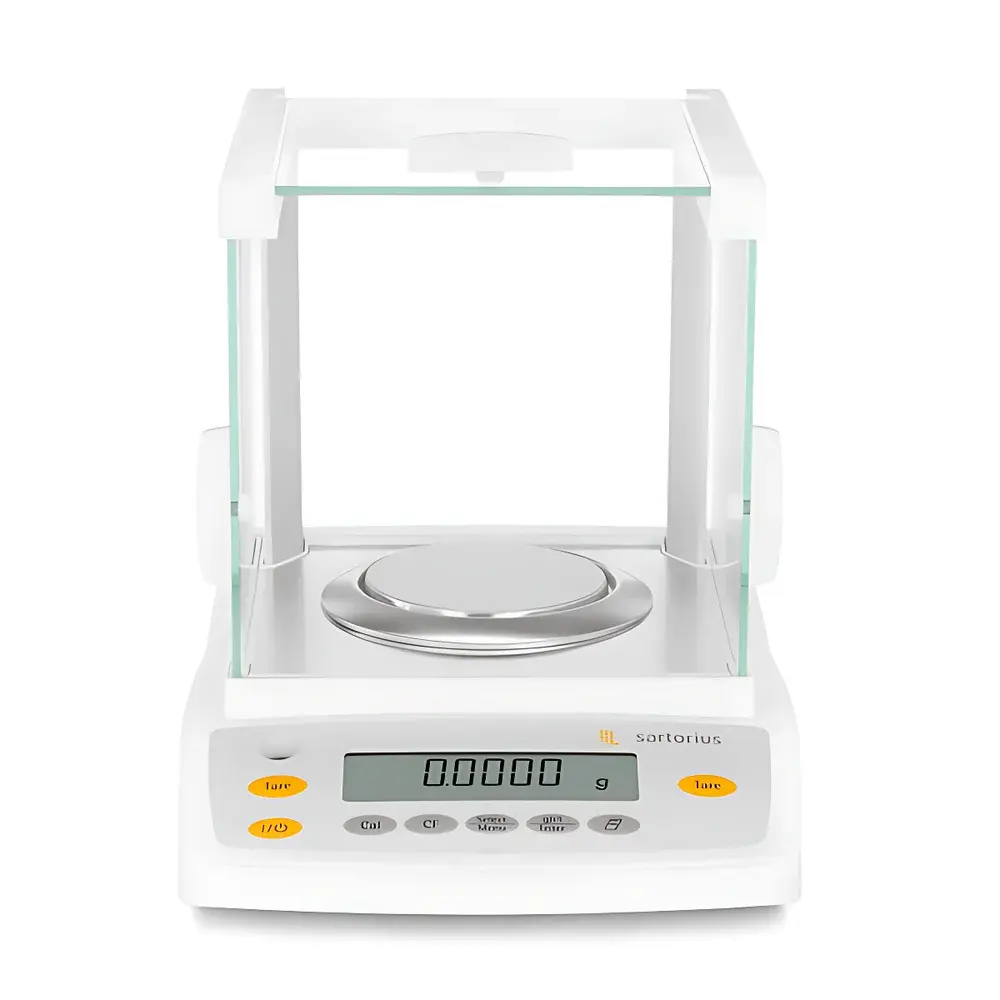
Sartorius Economical Analytical Balance GL224i-1SCN
| Origin | Germany |
|---|---|
| Manufacturer Type | Authorized Distributor |
| Origin Category | Imported |
| Model | GL224i-1SCN |
| Instrument Type | Analytical Balance |
| Maximum Capacity | 220 g |
| Readability | 0.1 mg |
| Repeatability | 0.1 mg |
| Calibration | Internal |
| Power Input | 100–240 V AC, ±10%, 50–60 Hz |
| Power Consumption | Max 16 VA (avg. 8 VA incl. adapter) |
| Operating Time (with YRB11Z battery) | ~35 h (backlight on) |
| Leveling | Integrated bubble-level indicator |
| Display | High-contrast white backlight, digit height 15 mm |
| Interface | RS232 (DB25 female) |
| Preinstalled Applications | Weighing, Density Determination, Percentage Weighing, Counting, Unit Conversion |
| Supported Units | g, kg, ct, lb, oz, ozt, hk tael, sg tael, tw tael, dwt, gr, mg, lb:oz, N, and 12 additional regional mass units |
| Languages | English, French, German, Italian, Polish, Russian, Spanish |
| Security | Integrated cable lock slot |
| Bottom-Loading Hook | Built-in |
Overview
The Sartorius GL224i-1SCN is an economical yet rigorously engineered analytical balance designed for routine laboratory weighing tasks requiring high repeatability and traceable metrological performance. Based on Sartorius’ decades of German precision engineering heritage, this model operates on electromagnetic force compensation (EMFC) principle — a proven technology ensuring stable, drift-free measurement across ambient temperature fluctuations from +10 °C to +30 °C. With a maximum capacity of 220 g and readability of 0.1 mg (100 µg), the GL224i-1SCN meets Class I accuracy requirements per OIML R 76-1 and complies with ISO/IEC 17025 calibration traceability standards when used with certified internal calibration weights. Its compact footprint and integrated leveling system facilitate rapid deployment on standard lab benches without dedicated vibration isolation tables — making it suitable for QC labs, educational institutions, and pharmaceutical production support environments where cost-efficiency must not compromise metrological integrity.
Key Features
- Internal motorized calibration with automatic temperature-triggered recalibration (ATC), eliminating manual intervention and reducing operator-induced error
- Overload protection circuitry safeguarding the load cell against accidental loads exceeding 250 g
- High-contrast 15-mm-digit LCD with white LED backlight optimized for low-glare visibility under varied ambient lighting conditions
- Dual-purpose weighing pan (Ø90 mm stainless steel) supporting both top-loading and bottom-hook suspension via integrated lower hook
- Robust aluminum die-cast housing with anti-static coating and IP42-rated enclosure for dust resistance in non-hazardous environments
- RS232 serial interface (DB25 female) compliant with ASTM E2656-17 for instrument data export to LIMS or ELN systems
- Multi-language UI supporting 7 major European and global languages — configurable without firmware update
- Cable lock slot enabling physical anchoring to benchtops per ISO/IEC 17025 security guidelines for regulated environments
Sample Compatibility & Compliance
The GL224i-1SCN accommodates solid, granular, and powdered samples within its 220 g capacity limit. Its open draft shield design permits unrestricted access during quick weigh-ins while maintaining adequate air-flow control for stable readings under typical HVAC conditions (air velocity < 0.2 m/s). For density determination, the balance supports optional Sartorius density kits (e.g., YDK01) with sinker and immersion vessel. Regulatory compliance includes full alignment with USP and EP 2.1.6 for analytical balance verification, as well as compatibility with FDA 21 CFR Part 11-compliant software when paired with Sartorius LabX Lite (via RS232 handshake protocol). All factory calibration certificates are issued with uncertainty budgets referenced to national metrology institutes (PTB, NIST, or NPL).
Software & Data Management
Data output follows ASCII-based RS232 protocol with user-definable delimiters and termination characters (CR/LF, TAB), enabling seamless integration into custom Excel macros or validated third-party data acquisition platforms. The built-in application suite — including density calculation, parts counting (with auto-average sample weight), and % relative weighing — stores up to 99 user-defined methods in non-volatile memory. Audit trail functionality is available via optional LabX Lite software (sold separately), which provides electronic signatures, time-stamped event logs, and change history for all parameter modifications — satisfying GLP/GMP documentation requirements for method validation and instrument qualification (IQ/OQ/PQ).
Applications
- Pharmaceutical formulation: Active pharmaceutical ingredient (API) dispensing and excipient ratio verification per USP
- Chemistry labs: Stoichiometric reagent preparation and gravimetric standard solution preparation (e.g., KCl for conductivity calibration)
- Materials science: Powder density profiling and catalyst loading consistency checks
- Food testing: Moisture content determination via loss-on-drying (LOD) workflows using external heating modules
- Academic teaching: Fundamental metrology instruction, statistical process control (SPC) exercises, and uncertainty budgeting labs
- Environmental labs: Filter weight analysis for particulate matter (PM2.5/PM10) quantification per EPA Method 201A
FAQ
Does the GL224i-1SCN support external calibration with certified weights?
Yes — although internally calibrated, the balance allows manual external calibration via RS232 command or front-panel menu, accepting user-provided NIST-traceable weights for independent verification.
Is the RS232 interface compatible with modern Windows 11 systems?
Yes — when used with a certified USB-to-RS232 adapter (e.g., FTDI chipset-based), the interface maintains full ASCII transmission fidelity and baud rate stability up to 115,200 bps.
What is the minimum sample weight for reliable measurement at 0.1 mg readability?
Per USP , the minimum weight is defined as 100 × readability = 10 mg; however, for GMP-regulated processes, Sartorius recommends ≥ 20 mg for robust uncertainty margins.
Can the balance operate continuously on battery power?
Yes — with the optional rechargeable YRB11Z battery pack, continuous operation lasts approximately 35 hours with backlight enabled, meeting ASTM D6956-18 field-portability criteria.
How frequently should internal calibration be performed?
Sartorius recommends initiating internal calibration after every 2 °C ambient temperature shift or at least once per shift in regulated environments — programmable via Auto-Cal interval settings.