
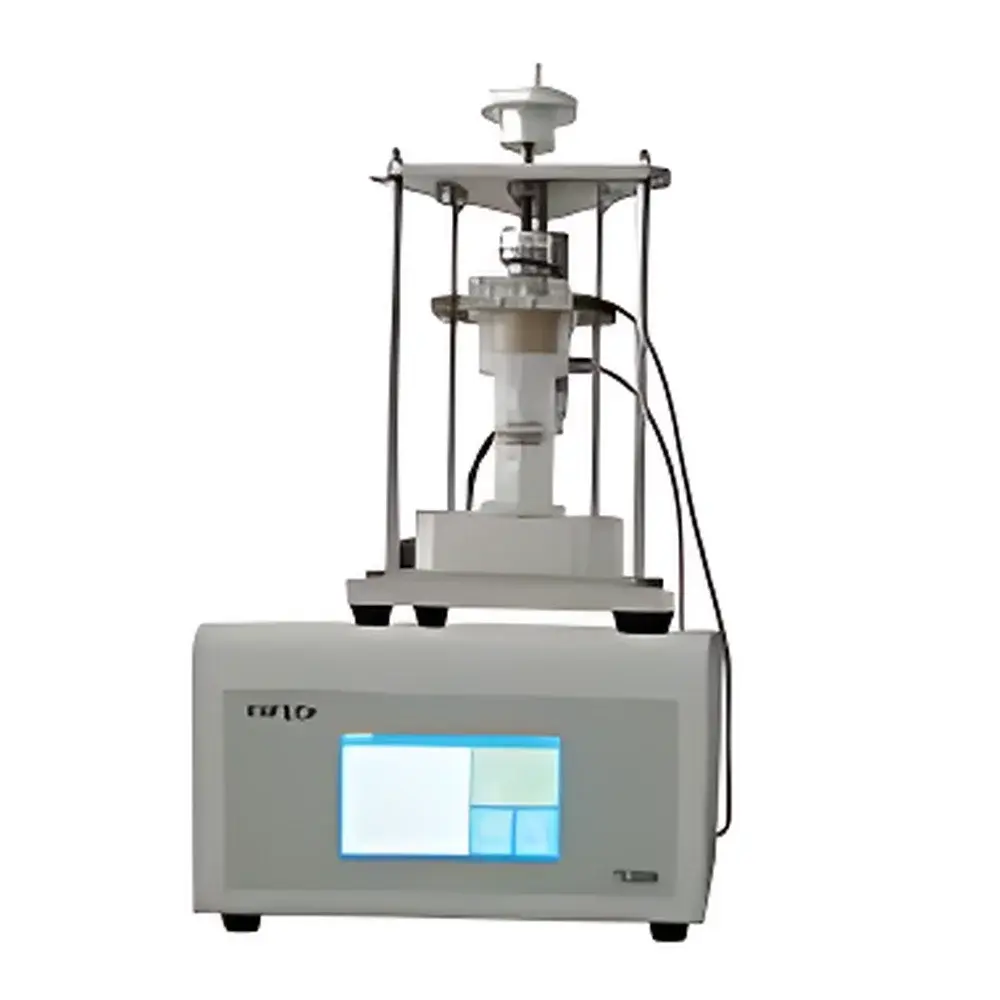
XIATECH TC2120 Series Heat Flow Method Thermal Conductivity Analyzer
| Brand | XIATECH |
|---|---|
| Origin | Shaanxi, China |
| Manufacturer Type | Authorized Distributor |
| Country of Origin | China |
| Model | TC2120 Series |
| Instrument Type | Heat Flow Method |
| Sample Capacity | Single sample per test |
| Test Environment | High-pressure compatible (up to 10 MPa) |
| Thermal Conductivity Range | 0.05–50 W/(m·K) |
| Accuracy | ±3–5% |
| Repeatability | ±2% |
| Test Atmosphere | Ambient air |
| Sample Forms | Solid blocks, powders, pastes |
| Thickness Measurement | Laser displacement sensor (resolution ≤1 µm, min. measurable thickness: 0.1 mm) |
| Temperature Control Stability | ±0.05 °C |
| Compliant Standard | ASTM D5470 |
Overview
The XIATECH TC2120 Series Thermal Conductivity Analyzer is a precision benchtop instrument engineered for the quantitative characterization of thermal transport properties in thermal interface materials (TIMs) using the standardized heat flow method (HFM). Based on Fourier’s law of conduction and calibrated steady-state one-dimensional heat transfer across a sandwiched sample under controlled compressive load, the TC2120 delivers traceable, reproducible measurements of thermal conductivity (k) and interfacial thermal resistance (Rth) in accordance with ASTM D5470—*Standard Test Method for Thermal Transmission Properties of Thermally Conductive Electrical Insulation Materials*. Its core architecture integrates high-stability temperature control, motor-driven pressure actuation, and non-contact laser-based thickness metrology, enabling rigorous evaluation of low-thickness TIMs—including thermal greases, phase-change pads, elastomeric sheets, and sintered ceramics—under realistic mechanical loading conditions.
Key Features
- Motorized Pressure Control System: Integrated servo-motor actuator enables programmable compression from 0.1 to 10 MPa with real-time feedback and hold capability; minimizes interfacial contact resistance and supports pressure-dependent k(R) profiling.
- Laser Displacement Thickness Metrology: Class-1 laser sensor measures sample thickness with ≤1 µm resolution and sub-0.1 mm minimum detectable thickness; eliminates manual micrometer error and ensures accurate cross-sectional area calculation.
- High-Stability Dual-Zone Temperature Control: Independent hot/cold plate regulation maintains ΔT stability within ±0.05 °C over extended steady-state periods; supports test temperatures from ambient to 150 °C (optional upgrade).
- Automated Workflow Integration: Synchronized acquisition of thickness, pressure, temperature differential, and heat flux data; fully automated report generation compliant with GLP documentation requirements.
- Modular Sample Interface Design: Interchangeable platens accommodate irregular geometries and soft deformable samples; surface finish optimized for uniform pressure distribution and minimal edge losses.
Sample Compatibility & Compliance
The TC2120 accommodates solid blocks (e.g., AlN substrates, BN ceramics), compliant pastes (silicone- or metal-filled thermal greases), granular powders (graphite flakes, alumina fillers), and viscoelastic gels—without requiring encapsulation or binder addition. All measurements are performed under ambient air atmosphere unless modified with optional purge gas adapters. The system complies with ASTM D5470 for thermal resistance and conductivity testing of electrically insulating TIMs, and its hardware architecture supports audit-ready operation under ISO/IEC 17025 and FDA 21 CFR Part 11 environments when paired with XIATECH’s validated software suite.
Software & Data Management
The TC2120 operates via XIATECH’s proprietary THERMO-ANALYZE v4.x software, which provides real-time visualization of thermal gradient development, pressure relaxation curves, and convergence diagnostics. Raw data—including thermocouple voltages, load cell outputs, and displacement signals—are stored in HDF5 format with embedded metadata (operator ID, timestamp, calibration certificate IDs, environmental logs). Export options include CSV, PDF reports with digital signatures, and XML files compatible with LIMS integration. Audit trail functionality records all parameter modifications, user logins, and report revisions, satisfying GMP/GLP traceability mandates.
Applications
- Qualification of thermal interface materials for power electronics packaging (IGBT modules, SiC inverters)
- R&D screening of filler-loaded polymer composites for EV battery thermal management
- Process validation of screen-printed thermal pastes in semiconductor assembly lines
- Comparative analysis of anisotropic conductivity in layered graphite films and metal matrix composites
- Reliability assessment of TIM performance degradation under thermal cycling and compression set
FAQ
What standards does the TC2120 comply with?
ASTM D5470 is natively supported; optional firmware modules enable alignment with ISO 22007-2 and JIS R 1611 upon request.
Can the TC2120 measure anisotropic materials?
No—it assumes isotropic conduction; directional conductivity requires guarded hot plate or laser flash methods.
Is vacuum or inert gas testing possible?
Yes—via optional sealed chamber add-on with N2/Ar purge ports and pressure monitoring.
How is calibration traceability maintained?
Each unit ships with NIST-traceable reference standards (SRM 1470a glass, SRM 1469a stainless steel) and full calibration certificates valid for 12 months.
Does the system support multi-sample sequential testing?
Not natively—the TC2120 is configured for single-sample, high-fidelity measurement; throughput optimization requires external robotic sample handling integration.



