
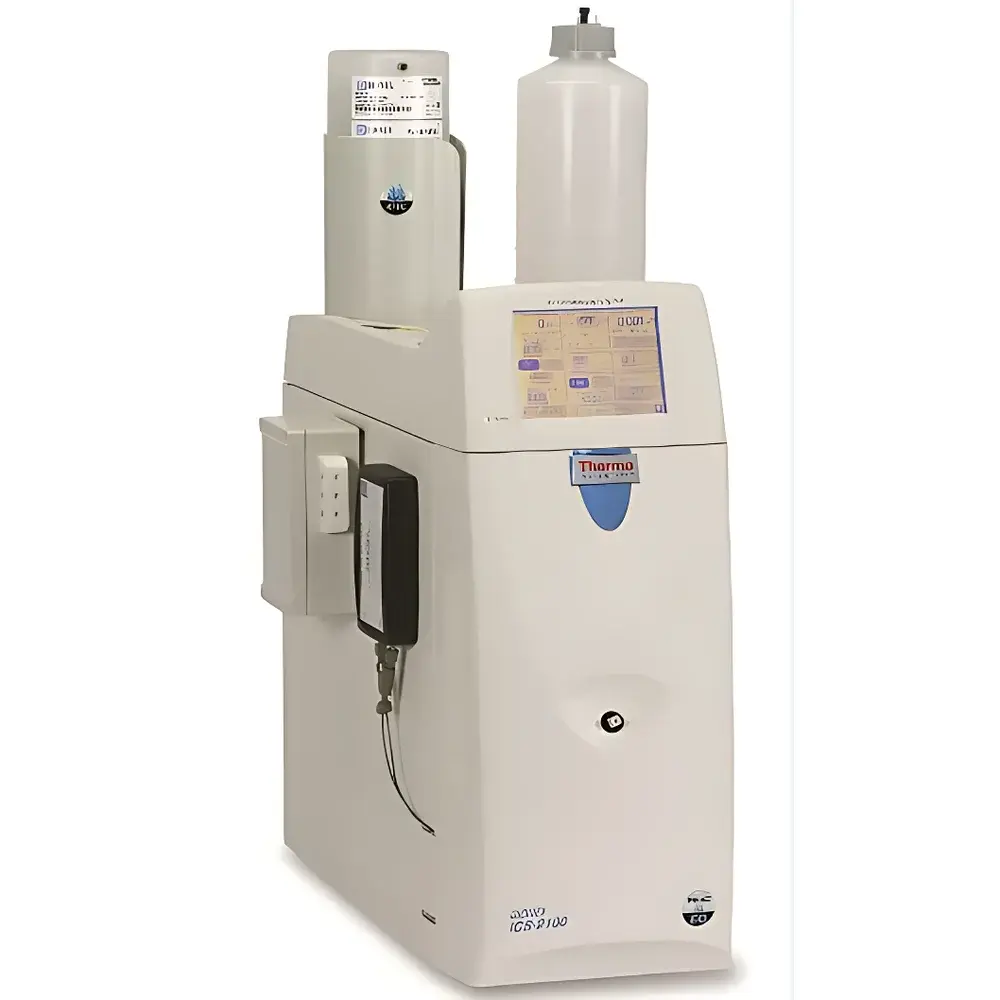
Thermo Fisher Scientific ICS-2100 Reagent-Free Ion Chromatography System
| Brand | Thermo Fisher Scientific |
|---|---|
| Origin | USA |
| Manufacturer Type | Original Equipment Manufacturer (OEM) |
| Origin Category | Imported |
| Model | ICS-2100 |
| Instrument Type | Laboratory Benchtop System |
| Maximum Pump Pressure | 6000 psi |
| Operating Pressure Range | Up to 5000 psi |
| Column Oven Temperature Range | 4–40 °C |
| Eluent Concentration Range | 0–100 mM KOH (varies with eluent chemistry) |
| Detection Principle | Suppressed Conductivity Detection with Electrolytic Eluent Generation and Electrolytic Sample Preparation |
Overview
The Thermo Fisher Scientific ICS-2100 Reagent-Free Ion Chromatography (RFIC™) System represents a foundational advancement in modern anion and cation analysis. Engineered for precision, reproducibility, and operational autonomy, the ICS-2100 integrates two proprietary electrolytic technologies—Reagent-Free Ion Chromatography with Eluent Generation (RFIC-EG) and Electrolytic Sample Preparation (RFIC-ESP)—into a single, unified platform. Unlike conventional ion chromatographs requiring manual preparation of chemical eluents and offline sample pretreatment, the ICS-2100 generates high-purity, precisely controlled potassium hydroxide (KOH) or methanesulfonic acid (MSA) eluents *in situ* via water electrolysis. This eliminates variability from human handling, reduces reagent contamination risk, and ensures batch-to-batch consistency across multi-day analyses. The system operates on ultra-pure water only—no stock solutions, no hazardous acids/bases, no volumetric glassware. Its core detection architecture employs suppressed conductivity detection with Thermo Fisher’s patented Electrolytic Regeneration Suppressor (ERS 500), delivering sub-ppb detection limits for common inorganic anions (e.g., F⁻, Cl⁻, NO₂⁻, Br⁻, NO₃⁻, PO₄³⁻, SO₄²⁻) and cations (e.g., Li⁺, Na⁺, NH₄⁺, K⁺, Mg²⁺, Ca²⁺) under isocratic or linear gradient conditions.
Key Features
- RFIC-EG Technology: On-demand, programmable generation of KOH (0–100 mM) or MSA eluents directly from deionized water; eliminates manual eluent preparation, improves retention time stability (<0.05% RSD over 72 h), and enables seamless gradient elution using a single isocratic pump.
- RFIC-ESP Module: Integrated electrolytic sample pretreatment unit utilizing valve-switching and water electrolysis to generate ultrapure water and controlled pH/oxidation environments—enabling online matrix removal, analyte preconcentration, and oxidation state adjustment for complex environmental, food, or biological matrices.
- Dual-Column Compatibility: Supports both 2 mm and 4 mm internal diameter analytical columns; optimized for high-resolution separation with low flow rates (0.25–2.0 mL/min) and minimal solvent consumption.
- High-Performance Dual-Piston Pumps: All-PEEK fluidic path rated to 6000 psi; delivers pulse-free, low-drift flow (≤0.1% RSD) across full pressure range; chemically inert to strong bases, acids, and organic modifiers (e.g., acetone, methanol).
- Digital Conductivity Detector: Temperature-stabilized cell with 1500 µS/cm, enabling simultaneous quantification of trace and major ions in one injection.
- Intelligent Column Compartment: Precision-controlled oven (4–40 °C ±0.1 °C); accommodates up to two columns and suppressor; minimizes retention time drift induced by ambient fluctuations.
Sample Compatibility & Compliance
The ICS-2100 is validated for direct injection of aqueous samples including drinking water, wastewater, semiconductor process rinsates, pharmaceutical excipients, food extracts, and biological fluids (after appropriate dilution/filtration). Its all-PEEK flow path and RFIC-EG architecture ensure compatibility with high-pH eluents and organic solvents—critical for carbohydrate, organic acid, and transition metal speciation applications. The system meets key regulatory requirements for routine QC/QA workflows: it supports 21 CFR Part 11-compliant audit trails and electronic signatures when operated with Chromeleon™ 7.3 CDS software; complies with ASTM D4327 (anions in water), ISO 10304-1 (determination of dissolved anions), and USP (conductivity of purified water). Suppressor performance adheres to ISO 17993:2018 specifications for baseline noise (95% for common anions).
Software & Data Management
Controlled exclusively via Chromeleon™ Chromatography Data System (CDS) v7.3 or later, the ICS-2100 supports fully automated method development, sequence execution, peak integration, calibration curve generation (linear, quadratic, weighted), and report export (PDF, CSV, XML). The software includes embedded RFIC-EG method wizards, real-time pump pressure monitoring, suppressor health diagnostics, and predictive maintenance alerts. All raw data files are stored in vendor-neutral .cd format with embedded metadata (instrument configuration, eluent concentration, temperature setpoints, detector gain). Audit trail functionality records user actions, method changes, and result modifications with timestamped, non-erasable entries—fully compliant with GLP and GMP documentation standards. Remote monitoring via Ethernet or USB 2.0 enables centralized lab management without local workstation dependency.
Applications
- Environmental monitoring: Quantification of regulated anions in EPA Method 300.0 and 300.1 matrices; nitrate/nitrite speciation in groundwater; perchlorate analysis per EPA Method 314.1.
- Pharmaceutical quality control: Counterion profiling in APIs (e.g., sodium in heparin, chloride in insulin formulations); residual catalyst analysis (e.g., Pd²⁺, Pt⁴⁺) in synthetic intermediates.
- Food & beverage safety: Bromide/bromate in bread and beverages; iodide in dairy; phosphate additives in processed meats; sulfite preservative screening.
- Power generation: Chloride and sulfate monitoring in boiler feedwater per ASTM D4582; trace fluoride in nuclear-grade coolant.
- Electronics manufacturing: Ultra-trace halide analysis (Cl⁻, F⁻, Br⁻) in photoresist solvents and CMP slurries at sub-ppq levels.
FAQ
What eluents can be generated using RFIC-EG on the ICS-2100?
KOH (0–100 mM) for anion analysis and methanesulfonic acid (MSA, 0–100 mM) for cation analysis—both generated continuously from deionized water.
Is column switching or valve-based sample pretreatment supported?
Yes—the ICS-2100 provides dedicated mounting space and electrical interfaces for optional 6-port or 10-port switching valves, enabling automated inline filtration, solid-phase extraction (SPE), or matrix elimination protocols.
Does the system require external gas supply or chemical regeneration solutions?
No. The ERS 500 suppressor is continuously regenerated electrolytically; no CO₂ scrubbers, external acid/base reservoirs, or蠕动 pumps are required.
Can the ICS-2100 be integrated into a networked laboratory environment?
Yes. It supports standard TCP/IP communication, LIMS connectivity via ODBC drivers, and scheduled remote diagnostics through Chromeleon’s enterprise server module.
What is the typical maintenance interval for the ERS 500 suppressor?
Under normal operating conditions (≤5000 psi, ≤40 °C, filtered samples), the ERS 500 requires zero routine maintenance and demonstrates >2 years of continuous service life before replacement.






