
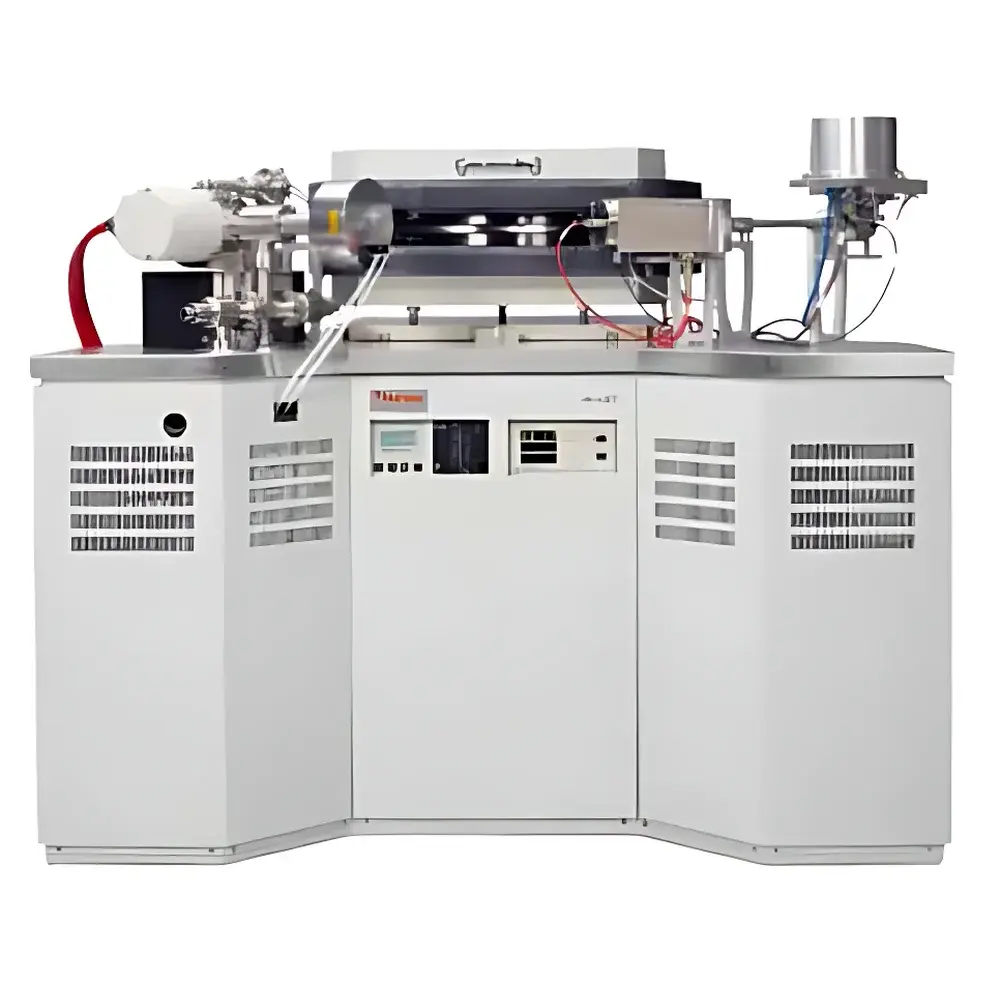
Thermo Scientific HELIX SFT Multi-Collector Static Vacuum Rare Gas Mass Spectrometer
| Brand | Thermo Fisher |
|---|---|
| Origin | Germany |
| Manufacturer | Thermo Fisher Scientific |
| Instrument Type | Rare Gas Isotope Ratio Mass Spectrometer |
| Model | HELIX SFT |
| Measurement Range | Full mass range for noble gases (He, Ne, Ar, Kr, Xe) |
| Resolution | >700 at low mass (e.g., m/z 3), enabling baseline separation of ³He from HD⁺ and H₃⁺ interferences |
| Abundance Sensitivity | <1 ppb at m/z 4 relative to m/z 3 |
| Internal Volume | ~1400 cm³ |
| Amplifier Options | 10¹⁰ Ω, 10¹¹ Ω, 10¹² Ω, and 10¹³ Ω Faraday cup amplifiers |
| Detection Modes | Simultaneous multi-collection (e.g., ³He/⁴He) and peak-jumping for full noble gas isotope systems |
Overview
The Thermo Scientific HELIX SFT is a high-resolution, multi-collector static vacuum rare gas mass spectrometer engineered for ultra-precise isotopic ratio measurements of helium, neon, argon, krypton, and xenon. Based on over two decades of dedicated development in noble gas mass spectrometry, the HELIX SFT implements a fully static vacuum architecture—eliminating dynamic pumping cycles and mechanical scanning—to ensure exceptional signal stability, reduced memory effects, and superior long-term reproducibility. Its core measurement principle relies on magnetic sector mass separation coupled with discrete Faraday cup and optional secondary electron multiplier (SEM) detection, optimized for low-abundance isotopes such as ³He in geological, atmospheric, and nuclear safeguards applications. The instrument operates under ultra-high vacuum conditions (<5 × 10⁻¹⁰ mbar base pressure), minimizing background contributions and enabling sub-part-per-trillion detection limits for key noble gas species.
Key Features
- Simultaneous multi-collection capability: Dedicated Faraday cup arrays allow concurrent detection of ³He and ⁴He without peak jumping—reducing analysis time by up to 40% and improving internal precision to ≤0.05‰ (2σ) for ³He/⁴He ratios in standard reference materials.
- Unprecedented abundance sensitivity: Achieves <1 part-per-trillion (ppt) interference at m/z 4 from adjacent masses (e.g., HD⁺ and H₃⁺), critical for accurate ³He quantification in low-³He matrices such as mid-ocean ridge basalts or groundwater samples.
- Optimized low-mass resolution: Resolution >700 at m/z 3 ensures complete baseline separation of ³He⁺ from HD⁺ (m/z 3.022) and H₃⁺ (m/z 3.023), eliminating reliance on mathematical correction algorithms and enhancing data integrity.
- Expanded internal volume (≈1400 cm³): Larger source and analyzer chamber volume improves ion transmission efficiency and reduces space charge effects—particularly beneficial for high-sensitivity ²¹Ne and ³⁸Ar measurements in small-volume samples.
- Modular amplifier suite: Integrated 10¹⁰ Ω to 10¹³ Ω Faraday cup amplifiers provide calibrated dynamic range spanning 12 orders of magnitude, supporting both high-intensity major isotope signals (e.g., ⁴⁰Ar) and trace-level minor isotopes (e.g., ³⁶Ar) within a single run.
- Static vacuum architecture: No moving parts in the mass analyzer; no scanning magnets or slits—ensuring mechanical stability, minimal thermal drift, and compatibility with long-duration, unattended operation required for high-precision geochronology and noble gas thermochronology protocols.
Sample Compatibility & Compliance
The HELIX SFT interfaces seamlessly with Thermo Scientific’s line of ultra-high-vacuum noble gas extraction lines (e.g., HELIX He/Ne Extraction Line, ARGUS Ar Extraction System) and supports sample introduction via stainless steel or fused silica micro-tubes, stainless steel bellows, or direct coupling to laser-heating or resistance-furnace extraction modules. It meets essential regulatory and quality framework requirements for analytical laboratories operating under ISO/IEC 17025:2017, ASTM D7918–21 (standard test method for helium isotope ratio analysis), and USP (Isotopic Purity). Data acquisition and processing comply with FDA 21 CFR Part 11 through optional Thermo Scientific Qtegra ISDS software with electronic signatures, audit trails, and secure user access controls—supporting GLP and GMP environments in nuclear forensics and environmental monitoring labs.
Software & Data Management
Controlled via Thermo Scientific Qtegra Intelligent Scientific Data Solution (ISDS) v3.5+, the HELIX SFT provides real-time spectral visualization, automated peak centering, dynamic background subtraction, and integrated isotope ratio calculation with internal and external standard normalization. All raw voltage/time-series data are stored in vendor-neutral .raw format with embedded metadata (instrument configuration, tuning parameters, calibration history). Batch processing workflows support standardized reporting per IUPAC Technical Report “Isotopic Reference Materials for Noble Gases” (2022), including uncertainty propagation using Monte Carlo simulation for correlated errors across amplifier gain, cup geometry, and mass fractionation corrections. Raw data archives are compatible with third-party platforms such as IsoplotR and Squid2 for geochronological modeling.
Applications
- Geochronology and thermochronology: ⁴⁰Ar/³⁹Ar dating, (U-Th)/He dating, and cosmogenic ³He surface exposure dating.
- Earth mantle dynamics: High-precision ³He/⁴He and ²⁰Ne/²²Ne ratios in ocean island basalts and mid-ocean ridge glasses to constrain mantle plume sources and crust-mantle interaction.
- Nuclear safeguards and non-proliferation: Quantitative analysis of fissiogenic ¹³⁶Xe, ¹³⁴Xe, and ¹³²Xe isotopes in environmental swipe samples.
- Atmospheric science: Isotopic characterization of stratospheric/tropospheric noble gas fluxes and anthropogenic leakage tracing (e.g., natural gas venting, nuclear reprocessing effluents).
- Planetary science: Analysis of noble gas isotopic signatures in extraterrestrial samples (lunar regolith, meteorites) using ultra-low-blank extraction protocols.
FAQ
What vacuum level does the HELIX SFT achieve during analysis?
The system maintains a base pressure below 5 × 10⁻¹⁰ mbar in the source and analyzer regions, achieved via differential pumping with turbomolecular and ion getter pumps.
Can the HELIX SFT measure all five stable noble gases in a single session?
Yes—when coupled with appropriate extraction and purification hardware, it supports full-suite noble gas isotope analysis (He, Ne, Ar, Kr, Xe) using either simultaneous multi-collection (for He/Ne/Ar) or sequential peak-jumping (for Kr/Xe) modes.
Is the instrument compliant with ISO 17025 analytical validation requirements?
Yes—the system supports full method validation including limit of detection (LOD), limit of quantitation (LOQ), linearity, repeatability, and intermediate precision assessments per ISO/IEC 17025:2017 Annex B.
How is mass fractionation corrected during data reduction?
Mass-dependent fractionation is corrected using internal standardization (e.g., ⁴⁰Ar/³⁶Ar or ²⁰Ne/²²Ne) combined with exponential or power-law models, with uncertainty propagated through the entire reduction chain.
What maintenance intervals are recommended for optimal performance?
Source cleaning every 6–12 months (depending on sample load), Faraday cup resistor verification annually, and full vacuum system bake-out every 24 months—documented in the Thermo Scientific Preventive Maintenance Manual v4.1.



