
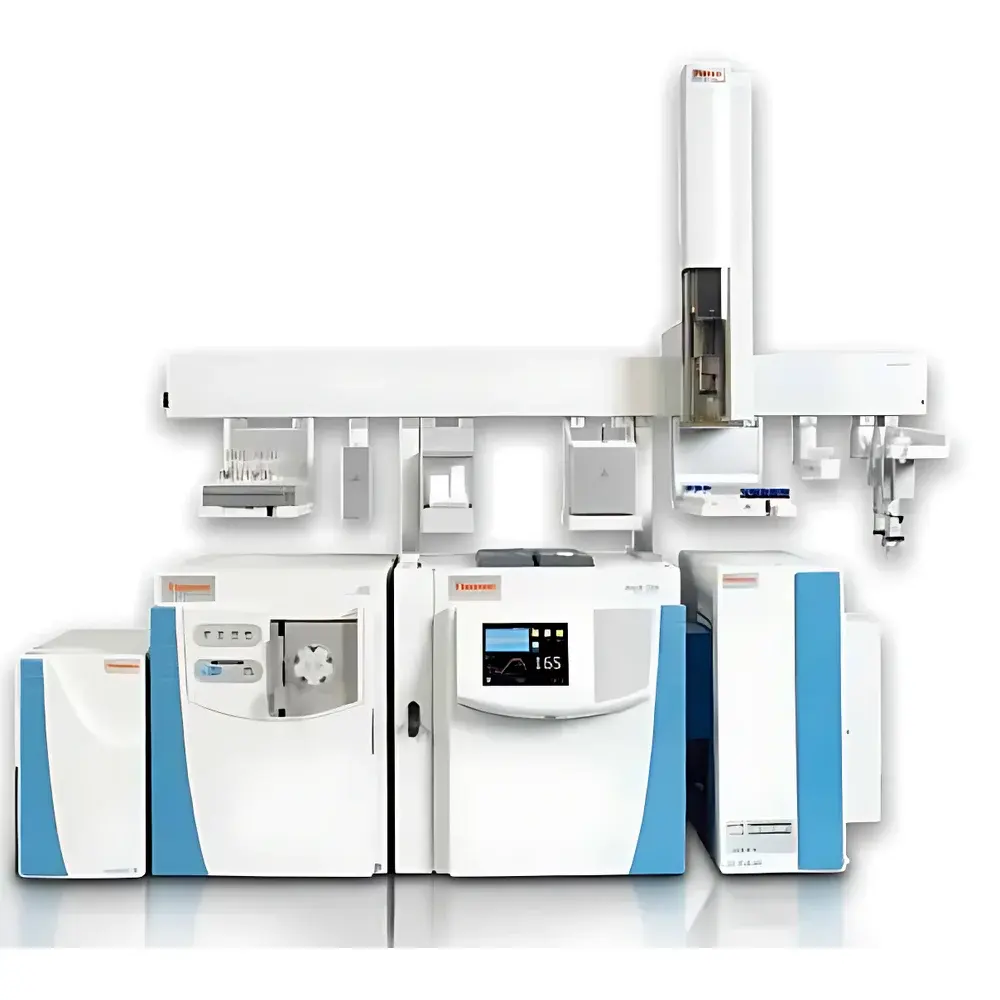
Thermo Fisher Scientific GC IsoLink II Isotope Ratio Mass Spectrometry Interface
| Brand | Thermo Fisher Scientific |
|---|---|
| Origin | Germany |
| Manufacturer Type | Original Equipment Manufacturer (OEM) |
| Import Status | Imported |
| Model | GC IsoLink II |
| Instrument Category | Dedicated GC-IRMS Interface System |
| Pricing Range | USD 135,000 – 270,000 (FOB Hamburg) |
Overview
The Thermo Scientific GC IsoLink II is a purpose-built, high-precision interface system engineered to couple gas chromatographs (GC) with isotope ratio mass spectrometers (IRMS) for compound-specific stable isotope analysis (CSIA). It operates on the principle of quantitative, on-line conversion of chromatographically separated organic analytes into simple, diatomic or triatomic gases—CO2, N2, H2, or CO—via controlled high-temperature oxidation, reduction, or pyrolysis. This enables accurate, real-time measurement of 13C/12C, 15N/14N, D/H, and 18O/16O isotope ratios at natural abundance levels. Designed for trace-level isotopic fidelity, the GC IsoLink II maintains rigorous thermal stability, minimal memory effects, and sub-nanomole carbon throughput precision—critical for applications demanding high reproducibility in environmental forensics, metabolic flux studies, geochemical tracing, and authenticity verification.
Key Features
- Dual-reaction-channel architecture: Independent, thermally isolated CN and H/O reaction zones enable parallel optimization of combustion (for C/N) and high-temperature pyrolysis (for H/O) without cross-contamination.
- Patented four-way valve switching: Fully automated, software-controlled valve sequencing eliminates manual reactor swaps during CNH or CNO analytical sequences—reducing operator intervention and method transfer variability.
- Ultra-low dead volume interface design: Minimizes band broadening and isotopic fractionation between GC effluent and IRMS ion source, preserving chromatographic resolution and isotopic integrity.
- Integrated temperature-controlled oven: Maintains precise, uniform heating profiles across all reactors (up to 1050 °C for CN, 1420 °C for H pyrolysis), ensuring complete and stoichiometric conversion of diverse organic matrices.
- Robust ceramic and quartz reactor construction: Resists corrosion from halogenated, sulfur-rich, or nitrogen-dense samples; compatible with routine use of CuO, NiO, and Cr2O3 catalysts.
- Real-time signal synchronization: Hardware-level triggering between GC oven ramp, valve actuation, and IRMS data acquisition ensures time-aligned isotope ratio integration over each peak apex.
Sample Compatibility & Compliance
The GC IsoLink II supports a broad range of volatile and semi-volatile organic compounds—including hydrocarbons, fatty acids, amino acids, carbohydrates, and chlorinated solvents—provided they are amenable to GC separation (typically C4–C30). It complies with ASTM D7824 (standard test method for δ13C analysis of gasoline-range hydrocarbons), ISO 17025 requirements for accredited isotopic testing laboratories, and supports full audit trails aligned with FDA 21 CFR Part 11 when operated with compliant IRMS data systems. All reactor consumables meet IUPAC traceability standards for isotopic reference materials (e.g., USGS40, IAEA-CH-7, NBS-19).
Software & Data Management
Controlled via Thermo Scientific Chromeleon Chromatography Data System (CDS) v7.3+, the GC IsoLink II integrates bidirectionally with IRMS platforms (e.g., Delta V, 253 Plus) through native Ethernet communication. Method templates include pre-validated calibration routines for dual-point bracketing with certified reference gases (CO2, N2, H2) and automatic drift correction using internal reference peaks. Raw isotope ratio data are exported in .csv and .cdf formats, supporting post-acquisition processing in Isodat v3.0+ for delta-value calculation, error propagation modeling, and multi-element correlation analysis. Full electronic records—including valve state logs, temperature ramp profiles, and detector voltage history—are retained for GLP/GMP-compliant reporting.
Applications
- Environmental science: Source apportionment of petroleum hydrocarbons in soil/water via δ13C fingerprinting; nitrate origin tracing (δ15N–δ18O) in groundwater.
- Food authenticity: Detection of synthetic vanillin, honey adulteration, or olive oil blending using compound-specific δ2H and δ13C signatures.
- Biogeochemistry: Carbon fixation pathway identification (C3 vs. C4 vs. CAM) in plant metabolites; microbial substrate utilization tracking in sediment incubations.
- Pharmaceutical metabolism: Position-specific isotope enrichment (PSIE) studies in drug biotransformation pathways using 13C-labeled precursors.
- Forensic chemistry: Differentiation of illicit drug synthesis routes (e.g., ephedrine vs. pseudoephedrine origin) via δ15N and δ13C co-variation.
FAQ
What sample types require derivatization prior to GC IsoLink II analysis?
Derivatization (e.g., silylation, acylation) is recommended for polar compounds with low volatility or thermal lability—such as organic acids, sugars, and amino acids—to ensure sharp chromatographic peaks and quantitative transfer through the interface.
Can the GC IsoLink II be retrofitted to legacy IRMS systems?
Yes—hardware compatibility extends to Thermo Delta series (Delta Plus XP, Delta V), as well as select Nu Instruments and Isoprime platforms, provided analog/digital I/O and serial command protocols are supported via optional interface modules.
How often must reactor tubes be replaced under routine operation?
With typical usage (≤20 samples/day, non-halogenated matrices), CN reactors last ≥6 months; H-pyrolysis reactors require replacement every 3–4 months. Replacement intervals extend significantly when using oxygen-scavenging traps and inline moisture filters.
Is external calibration gas required for daily operation?
A continuous, low-flow reference gas stream (e.g., CO2 at 50 mL/min) is mandatory for real-time background correction and mass-dependent fractionation normalization; certified standard gases are used for periodic two-point calibration per ISO 17025 protocols.




