
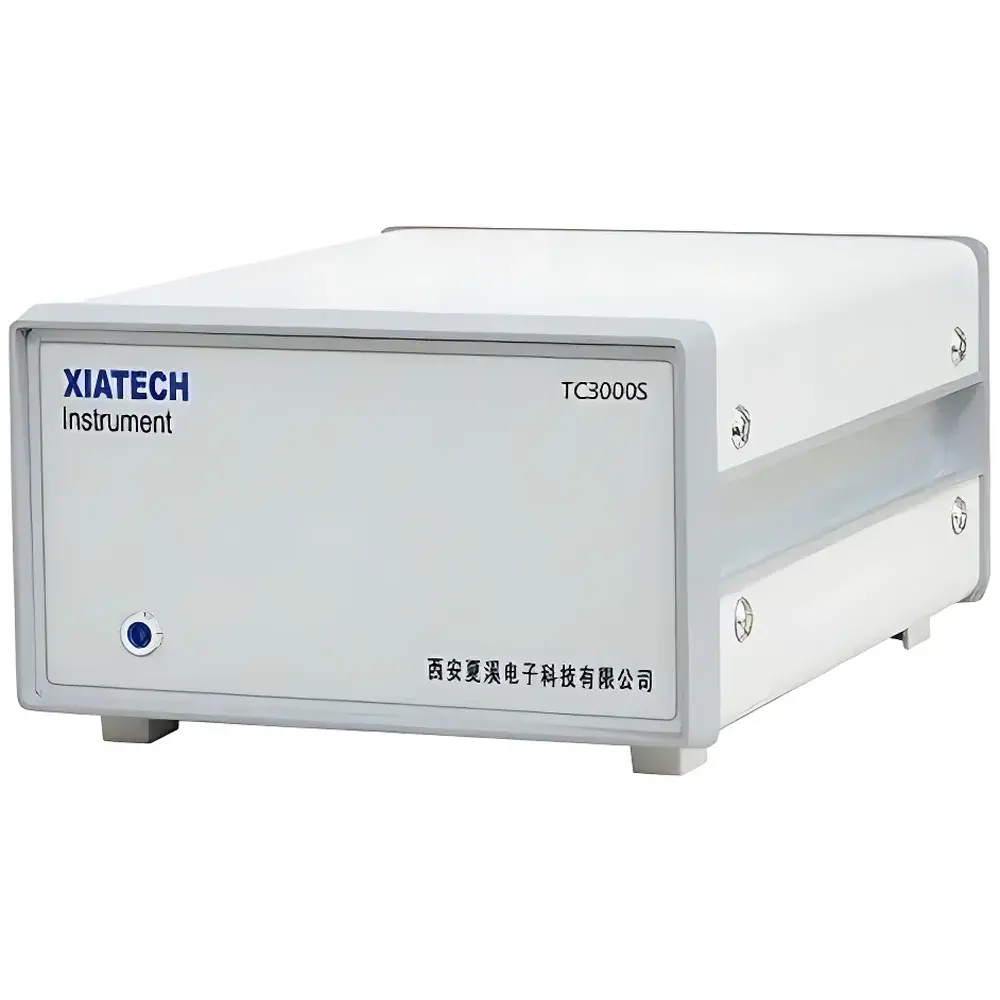
Xiatech TC3000S Single-Sided Transient Line Source Thermal Conductivity Analyzer
| Brand | Xiatech |
|---|---|
| Origin | Shaanxi, China |
| Manufacturer Type | Authorized Distributor |
| Country of Origin | China |
| Model | TC3000S |
| Instrument Principle | Transient Line Source Method (Single-Sided) |
| Sample Throughput | Single sample per measurement |
| Operating Environment | Ambient temperature (20–25 °C, 40–60% RH) |
| Dimensions (L×W×H) | 350 × 250 × 150 mm |
| Accuracy | ±5% |
| Thermal Conductivity Range | 0.001–10 W/(m·K) |
| Repeatability | ±3% |
| Test Atmosphere | Air (standard ambient) |
| Sample Forms | Solids, liquids, pastes, gels, powders, granules |
Overview
The Xiatech TC3000S Single-Sided Transient Line Source Thermal Conductivity Analyzer is a compact, field-deployable instrument engineered for rapid, non-destructive thermal conductivity assessment of heterogeneous and irregularly shaped materials under ambient conditions. It operates on the transient line source principle—where a thin, resistively heated wire (line source) embedded in a planar sensor delivers a controlled heat pulse to the sample surface, and the resulting temperature rise at the interface is monitored over time. By solving the one-dimensional heat conduction equation for semi-infinite media with constant properties, the system calculates thermal conductivity from the slope of the ln(t)-T curve during the early-time linear regime. This method eliminates the need for full sample encapsulation or dual-sided contact, making it especially suitable for quality control environments where speed, minimal sample preparation, and operational flexibility are critical.
Key Features
- Single-sided contact configuration: Sensor assembly places the line source and thermocouple directly onto the sample surface—no backing plate, clamping fixture, or thermal interface material required.
- Integrated mechanical pressure mechanism: Ensures consistent, reproducible interfacial contact without manual force variation; maintains nominal contact pressure (~0.1 MPa) across diverse sample topographies.
- Portable form factor: Weighing under 4.2 kg with footprint <0.1 m², the TC3000S supports benchtop, production-line, and on-site deployment—including warehouse inspections and supplier audits.
- Minimal sample requirements: Accepts specimens with exposed surface area ≥25 mm × 25 mm; thickness >5 mm recommended for solids; no minimum volume constraint for liquids or semi-solids.
- Compliance-ready measurement protocol: Fully aligned with ASTM C1113 (Standard Test Method for Thermal Conductivity of Refractory Materials by Hot Wire), ASTM D5930 (Standard Test Method for Thermal Conductivity of Plastics), GB/T 10297 (General Principles for Thermal Conductivity Measurement of Insulating Materials), and GB/T 11205 (Rubber—Determination of Thermal Conductivity).
Sample Compatibility & Compliance
The TC3000S accommodates a broad spectrum of physical states and industrial material classes without phase-specific hardware modification. Solid samples include polymer composites, foams, ceramics, geological cores, and construction insulators. Liquids span base oils, coolants, and functional fluids; pastes and gels cover thermal interface materials (TIMs), adhesives, and battery electrode slurries. Powders and granular media—such as silica fillers, metal oxides, and pharmaceutical excipients—are measured in consolidated, unconfined beds. All measurements are conducted under standard atmospheric air—no purge gas or vacuum chamber needed. The instrument’s traceable calibration protocol adheres to ISO/IEC 17025 principles, and raw data files retain full metadata (timestamp, ambient T/RH, contact pressure, pulse duration, curve-fitting residuals) to support GLP/GMP documentation and internal audit trails.
Software & Data Management
The TC3000S is operated via Xiatech’s proprietary TC-Control Suite v3.2—a Windows-based application supporting real-time curve visualization, automatic baseline correction, multi-point drift compensation, and ISO-standardized regression analysis. Each measurement generates a timestamped .csv file containing raw thermocouple voltage vs. time, derived thermal diffusivity and conductivity values, uncertainty estimates (based on propagation-of-error modeling), and pass/fail flags against user-defined specification limits. Audit logs record operator ID, calibration status, firmware version, and environmental sensor readings. Export formats include PDF reports compliant with FDA 21 CFR Part 11 requirements (electronic signatures, immutable records, and change history tracking) and Excel-compatible structured datasets for LIMS integration.
Applications
Primary use cases center on incoming material verification and process consistency monitoring. In polymer manufacturing, the TC3000S validates thermal performance of injection-molded housings, extruded insulation sheaths, and additive-filled compounds prior to batch release. For building materials suppliers, it enables rapid screening of aerogel blankets, mineral wool boards, and spray-applied coatings against ASTM C518 tolerances. In R&D labs, researchers employ it for iterative formulation testing of phase-change materials (PCMs), battery thermal management gels, and geopolymer cements—where traditional guarded-hot-plate methods would require days of equilibration. Its ability to measure soft, compressible, or anisotropic surfaces—without edge effects or contact resistance artifacts—makes it indispensable for evaluating TIMs in electronics packaging and thermal interface validation in EV battery module assembly lines.
FAQ
What standards does the TC3000S comply with?
ASTM C1113, ASTM D5930, GB/T 10297, and GB/T 11205.
Can the TC3000S measure anisotropic materials?
Yes—when oriented consistently relative to the thermal gradient direction, it quantifies through-plane conductivity; lateral anisotropy requires complementary in-plane measurement techniques.
Is calibration traceable to NIST or CNAS?
Calibration is performed using certified reference materials (e.g., Pyrex glass, stainless steel 304) with uncertainties traceable to CNAS-accredited laboratories; NIST-traceable options available upon request.
Does the instrument require external cooling or purge gas?
No—designed for operation in ambient air; optional desiccant housing available for high-humidity environments.
How is interfacial contact resistance mitigated?
Through integrated spring-loaded pressure actuation and real-time thermal impedance monitoring during the initial 0.5 s of heating, ensuring valid data acquisition only when contact resistance remains below 5% of total thermal resistance.



