
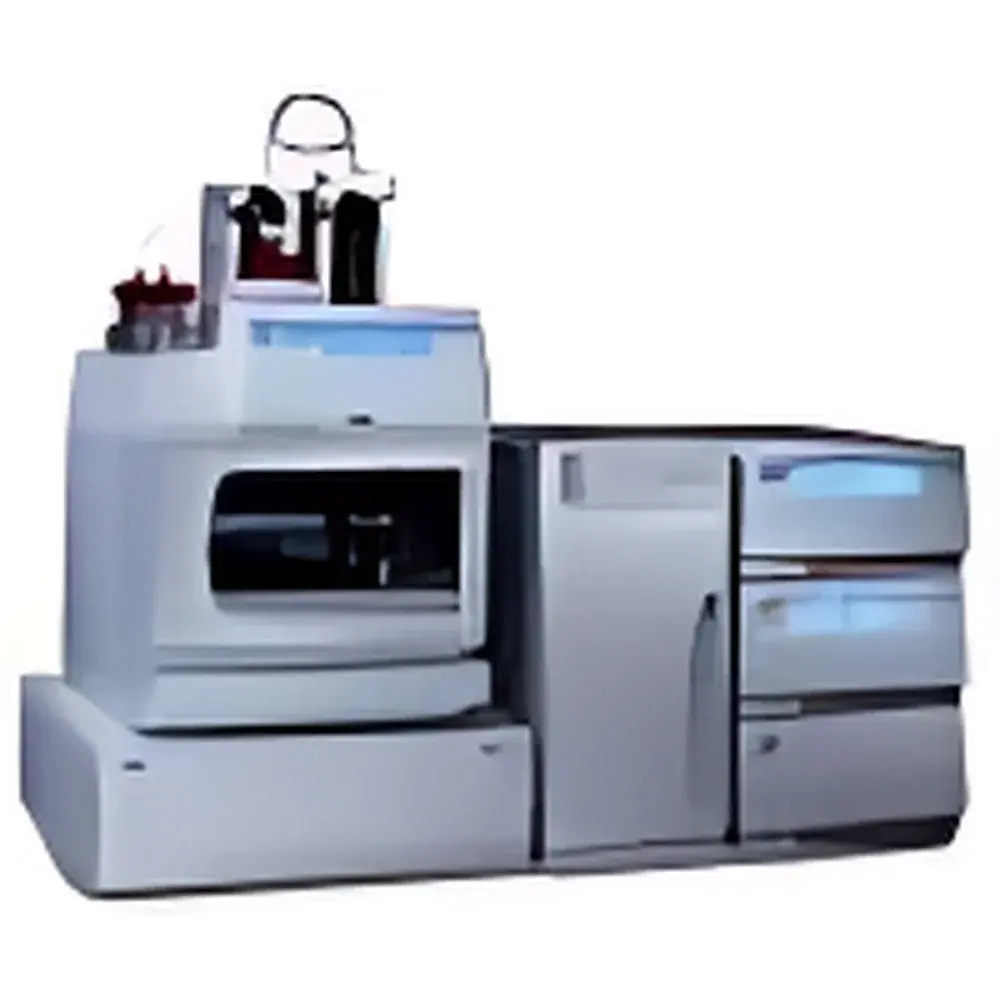
Thermo Fisher AAA-Direct Amino Acid Analyzer
| Brand | Thermo Fisher |
|---|---|
| Origin | USA |
| Manufacturer | Thermo Fisher Scientific |
| Category | Imported Instrument |
| Model | AAA-Direct |
| Pricing | Upon Request |
| Pump Material | PEEK (chemically inert, pH 0–14 compatible) |
| Pump Type | Tandem dual-piston, constant stroke |
| Flow Rate Range | 0.001–10 mL/min |
| Flow Accuracy | <0.1% at 1.0 mL/min |
| Flow Precision | <0.1% RSD at 1.0 mL/min |
| Pressure Range | 50–5000 psi |
| Pressure Pulsation | ≤1% |
| Gradient Ratio Accuracy | ±0.5% at 2.0 mL/min |
| Gradient Ratio Precision | ±0.5% RSD at 2.0 mL/min |
| Eluent Options | Isocratic: 1 |
| Gradient | up to 4 |
| Gradient Delay Volume | <400 µL |
| EG Concentration Range | 0.01–100 mM |
| EG Compatible Eluents | KOH, LiOH, NaOH, CO₃²⁻/HCO₃⁻, CO₃²⁻, MSA |
| EG Concentration Increment | 0.01 mM |
| EG Flow Range | 0.1–3.0 mL/min |
| Max EG Operating Pressure | 3000 psi (21 MPa) |
| Organic Solvent Tolerance | Anion mode: ≤25% methanol |
| Cation mode | solvent-free aqueous only |
| Operating Temperature | 4–40 °C |
| Operating Humidity | 5–95% RH (non-condensing) |
| Dimensions (H×W×D) | 41×23×56 cm |
| Weight | 25 kg |
| Power | 90–265 V AC, 47–63 Hz |
| Ion Reservoir Dimensions | 23×7×10 cm, 1.6 kg |
| Cr-TC Trap Column | 3.8×3.8×5.8 cm, 60 g |
| Eluent Organizer (EO) | Holds four 1–2 L or two 4 L chemically resistant PE/epoxy-coated bottles |
Overview
The Thermo Fisher AAA-Direct Amino Acid Analyzer is a high-performance, modular chromatographic platform engineered for precision analysis of free and hydrolyzed amino acids in complex biological, clinical, food, and pharmaceutical matrices. Built upon the foundational architecture of the Thermo Fisher ICS-3000 Reagent-Free Ion Chromatography System—awarded the 2005 Pittsburgh Conference Silver Editor’s Choice Award—the AAA-Direct integrates dedicated amino acid separation chemistry with advanced electrochemical detection (ECD), gradient eluent generation (EG), and thermally controlled flow path management. Its core analytical principle relies on high-resolution anion-exchange chromatography coupled with pulsed amperometric detection (PAD), enabling direct, derivatization-free quantification of all 20 proteinogenic amino acids plus key non-proteinogenic species (e.g., taurine, hydroxyproline, γ-aminobutyric acid) in a single run. Unlike post-column derivatization systems, the AAA-Direct eliminates reagent degradation, timing drift, and column fouling associated with o-phthalaldehyde (OPA) or ninhydrin protocols—thereby delivering superior long-term reproducibility, reduced maintenance intervals, and full compliance with GLP/GMP and FDA 21 CFR Part 11 data integrity requirements.
Key Features
- Reagent-free eluent generation (EG) with programmable concentration control from 0.01 to 100 mM across multiple chemistries (KOH, LiOH, NaOH, carbonate/bicarbonate, MSA), ensuring unmatched method robustness and inter-laboratory transferability.
- Tandem dual-piston PEEK pump system with <0.1% flow accuracy and precision at 1.0 mL/min—critical for retention time stability and quantitative linearity across wide dynamic ranges (sub-µM to mM).
- Integrated thermostatted chromatography compartment (4–40 °C) and ECD cell housing, minimizing baseline drift and enhancing signal-to-noise ratio for trace-level amino acid detection.
- Modular DC (Dual Channel) architecture supporting simultaneous or sequential operation of amino acid, ion, and biomolecule analysis modules without hardware reconfiguration.
- Electrochemical detector with 3D data acquisition (potential, current, time) and adaptive waveform optimization for each analyte—enabling selective detection in multi-component samples with overlapping redox potentials.
- Full system integration via Chromeleon™ CDS software with audit trail, electronic signatures, and automated calibration verification—validated for regulated environments including USP , ISO 17025, and ICH Q2(R2) method validation frameworks.
Sample Compatibility & Compliance
The AAA-Direct accommodates diverse sample types—including serum, plasma, urine, tissue homogenates, fermentation broths, hydrolyzed proteins, and plant extracts—following standardized preparation protocols (e.g., solid-phase extraction, ultrafiltration, acid hydrolysis). Its PEEK fluidic path ensures compatibility with aggressive eluents across the full pH range (0–14), eliminating metal leaching and adsorption artifacts common in stainless-steel systems. The instrument meets essential regulatory benchmarks: CE marking per EU Directive 2014/30/EU (EMC) and 2014/35/EU (LVD); compliance with ASTM D6919 (anion analysis in water), ISO 13877 (amino acids in food), and CLSI EP28-A3c (clinical laboratory method validation). All firmware and software components are designed for 21 CFR Part 11 compliance, including role-based access control, immutable audit trails, and electronic signature enforcement.
Software & Data Management
Chromeleon™ Chromatography Data System (CDS) v7.3 or later serves as the unified control, acquisition, and reporting engine. It provides method editor templates specifically optimized for amino acid analysis—including pre-configured gradient profiles, PAD waveform libraries, and peak integration algorithms trained on reference standards (NIST SRM 2389a, AASFA Certified Reference Materials). Raw data files (.cdf) are stored in vendor-neutral format with embedded metadata (instrument configuration, calibration history, user ID, timestamp). Automated report generation supports customizable PDF/Excel outputs compliant with ISO/IEC 17025 clause 7.8.2. Optional integration with LIMS (via ASTM E1482 or HL7 interfaces) enables seamless workflow handoff from sample registration to final certificate of analysis.
Applications
- Clinical diagnostics: Quantitative profiling of plasma amino acids for inborn errors of metabolism (e.g., phenylketonuria, maple syrup urine disease) per ACMG guidelines.
- Biopharmaceutical development: Release testing of monoclonal antibody aggregates and fragments via amino acid composition analysis following enzymatic digestion.
- Nutritional science: Accurate determination of essential amino acid scores (PDCAAS, DIAAS) in plant-based proteins and infant formulas.
- Food authenticity: Detection of adulteration (e.g., soy protein in dairy powders) through signature amino acid ratio fingerprinting.
- Cell culture monitoring: Real-time tracking of glutamine, asparagine, and cystine depletion in bioreactor harvests to optimize feeding strategies.
- Environmental biochemistry: Analysis of dissolved free amino acids (DFAA) in seawater and sediment porewater using low-volume microbore columns (2 mm ID).
FAQ
Does the AAA-Direct require pre-column derivatization?
No. It uses direct detection via pulsed amperometry on a gold working electrode, eliminating derivatization reagents, reaction coils, and associated system complexity.
Can the same column be used for both amino acid and inorganic anion analysis?
No. Dedicated high-capacity anion-exchange columns (e.g., Thermo Scientific Acclaim™ AAA-1) are optimized for amino acid resolution and must not be used for routine inorganic anion work due to irreversible retention of phosphate and sulfate.
Is the EG module required for amino acid analysis?
Yes. Gradient elution with potassium hydroxide is essential for resolving structurally similar amino acids (e.g., leucine/isoleucine, valine/threonine); isocratic methods lack sufficient selectivity.
What is the typical column lifetime under routine use?
With proper mobile phase filtration (0.2 µm), daily system flushing, and avoidance of protein-rich unfiltered samples, column lifetimes exceed 2,000 injections when operated within specified pH and temperature parameters.
How does the system support method transfer between laboratories?
Chromeleon CDS includes method portability features: embedded instrument configuration snapshots, EG calibration certificates, and exportable sequence templates—ensuring consistent performance across global manufacturing sites and contract testing labs.





