
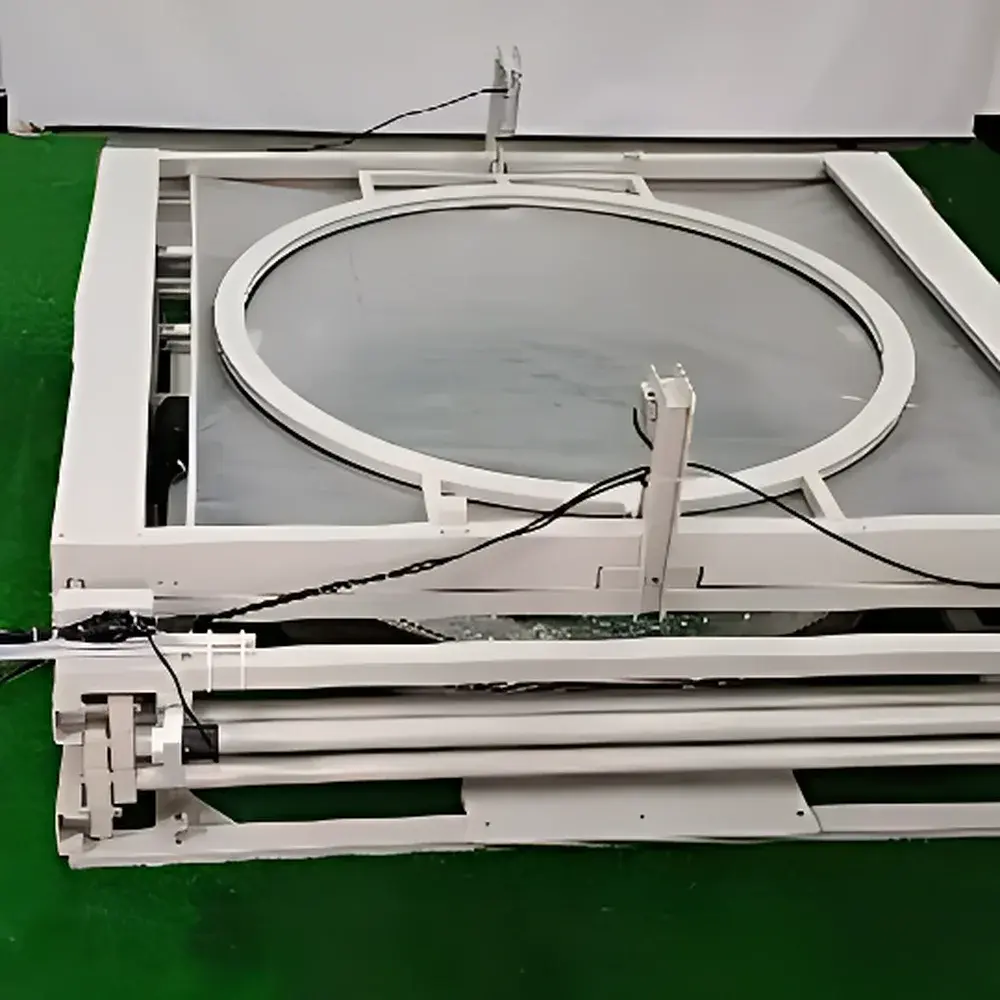
AZ-iChamber Multi-Functional Automated Ecosystem Chamber System
| Brand | AZ (Beijing Aozuo) |
|---|---|
| Origin | Beijing, China |
| Manufacturer Type | Direct Manufacturer |
| Country of Origin | China |
| Model | AZ-iChamber |
| Height Options | 0.5 / 0.8 / 2.0 m |
| Footprint Options | 0.08 / 0.3 / 1.0 m² |
| Configurable | Transparent or Opaque |
Overview
The AZ-iChamber is a modular, motorized automated ecosystem chamber system engineered for high-fidelity, non-destructive measurement of net ecosystem exchange (NEE), ecosystem respiration (ER), and gross primary production (GPP) at the whole-plant or plant-community scale. Unlike leaf-level gas exchange systems constrained by small cuvettes, the AZ-iChamber overcomes spatial scaling limitations through its configurable vertical architecture—up to 2.0 meters in height and 1.0 m² in footprint—enabling enclosure of intact herbaceous stands, shrubs, or young tree canopies under ambient or controlled conditions. Its operation is grounded in closed-path infrared gas analysis (IRGA) principles, integrating real-time CO₂ and CH₄ concentration monitoring with synchronized environmental parameter logging (soil temperature, moisture, redox potential, pH, EC, and thermal flux). Designed for integration within the broader AZ RhizoScope platform, the iChamber serves as the aboveground interface of a vertically resolved biogeochemical observatory—linking canopy photosynthetic activity directly to root-zone carbon dynamics, microbial gas production, and soil physicochemical gradients.
Key Features
- Modular height and footprint configuration: Three standard height tiers (0.5 m, 0.8 m, 2.0 m) and three base area options (0.08 m², 0.3 m², 1.0 m²) support scalable deployment across grassland, agroecosystem, and early-successional forest studies.
- Motorized vertical adjustment: Precision stepper-driven lift mechanism enables dynamic repositioning during longitudinal growth experiments—maintaining consistent chamber-to-canopy distance without manual intervention.
- Dual optical mode: Interchangeable transparent (for NEE/GPP) and opaque (for ER-only) chamber covers permit standardized partitioning of carbon flux components per ISO 16634-2 and AmeriFlux protocols.
- Foldable aluminum alloy frame: Enables rapid field deployment and transport; compatible with anchoring systems for wind-exposed sites.
- Integrated sensor interface: Standardized M12 and Phoenix Contact terminals support plug-and-play connection to AZG-300 multi-gas analyzers, AZR-300 root imaging units, and iChamber-G soil gas profiling probes.
- IP54-rated enclosure: Sealed gasketed joints and corrosion-resistant anodized finish ensure operational reliability in humid, saline, or dusty field environments.
Sample Compatibility & Compliance
The AZ-iChamber accommodates heterogeneous vegetation structures—including monocots, dicots, clonal species, and mixed-species assemblages—without requiring destructive harvest or canopy trimming. Its large internal volume minimizes boundary-layer artifacts common in small-chamber systems, improving representativeness for eddy-covariance ground-truthing and model validation. The system conforms to core methodological standards for ecosystem carbon flux reporting: ASTM D6347/D6347M (standard test method for determination of CO₂ evolution from soils), ISO 14246 (soil quality — determination of carbon dioxide evolution), and FAO’s Global Soil Laboratory Network (GLOSOLAN) guidelines for chamber-based flux quantification. When deployed with AZG-300 gas analyzers, data acquisition meets GLP-aligned traceability requirements—including timestamped raw signal logs, calibration gas verification records, and user-accessible audit trails.
Software & Data Management
Control and data acquisition are managed via AZ-OS v4.2, a deterministic real-time operating environment compliant with IEC 61131-3 structured text architecture. The software supports synchronized multi-sensor sampling at user-defined intervals (1–300 s), automatic zero/span calibration scheduling, and on-board compensation for pressure, temperature, and humidity drift. All datasets are exported in CF-compliant NetCDF-4 format, embedding georeferenced metadata (WGS84 coordinates, UTC timestamps, instrument serial IDs) required for FAO SoLIM and ICOS data submission. Audit logs record operator login events, parameter modifications, and hardware fault alerts—supporting 21 CFR Part 11-compliant electronic signatures when paired with AZ-certified authentication modules. Raw spectral outputs from integrated EcoChem LIBS units are processed using PCA-LDA chemometric pipelines embedded in the same software suite, enabling concurrent elemental mapping (C, N, Fe, Mg, etc.) alongside gas flux time series.
Applications
- Ground-truthing satellite-derived GPP and NEE products (e.g., MODIS, Sentinel-3 OLCI) via spatially explicit, temporally resolved chamber measurements.
- Evaluating climate change impacts on carbon sequestration efficiency across land-use gradients (cropland vs. restored prairie vs. afforested margins).
- Quantifying rhizosphere priming effects by coupling iChamber NEE data with RhizoScope-controlled soil water potential and thermal flux manipulations.
- Validating process-based models (e.g., DAYCENT, APSIM-SoilN) under realistic plant-soil-atmosphere continuum conditions.
- Supporting UNFCCC Article 5 MRV frameworks through standardized, manufacturer-validated chamber protocols suitable for national greenhouse gas inventories.
FAQ
Can the AZ-iChamber be used for both CO₂ and CH₄ flux measurements?
Yes. When interfaced with the AZG-300 dual-channel IRGA module, the chamber supports simultaneous high-sensitivity detection of CO₂ (detection limit: 0.1 ppm) and CH₄ (detection limit: 2 ppb) with cross-interference correction applied in real time.
Is the system compatible with third-party gas analyzers?
The AZ-iChamber provides analog voltage (0–5 V) and RS-485 Modbus RTU outputs for external analyzer integration; however, full synchronization with motorized actuation, lighting control, and diagnostic self-tests requires native AZG-300 or AZG-500 modules.
What maintenance is required for long-term unattended operation?
Quarterly inspection of sealing gaskets and lubrication of lift rails is recommended; optical windows require cleaning only when particulate accumulation exceeds 5% transmittance loss, verified via built-in reference photodiode diagnostics.
Does the system meet ISO/IEC 17025 calibration traceability requirements?
Yes. Each AZ-iChamber unit ships with NIST-traceable calibration certificates for integrated temperature, humidity, and pressure sensors; gas analyzer modules are certified to ISO 17025 via CNAS-accredited calibration laboratories in Beijing.
How is data security ensured during remote deployments?
All communication uses TLS 1.2-encrypted MQTT over cellular or LoRaWAN; local edge storage employs AES-256 encryption with write-once-read-many (WORM) policy enforcement to prevent post-collection tampering.







