
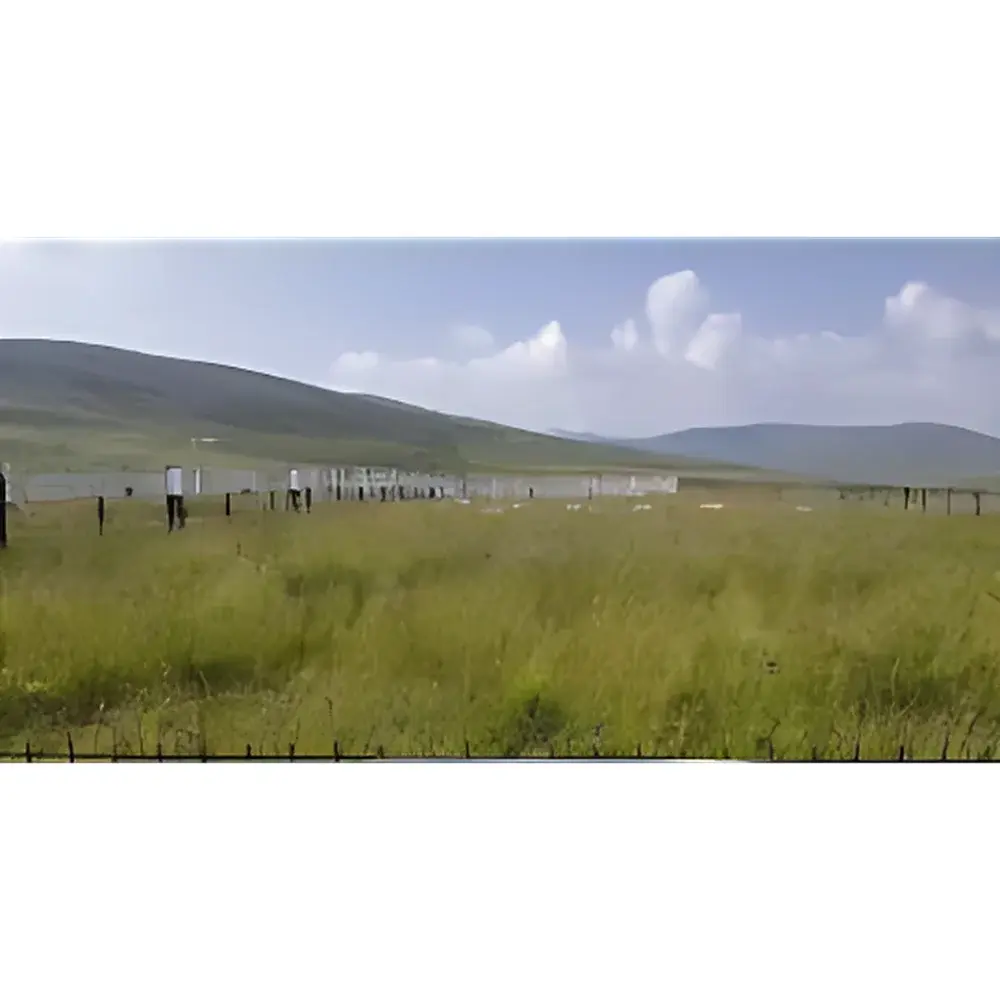
SmartSoil Field Soil Warming System by AZ (Beijing)
| Brand | AZ (Beijing) |
|---|---|
| Origin | Beijing, China |
| Manufacturer Type | Direct Manufacturer |
| Product Category | Domestic |
| Model | SmartSoil |
| Instrument Type | Multi-Parameter Field Soil Warming and Monitoring System |
| Heating Area | 7 m² |
| Supply Voltage | 380 V AC |
| Total Heating Power | 5 kW per Heating Zone |
| Adjustable Warming Range | +0.1 °C to +5.0 °C above ambient |
| Temperature Uniformity Control | Achieved via in-soil distributed heating elements |
| Monitoring Points | 10 embedded PT100 sensors within warming zone |
| Auxiliary Configuration | Optional vertical column integration for concurrent soil moisture and temperature regulation |
| Perimeter Maintenance Zone | 1 m width × 2 m depth annular trench surrounding active area |
Overview
The SmartSoil Field Soil Warming System is an engineered field-deployable infrastructure designed for controlled, in-situ soil temperature manipulation in ecological climate change research. Unlike surface-based infrared radiative heating or point-source rod-type heaters—both of which generate steep thermal gradients and fail under sub-zero ambient conditions—the SmartSoil system employs a distributed, subsurface resistive heating architecture. This design ensures spatially uniform thermal elevation across the entire experimental plot, enabling physiologically relevant and statistically robust observations of soil–plant–microbe interactions under sustained warming scenarios. The system operates on the principle of Joule heating through insulated, corrosion-resistant heating cables embedded at standardized depth intervals (typically 5–20 cm), allowing precise energy delivery directly into the soil matrix. Its operational envelope spans +0.1 °C to +5.0 °C above ambient, with real-time feedback control maintaining setpoint stability within ±0.2 °C over diurnal and seasonal cycles.
Key Features
- Distributed in-soil heating: Eliminates surface conduction bias and lateral heat loss, delivering homogeneous thermal elevation across the full 7 m² circular plot (diameter = 3 m).
- Modular dual-setpoint capability: Supports independent configuration of two distinct warming treatments within the same plot—enabling paired experimental designs (e.g., +2 °C vs. +4 °C) without physical replication.
- Integrated high-resolution monitoring: Ten calibrated PT100 resistance temperature detectors (RTDs) are permanently embedded at fixed radial and depth positions, providing spatially resolved thermal profiles with 0.1 °C resolution and traceable NIST-traceable calibration documentation.
- Robust field-grade construction: All electrical components conform to IP67 ingress protection; heating cables feature polyimide insulation and stainless-steel braiding for long-term burial stability in variable pH and redox soils.
- Annular maintenance trench: A 1 m wide × 2 m deep perimeter trench isolates the active warming zone from lateral thermal interference and facilitates cable access, sensor replacement, and drainage management.
- Expandable vertical column option: Compatible with cylindrical soil monoliths (up to 1 m height × 0.3 m diameter) equipped with co-located TDR moisture probes and thermocouples, enabling coupled hydrothermal perturbation experiments.
Sample Compatibility & Compliance
The SmartSoil system is compatible with undisturbed native soils—including clay loam, sandy loam, peat, and volcanic ash—across temperate, boreal, and alpine biomes. It supports both bare-soil and vegetated (grassland, shrub, or young tree sapling) experimental configurations. The system complies with ISO 18400-101:2017 (soil sampling principles), ASTM D5084-16 (in-situ hydraulic conductivity measurement compatibility), and ITRC (Interstate Technology & Regulatory Council) guidelines for field-scale climate manipulation infrastructure. All data acquisition firmware adheres to GLP-compliant metadata tagging (time stamp, sensor ID, calibration coefficient, environmental context) and supports audit-ready export formats (CSV, NetCDF). Electrical safety conforms to IEC 61000-6-4 (EMC emission limits) and IEC 60364-7-712 (electrical installations in agricultural and horticultural premises).
Software & Data Management
The SmartSoil controller runs embedded Linux-based firmware with a web-accessible interface (HTTPS/TLS 1.2 secured) for remote configuration, real-time visualization, and alarm management. Temperature setpoints, ramp rates, and duty-cycle modulation are programmable via intuitive GUI or RESTful API. All sensor data—including raw RTD resistance, compensated temperature, and heater power draw—are timestamped with GPS-synchronized UTC and stored locally on industrial-grade microSD (16 GB, write-endurance rated) with automatic rollover. Data exports support FAIR principles (Findable, Accessible, Interoperable, Reusable): CSV files include column headers with SI units and ISO 8601 timestamps; NetCDF outputs embed CF-1.8 metadata conventions for climate model assimilation. Audit trails record all user-initiated parameter changes with operator ID, timestamp, and pre-/post-values—meeting requirements for FDA 21 CFR Part 11–aligned electronic records in long-term ecological research programs.
Applications
- Soil carbon dynamics: Quantifying Q₁₀ responses of heterotrophic respiration and dissolved organic carbon leaching under sustained warming.
- Microbial functional genomics: Coupling warming treatments with metatranscriptomic sampling to resolve thermal thresholds of nitrifier and methanogen activity.
- Plant–soil feedback studies: Assessing root exudation shifts, mycorrhizal colonization rates, and nutrient uptake efficiency across warming gradients.
- Permafrost-adjacent transition zones: Enabling winter-active experiments where ambient air temperatures fall below −20 °C—unachievable with IR-based systems.
- Model validation: Providing high-temporal-resolution field data for calibrating biogeochemical models (e.g., DAYCENT, CENTURY, CLM-Soil).
FAQ
Can the SmartSoil system operate continuously during snow cover or frozen ground conditions?
Yes. Its subsurface heating design maintains thermal contact with unfrozen soil layers beneath the frost front, enabling uninterrupted operation down to −30 °C ambient air temperature.
What is the expected service life of the buried heating elements?
Rated for ≥10 years of continuous operation under typical field conditions, verified by accelerated aging tests per IEC 60216 and field deployments across 12 long-term ecological research sites since 2018.
Is third-party calibration certification available for the RTD sensors?
Yes. Each sensor batch is supplied with individual calibration certificates traceable to NPL (UK) or NIM (China), including deviation tables across −10 °C to +50 °C.
Does the system support integration with external meteorological stations or eddy covariance towers?
Yes. The controller provides Modbus RTU (RS-485) and analog 4–20 mA inputs for synchronized ingestion of PAR, precipitation, wind speed, and CO₂ flux data.
How is thermal uniformity validated prior to experiment initiation?
A pre-deployment thermal mapping protocol—using a grid of 36 temporary thermistor probes—is executed over 72 hours; final acceptance requires ≤±0.3 °C spatial standard deviation across the 7 m² zone.







