
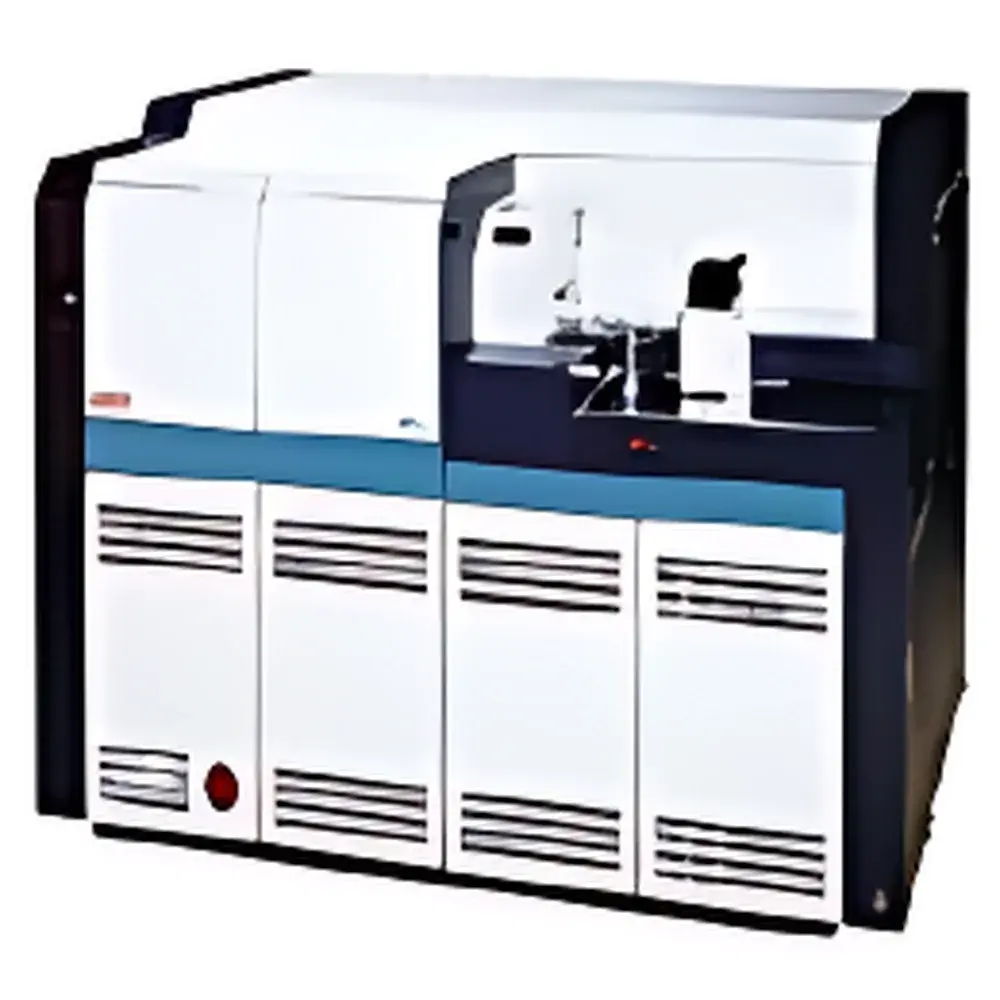
Thermo Scientific NEPTUNE Plus Multi-Collector Inductively Coupled Plasma Mass Spectrometer
| Brand | Thermo Fisher |
|---|---|
| Origin | Germany |
| Manufacturer Type | Original Equipment Manufacturer (OEM) |
| Import Status | Imported Instrument |
| Model | NEPTUNE Plus |
| Price Range | USD 680,000 – 950,000 (FOB Hamburg) |
| Instrument Type | Magnetic Sector Mass Spectrometer |
Overview
The Thermo Scientific NEPTUNE Plus is a third-generation multi-collector inductively coupled plasma mass spectrometer (MC-ICP-MS) engineered for ultra-high-precision isotopic ratio measurements at sub-permil (δ-value) and sub-ppq (parts-per-quadrillion) trace element concentration levels. It integrates the high-transmission TRITON Plus multi-collector detection system with the ELEMENT 2 ICP ion source and advanced interface architecture—representing the culmination of over two decades of Thermo Fisher’s expertise in magnetic sector ICP-MS design. Unlike quadrupole or time-of-flight instruments, the NEPTUNE Plus employs a double-focusing magnetic sector mass analyzer to achieve mass-resolving power exceeding 10,000 (M/ΔM, 10% valley), enabling rigorous interference separation (e.g., 40Ar16O+ from 56Fe+, 40Ar40Ar+ from 80Se+) without compromising sensitivity or mass bias stability. Its core application domain spans geochronology (U–Pb, Lu–Hf, Re–Os), cosmochemistry (Mg, Si, Cr, Ti isotopes), nuclear forensics, environmental tracer studies (Sr, Nd, Pb, Hf), and high-accuracy elemental quantification under ISO/IEC 17025-accredited laboratory conditions.
Key Features
- Jet Interface Technology: A proprietary high-efficiency skimmer cone and jet-type interface increases total ion transmission by 10–20× across the full mass range (5–260 u), significantly enhancing signal-to-noise ratios for low-abundance isotopes such as 176Hf, 180W, and 236U.
- Virtual Amplifier Architecture: Eliminates physical cup-to-amplifier rewiring via digital gain assignment in software; enables seamless switching between Faraday and secondary electron multiplier (SEM) detection modes while preserving long-term amplifier gain stability and minimizing mass-dependent instrumental drift.
- Modular Multi-Collector Array: Configurable detector block supports up to nine Faraday cups (with 1011 Ω and 1013 Ω resistors) and eight discrete-dynode SEMs—allowing simultaneous acquisition of ≥12 isotopic signals with real-time peak-jumping or static multi-collection protocols.
- Dynamic Zoom Optics: Electrostatic lens system dynamically adjusts ion beam focus across mass ranges, maintaining optimal beam diameter on all collectors regardless of mass difference—critical for minimizing mass fractionation effects during high-precision ratio analysis.
- Magnetic Sector Stability: Temperature-stabilized 90° magnetic sector with active field regulation ensures mass calibration reproducibility better than ±0.002 u over 24 h, supporting routine δ-value measurement repeatability ≤0.01‰ (2SD) for key isotope systems.
Sample Compatibility & Compliance
The NEPTUNE Plus accepts liquid nebulized samples (introduced via microconcentric or desolvating systems), laser ablation aerosols (compatible with 193 nm ArF excimer lasers), and gas-phase inputs (e.g., SF6, CO2) through dedicated inlet modules. It complies with ISO 17025:2017 requirements for testing and calibration laboratories, supports audit-ready data integrity workflows per FDA 21 CFR Part 11 (electronic signatures, audit trails, user access control), and meets GLP/GMP documentation standards for regulated isotopic analysis in pharmaceutical impurity profiling and nuclear material accountability. All hardware and firmware are CE-marked and RoHS-compliant.
Software & Data Management
Controlled by Thermo Scientific NeoMass v3.x software, the NEPTUNE Plus provides integrated instrument setup, method development, real-time data acquisition, offline data reduction, and uncertainty propagation (using Monte Carlo-based error modeling). The software supports standardized reporting formats (ASTM D7088, ISO 13576, USP /), automatic dead-time correction, exponential or linear mass bias correction (using bracketing or internal standardization), and batch processing of >1000 analyses with metadata tagging (sample ID, digestion batch, standard reference material, operator, timestamp). Raw data files (.neod) are stored in vendor-neutral HDF5 format for third-party interoperability and long-term archival.
Applications
- High-precision U–Pb zircon geochronology with common-Pb correction using 204Pb or 202Pb tracer
- Nd and Hf isotopic analysis of silicate rocks and minerals for crust-mantle evolution modeling
- Double-spike corrected Ca, Mg, Fe, and Zn isotope ratio measurements in biological fluids
- Nuclear safeguards verification via 235U/238U and 240Pu/239Pu isotopic signatures
- Environmental tracing of anthropogenic Pb sources using 206Pb/207Pb/208Pb triple-isotope plots
- Ultra-trace rare earth element (REE) and actinide quantification in seawater and ice cores (detection limits < 0.1 fg g−1)
FAQ
What distinguishes NEPTUNE Plus from single-collector ICP-MS systems?
It delivers simultaneous multi-isotope detection with magnetic sector resolution, enabling true internal normalization and elimination of time-related drift errors inherent in sequential scanning instruments.
Is the NEPTUNE Plus compatible with laser ablation sample introduction?
Yes—it supports direct coupling to commercial 193 nm excimer LA systems with optimized transport tubing and helium carrier gas flow control for stable signal intensity and reduced oxide formation.
How does the virtual amplifier improve long-term measurement stability?
By decoupling hardware gain settings from software-defined amplification paths, it removes mechanical contact variability and thermal drift associated with analog resistor networks, extending calibration interval validity.
Can the system be validated for ISO/IEC 17025 accreditation?
Yes—NeoMass includes full traceability logs, electronic signature support, and customizable validation templates aligned with ILAC-G8 and EURACHEM guidelines.
What maintenance intervals are recommended for routine operation?
Daily: Torch cleaning and vacuum check; Weekly: Interface cone inspection; Quarterly: Magnet shimming and Faraday cup alignment verification; Annually: Full ion optic recalibration and detector gain mapping.




