
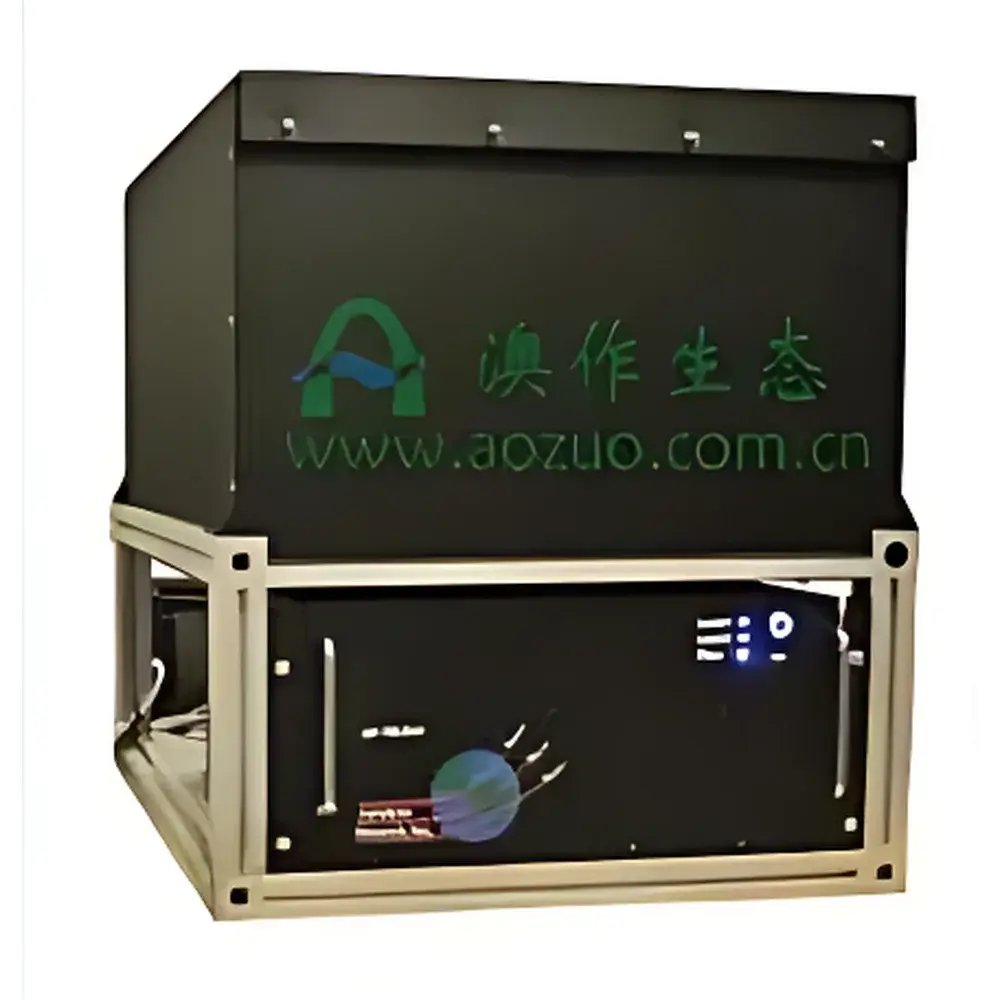
Aerodyne CO2 Clumped Isotope Measurement System (TILDAS-based)
| Brand | Aerodyne |
|---|---|
| Origin | USA |
| Model | Aerodyne CO2 |
| Detection Principle | Tunable Infrared Laser Direct Absorption Spectroscopy (TILDAS) |
| Configuration | Online, Benchtop |
| Response Time | <1 s |
| Measured Isotopologues | ¹³C¹⁶O₂, ¹²C¹⁶O¹⁸O, ¹²C¹⁷O¹⁶O, ¹²C¹⁶O²H, HOD, ¹⁵N¹⁴N¹⁶O (δ¹⁵Nα), ¹⁴N¹⁵N¹⁶O (δ¹⁵Nβ), COS, SO₂, NO, N₂O, NO₂, NH₃, HONO, HNO₃, CH₄, C₂H₄, HCHO, CHOOH, CO |
| Precision (Δ₆₃₈) | 0.01‰ (SE, 16 min, ≤1.6 mg calcite) |
| Path Length | 400 m (astigmatic multipass cell) |
| Power Consumption | 250–500 W (120/240 V, 50/60 Hz, without pump) |
| Dimensions | 560 × 770 × 640 mm (W × D × H) |
| Weight | 75 kg |
| Data Interfaces | RS-232, USB, Ethernet |
| Operating Environment | 10–35 °C, 0–20 slpm |
Overview
The Aerodyne CO2 Clumped Isotope Measurement System is a high-precision, online-capable laser spectrometer engineered for the direct, quantitative analysis of multiply substituted isotopologues in carbon dioxide—specifically the clumped isotopologue 13C16O18O (mass 47, denoted Δ638). Unlike conventional isotope ratio mass spectrometry (IRMS), this system employs Tunable Infrared Laser Direct Absorption Spectroscopy (TILDAS) in the mid-infrared region (2000–2300 cm−1), where fundamental vibrational–rotational transitions of CO2 and its isotopologues exhibit strong, spectrally resolved absorption features. The instrument utilizes two continuous-wave quantum cascade lasers (QCLs) operating simultaneously to resolve overlapping spectral lines with sub-MHz resolution, enabling unambiguous discrimination between 12C16O2, 13C16O2, 12C16O18O, and 13C16O18O without chemical conversion or ionization. Its patented astigmatic multipass absorption cell achieves an effective optical path length of up to 400 meters within a compact footprint, delivering sub-pptv detection limits and sub-0.01‰ (1σ) precision on Δ638 under optimized measurement protocols.
Key Features
- Direct, calibration-free quantification of CO2 clumped isotopes—including Δ638, δ13C, δ18O, and Δ17O—via first-principles spectroscopic modeling
- Simultaneous multi-isotopologue detection using dual QCL sources with real-time wavelength stabilization against molecular reference cells
- Patented astigmatic multipass cell architecture (400 m path length) enabling high sensitivity and low sample consumption (≤15 μmol CO2 per analysis)
- Integrated valve manifold with automated background subtraction, reference gas switching, and sequence-controlled measurement cycles
- TDLwintel software platform providing full instrument control, real-time spectral fitting, Allan deviation monitoring, and drift-corrected isotopic ratio calculation
- Benchtop design compatible with standard 19″ rack mounting or desktop placement; includes thermal-electric cooling, vacuum pump interface, and customizable inlet system for acid-liberated carbonate CO2
Sample Compatibility & Compliance
The system is validated for analysis of CO2 liberated from solid carbonate samples (e.g., calcite, aragonite, foraminifera) via phosphoric acid digestion at 25 °C or 90 °C, as well as for headspace gases, ambient air, and laboratory standards. It meets analytical requirements for geochemical applications governed by ASTM D7921-22 (Standard Practice for Stable Isotope Ratio Analysis of Carbonates) and ISO 18351:2016 (Carbonate clumped isotope analysis). All data acquisition, processing, and storage comply with GLP and GMP principles; audit trails, user authentication, and electronic signatures are supported through optional 21 CFR Part 11–compliant software modules. Instrument stability is verified daily using NIST-traceable CO2 reference gases (e.g., USGS-40, USGS-41, IAEA-CO-1), and raw Δ638 values are normalized using two-point linear correction against bracketing standards matched in matrix, pressure, and mixing ratio.
Software & Data Management
TDLwintel serves as the unified control and analysis environment, featuring a modular architecture with embedded Python scripting capability for custom calibration routines and batch processing. Spectral fitting uses Voigt line profiles convolved with instrument line shape functions derived from in situ laser frequency scans. Each measurement cycle outputs time-stamped, fully annotated spectra alongside calculated isotopic ratios, uncertainties (SE), Allan deviation metrics, and diagnostic flags (e.g., signal-to-noise ratio, baseline drift, water interference). Data export supports CSV, HDF5, and NetCDF formats, with metadata compliant with ISA-Tab and MIAME standards. Remote access, scheduled unattended operation, and integration with LIMS via RESTful API are available upon configuration.
Applications
- Palaeothermometry: Reconstruction of carbonate formation temperatures from Δ638 in fossil shells, speleothems, and sedimentary cements
- High-resolution palaeoaltimetry: Quantifying elevation history via δ18O–Δ638 coupling in volcanic glass and pedogenic carbonates
- Diagenetic and metamorphic history: Discriminating kinetic vs. equilibrium isotope exchange in reservoir rocks and ore deposits
- Ocean carbonate chemistry: Constraining air–sea CO2 exchange rates and biological pump efficiency using paired δ13C–Δ638 signals in planktonic foraminifera
- Biogeochemical tracer studies: Resolving microbial CO2 production pathways (e.g., methanogenesis vs. fermentation) via site-specific 13C and 18O signatures
FAQ
Does the system require sample pre-concentration or cryogenic trapping?
No. The 400 m multipass cell enables direct analysis of CO2 at natural abundance levels without pre-concentration.
Can it measure both Δ638 and δ15N in nitrous oxide simultaneously?
Yes—the dual-laser architecture supports concurrent targeting of CO2 clumped bands and N2O isotopologues (e.g., 15N14N16O and 14N15N16O) with independent spectral windows.
What is the minimum sample size for carbonate analysis?
As little as 0.4 mg of calcite yields Δ638 precision of 0.02‰ (4 min integration); 1.6 mg achieves 0.01‰ (16 min).
Is vacuum pumping integrated or external?
A dedicated vacuum pump is supplied as part of the system configuration but is externally mounted to minimize vibration coupling.
How is instrumental drift corrected during long-term measurements?
By interleaving sample and reference gas measurements every 5 minutes and applying Allan variance–guided drift modeling in post-processing.







