
AZ PICO-Profile Soil Moisture Profiling System
| Brand | AZ (Beijing Aozuo) |
|---|---|
| Origin | Beijing, China |
| Manufacturer | AZ |
| Country of Origin | China |
| Model | PICO |
| Instrument Type | Soil Moisture / Water Potential Analyzer |
| Measurement Principle | Time Domain Reflectometry (TDR) |
| Moisture Range | 0–100% vol. |
| Accuracy | ±2% vol. |
| Repeatability | <0.1% |
| EC Range | 0–>20 dS/m |
| Measured Soil Volume per Sensor | 1 dm³ |
| Calibration Options | Sandy Loam, Clay, Organic Soil, Dielectric Constant-based |
| Output Interfaces | SDI-12, IMP-BUS, RS485 |
| IP Rating | IP62 |
| Operating Temperature | −15°C to +50°C |
| Power Supply | 7–24 VDC |
| Probe Tube Diameter | Ø44 mm |
| Max. Probe Length | 3 m |
| Cable Options | 2 m / 5 m / 10 m |
| Housing Dimensions | 210 × Ø40 mm |
Overview
The AZ PICO-Profile Soil Moisture Profiling System is an engineered solution for high-resolution, long-term vertical profiling of soil volumetric water content and bulk electrical conductivity across multiple depths. Designed explicitly for hydrological research, precision agriculture, and ecohydrological monitoring, the system employs Time Domain Reflectometry (TDR)—a physically robust, non-destructive measurement principle grounded in electromagnetic wave propagation velocity in porous media. Each T3PN44 sensor head generates a calibrated step pulse into coaxial transmission lines embedded in soil; the reflected waveform’s travel time directly correlates with the dielectric permittivity of the surrounding medium, enabling quantitative derivation of volumetric water content under field conditions. Unlike point sensors or gravimetric sampling, the PICO-Profile delivers continuous, gap-free stratified data—critical for modeling root-zone dynamics, infiltration processes, evapotranspiration partitioning, and vadose zone transport in heterogeneous soils.
Key Features
- Multi-depth profiling capability with up to 10 independently configurable sensor heads per probe string, each measuring volumetric water content and bulk electrical conductivity simultaneously
- Modular, field-deployable architecture supporting both vertical insertion and horizontal trench installation—optimized for permanent monitoring stations, lysimeters, and eddy-covariance sites
- Depth-specific calibration flexibility: users may assign distinct empirical or physics-based calibration curves per layer (e.g., sandy loam, clay, organic-rich, or dielectric constant-derived models)
- High metrological stability: repeatability <0.1% ensures statistical reliability in long-term trend analysis and inter-site comparisons
- Ruggedized stainless-steel probe housing (IP62 rated) and chemically inert sensing elements suitable for deployment in aggressive environments—including saline, acidic, or karstic soils
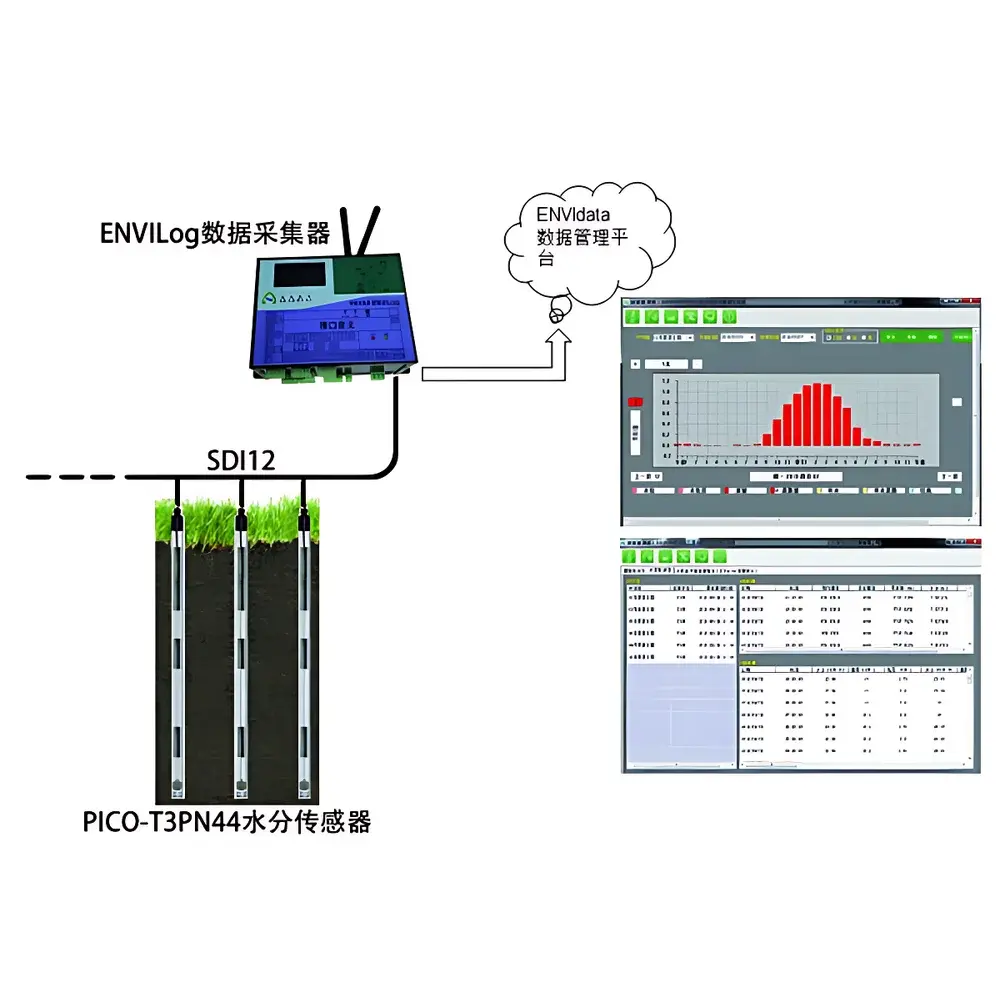
- Standardized digital interfaces (SDI-12, IMP-BUS, RS485) ensure seamless integration with third-party data loggers, SCADA systems, and telemetry platforms
- Each sensor interrogates a defined 1 dm³ soil volume—providing representative, spatially averaged measurements that minimize point-scale heterogeneity bias
Sample Compatibility & Compliance
The PICO-Profile system is validated for use across diverse pedological contexts—from coarse-textured aeolian sands to fine-grained vertisols and organic histosols. Its TDR-based design conforms to ASTM D5778 (Standard Test Method for Determining the In-Situ Electrical Resistivity of Soil) and supports traceable calibration against ISO/IEC 17025-accredited reference standards. While not certified for regulatory compliance under FDA 21 CFR Part 11, the system’s deterministic measurement protocol and stable output characteristics align with GLP-aligned field data collection practices. All firmware and hardware components are designed to meet IEC 61326-1 (EMC requirements for laboratory and industrial measurement equipment), and the probe assembly complies with RoHS Directive 2011/65/EU.
Software & Data Management
Data acquisition and visualization are supported by ENVIdata—a secure, scalable server-based platform developed and maintained by AZ. ENVIdata operates either on-premises (user-hosted Windows/Linux servers) or via AZ’s ISO 9001:2015-certified cloud infrastructure. The platform ingests time-stamped sensor data at user-defined intervals (1 minute to 24 hours), applies automated quality control flags (e.g., signal integrity checks, temperature-compensated EC correction), and stores metadata including probe geometry, calibration history, and site-specific soil classification. Users access real-time dashboards, generate multi-parameter time-series plots, overlay georeferenced sensor arrays on GIS-integrated maps, and export structured CSV/NetCDF files compatible with MATLAB, R, and Python-based hydrological modeling workflows (e.g., HYDRUS, SWAP, ParFlow). Audit trails, role-based permissions, and TLS 1.2 encrypted data transmission satisfy institutional IT security policies.
Applications
- Quantifying vertical soil moisture redistribution during infiltration events and drying cycles in agricultural catchments
- Parameterizing unsaturated hydraulic conductivity functions for numerical modeling of preferential flow in fractured bedrock or karst terrains
- Validating satellite-derived soil moisture products (e.g., SMAP, Sentinel-1) through ground-truthing at intermediate spatial support scales
- Monitoring salinity stratification in irrigated croplands and assessing leaching efficiency under variable-rate irrigation regimes
- Supporting ecohydrological studies of plant-water relations—particularly in deep-rooted species where root-zone water uptake spans >1.5 m depth
- Long-term monitoring of soil water balance in evaporation pans, weighing lysimeters, and flux towers
FAQ
What is the maximum number of sensor layers supported per probe string?
Up to 10 T3PN44 sensor heads can be integrated along a single 3-meter probe tube, with spacing determined by user-defined depth intervals.
Does the system require soil-specific calibration for accurate water content estimation?
Yes—while factory calibration covers general mineral soils, optimal accuracy requires application of site-specific or texture-class-specific calibration curves, especially in organic or saline soils.
Can the PICO-Profile operate autonomously in remote locations without cellular connectivity?
Yes—the system outputs standard SDI-12 or RS485 signals compatible with standalone data loggers (e.g., Campbell Scientific CR1000X, Onset HOBO RX3000); telemetry is optional.
Is the probe tube reusable after retrieval from the soil profile?
Yes—the stainless-steel tube and sealed sensor heads are designed for repeated installation and extraction, provided mechanical damage or corrosion is avoided during handling.
How does temperature affect measurement accuracy, and is compensation applied?
All T3PN44 sensors include integrated PT1000 thermistors; ENVIdata applies temperature-dependent dielectric mixing model corrections to water content and EC outputs.
Related Products







