
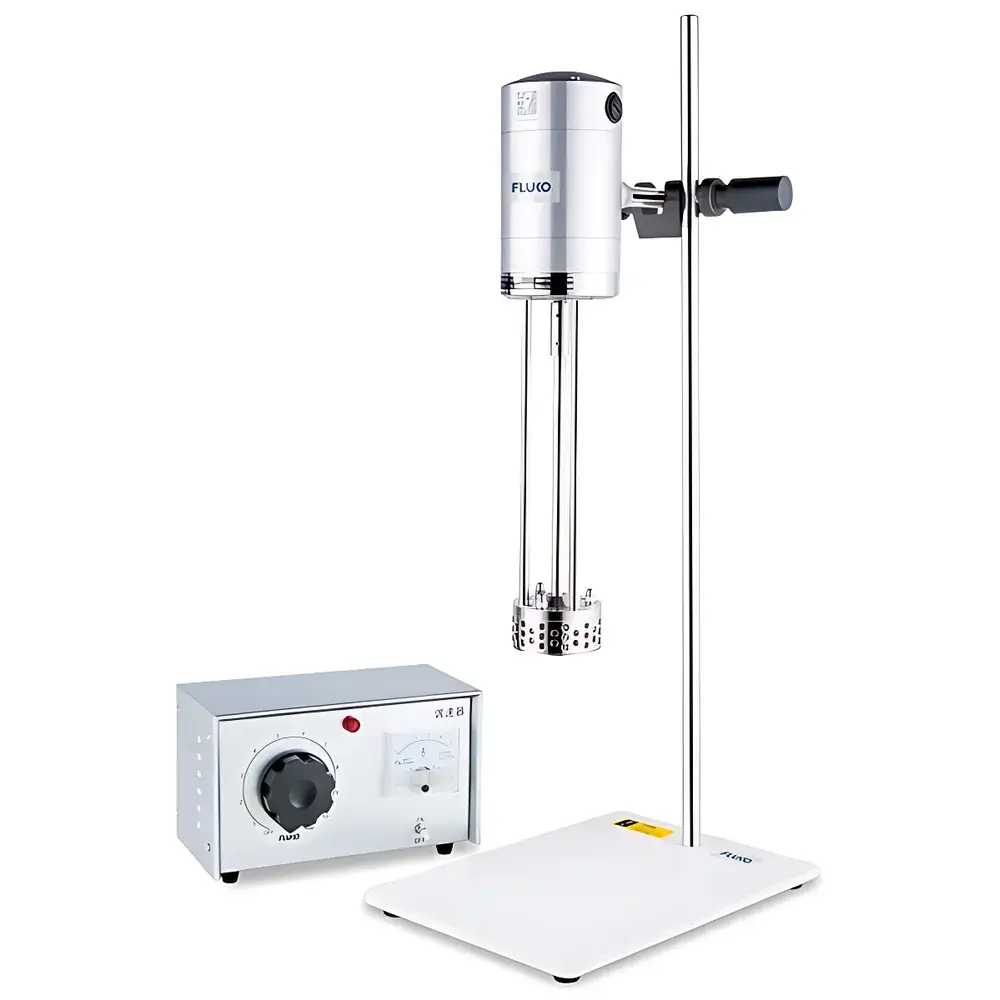
FLUKO FM300-S-S High-Shear Dispersing Homogenizer
| Brand | FLUKO |
|---|---|
| Origin | Shanghai, China |
| Model | FM300-S-S |
| Instrument Type | Probe-type Rotor-Stator Homogenizer |
| Dimensions (W×D×H) | 210 × 290 × 675 mm |
| Processing Volume (H₂O) | 200–10,000 mL |
| Power | 300 W |
| Voltage/Frequency | 220 V, 50 Hz |
| Speed Range | 300–11,000 rpm |
| Speed Display | Analog Dial |
| Speed Control | Continuous (Stepless) |
| Max. Viscosity | 5,000 cP |
| Wetted Materials | SS304 |
| Shaft Sleeve Material | Copper Alloy |
| Operating Ambient | 5–40 °C, ≤80% RH |
| Process Mode | Batch |
| Weight | ~13 kg |
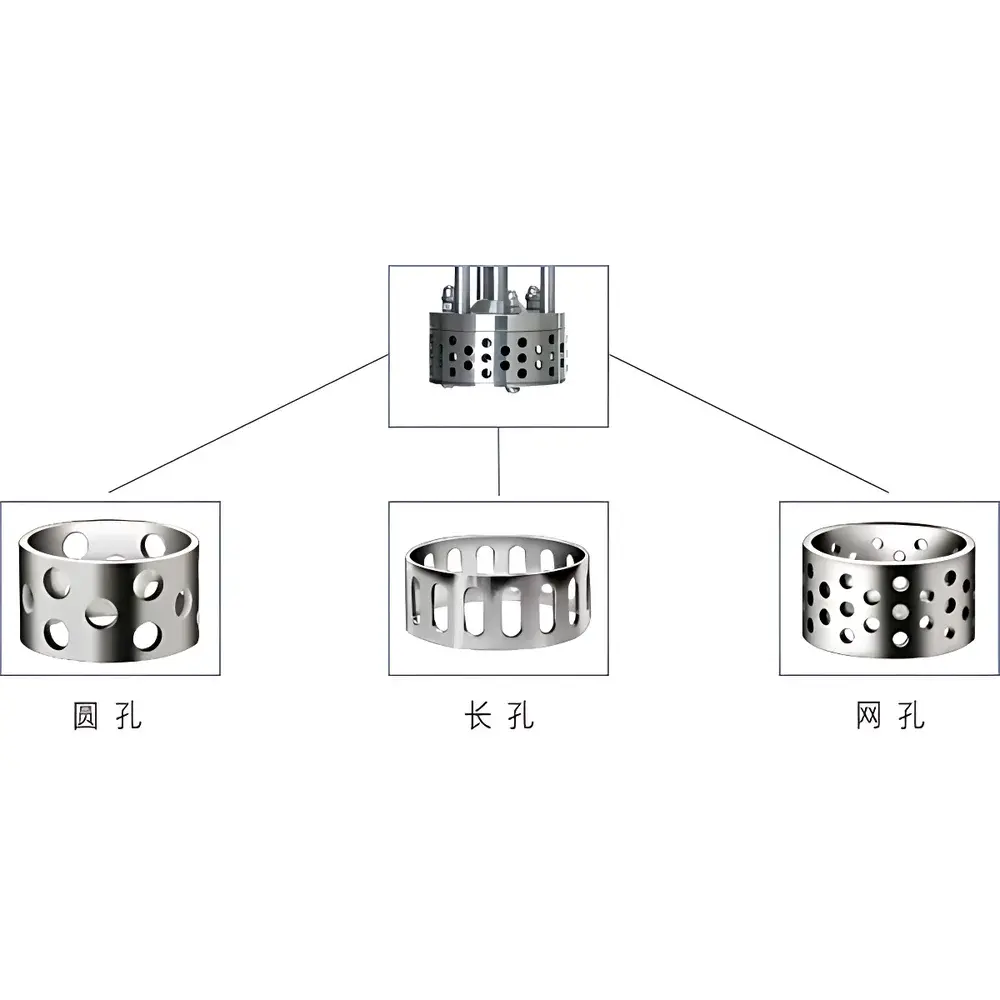
| Stator Configurations | Round-hole, Slit-type, Mesh-type |
Overview
The FLUKO FM300-S-S is a laboratory-scale high-shear dispersing homogenizer engineered for precision batch processing of viscous and heterogeneous systems. It operates on the rotor-stator principle: a high-speed rotating probe (rotor) generates intense hydrodynamic shear within a fixed stator housing, inducing turbulent flow, cavitation, and mechanical disruption at the microscale. This mechanism enables efficient particle size reduction, droplet breakup in emulsions, dispersion of agglomerates, and uniform distribution of active ingredients in suspensions or pastes. Designed for reproducible small-batch development—particularly in formulation R&D, QC testing, and pilot-scale process optimization—the FM300-S-S delivers consistent energy input across variable viscosities up to 5,000 cP, making it suitable for applications ranging from pharmaceutical suspensions and cosmetic emulsions to battery slurry pre-dispersion and polymer nanocomposite preparation.
Key Features
- 300 W brushless motor with high-torque output, enabling stable operation across the full speed range (300–11,000 rpm) without thermal derating
- Analog dial speed display for real-time, non-digital visual monitoring—minimizing electromagnetic interference concerns in sensitive lab environments
- Triple interchangeable stator configurations (round-hole, slit-type, and mesh-type) to tune shear intensity and flow pattern per application requirement
- Stainless steel 304 wetted components ensure corrosion resistance and compliance with general Good Manufacturing Practice (GMP) material compatibility expectations
- Copper alloy shaft sleeve provides dimensional stability under prolonged mechanical load and thermal cycling
- Integrated dual safety system: automatic motor cutoff upon probe removal and over-temperature protection in the drive unit
- Compact footprint (210 × 290 × 675 mm) optimized for standard fume hoods and benchtop integration; total mass ~13 kg ensures operational stability during high-shear operation
Sample Compatibility & Compliance
The FM300-S-S accommodates sample volumes from 200 mL to 10,000 mL (water-equivalent), supporting both narrow-neck vessels (e.g., 250 mL–2 L glass beakers with optional clamping adapters) and wide-mouth containers. Its rotor-stator geometry facilitates processing of Newtonian and moderately shear-thinning fluids, including aqueous polymer solutions, oil-in-water emulsions, ceramic slurries, and organogels. While not certified to ISO/IEC 17025 or FDA 21 CFR Part 11 out-of-the-box, the instrument’s mechanical design, traceable speed calibration via analog dial, and absence of embedded software make it compatible with GLP-compliant documentation workflows when used with external logging systems. All wetted materials meet ASTM F899 standards for stainless steel surgical instruments, and the device conforms to IEC 61000-6-2 (immunity) and IEC 61000-6-3 (emission) for laboratory electromagnetic compatibility.
Software & Data Management
The FM300-S-S is a stand-alone electromechanical instrument with no onboard digital controller, firmware, or data storage capability. Speed is adjusted manually via an integrated continuous (stepless) potentiometer, and rotational velocity is indicated solely by a calibrated analog dial—eliminating software validation requirements under FDA 21 CFR Part 11. This architecture supports audit-ready manual recordkeeping: users log speed setting, duration, vessel geometry, sample volume, temperature, and stator type directly into bound lab notebooks or validated electronic lab notebooks (ELNs). For automated data capture, third-party tachometers or torque sensors can be externally coupled and synchronized with time-stamped acquisition systems compliant with ALCOA+ principles (Attributable, Legible, Contemporaneous, Original, Accurate, Complete, Consistent, Enduring, Available).
Applications
- Pre-formulation screening of nanoemulsions and liposomal dispersions in pharmaceutical development
- Rapid dispersion of carbon black, graphite, or SiO₂ nanoparticles into electrode slurries for battery R&D
- Homogenization of viscous cosmetic bases (e.g., silicone emulsions, thickened surfactant gels)
- Deagglomeration of pigment masterbatches prior to rheological or spectrophotometric analysis
- Cell lysis and organelle isolation in life science protocols requiring controlled mechanical disruption
- Batch-wise stabilization of food-grade oil-in-water emulsions (e.g., mayonnaise analogs, functional beverage concentrates)
FAQ
Is the FM300-S-S suitable for continuous processing?
No—it is strictly designed for batch-mode operation. Continuous inline homogenization requires dedicated pump-coupled systems with flow control and thermal management.
Can the FM300-S-S be used with corrosive solvents such as chlorinated hydrocarbons or strong acids?
SS304 offers limited resistance to halogenated solvents and low-pH media; for aggressive chemistries, consult FLUKO’s chemical compatibility chart and consider optional Hastelloy-C276 rotor/stator upgrades.
Does the instrument include validation documentation (e.g., IQ/OQ protocols)?
No factory-supplied qualification documents are included; however, the mechanical simplicity and analog interface allow straightforward user-generated IQ/OQ protocols aligned with ISO 14644 or EU GMP Annex 15 guidelines.
What maintenance intervals are recommended for long-term reliability?
Inspect rotor-stator clearance and stator integrity every 200 operating hours; lubricate copper alloy sleeve annually with food-grade mineral oil; replace carbon brushes every 1,500 hours if equipped with brushed motor variant (not applicable to standard FM300-S-S brushless model).



