
ZONWON IVS800H-2 Automated High-Temperature Capillary Viscometer System for PE, PP, and UHMWPE
| Brand | ZONWON |
|---|---|
| Origin | Zhejiang, China |
| Manufacturer Type | Direct Manufacturer |
| Instrument Category | Domestic |
| Model | IVS800H-2 |
| Instrument Type | Fixed Capillary Viscometer |
| Application Environment | High-Temperature Operation |
| Viscosity Range | 0.3–50,000 mm²/s |
| Temperature Range | Ambient to 150 °C |
| Temperature Resolution | ±0.05 °C |
| Temperature Accuracy | ±0.05 °C |
Overview
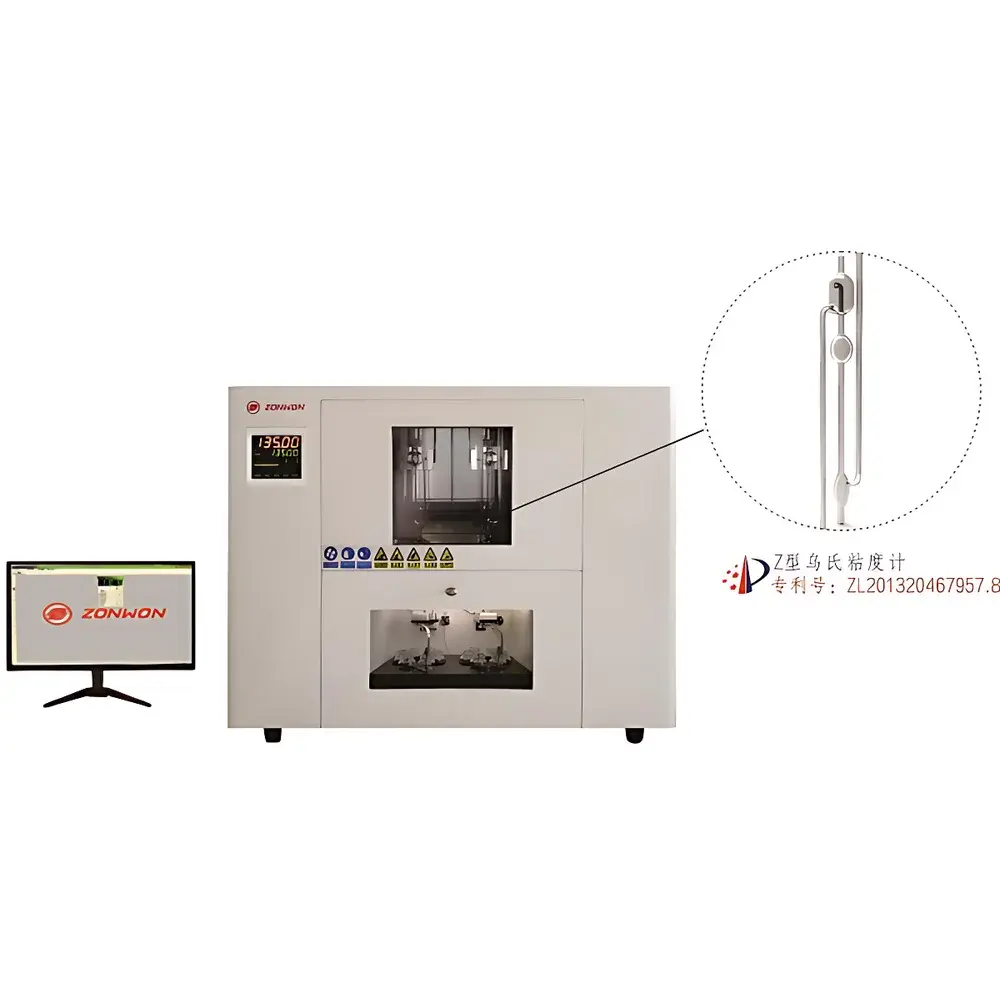
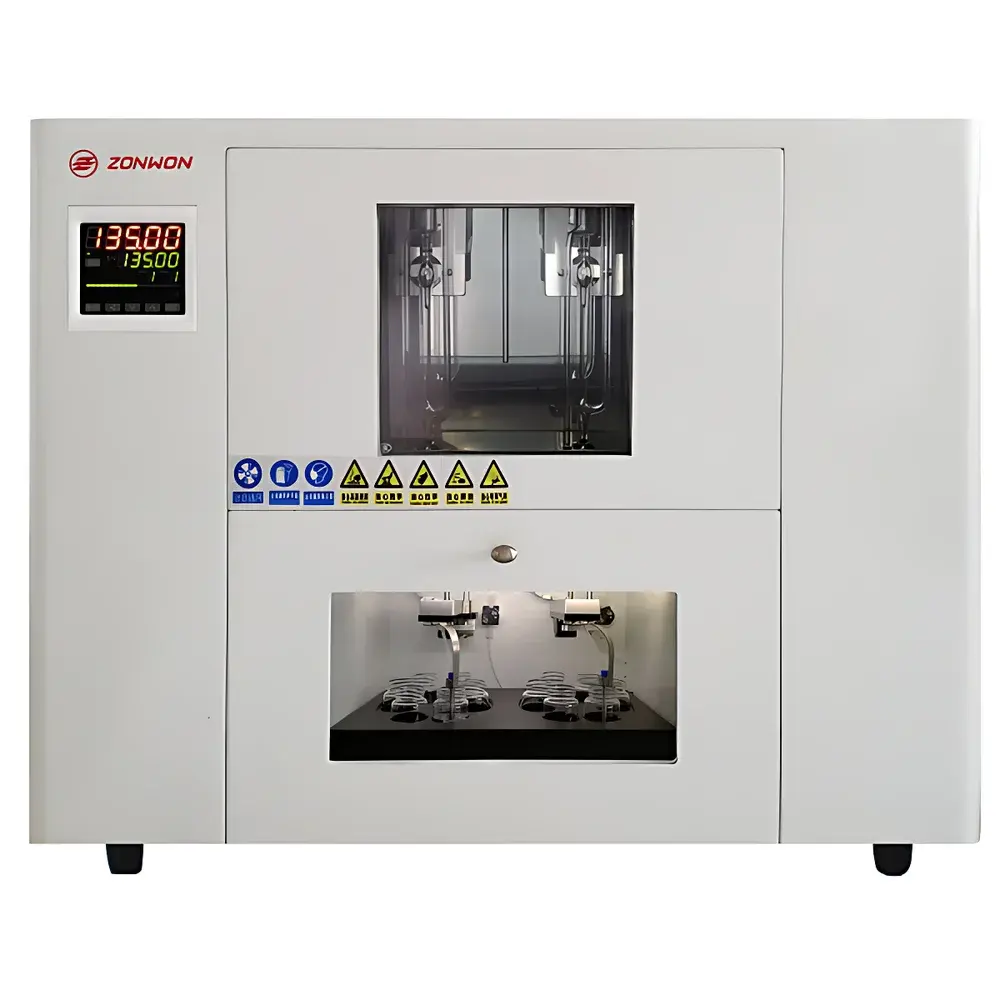
The ZONWON IVS800H-2 is an automated high-temperature capillary viscometer system engineered for precise intrinsic viscosity (IV) determination of thermoplastic polymers—including polyethylene (PE), polypropylene (PP), ethylene-propylene copolymers, and ultra-high-molecular-weight polyethylene (UHMWPE)—in concentrated solutions at elevated temperatures. It operates on the fundamental principle of capillary flow viscometry, specifically implementing a modified Ubbelohde (Z-type) capillary geometry optimized for polymer solution analysis under ISO 1628-3, ASTM D1601, GB/T 1632.3, and GB/T 1841 compliance. Unlike conventional manual or semi-automated oil-bath systems requiring operator intervention at temperatures up to 135 °C, the IVS800H-2 integrates fully automated sample handling, thermal equilibration, efflux timing, solvent rinsing, and hot-air drying—eliminating human exposure to high-temperature solvents and volatile organic vapors. Its dual-zone thermostatic bath separates temperature regulation from the measurement zone, ensuring thermal stability ≤±0.05 °C across the entire capillary path—critical for reproducible efflux time acquisition in dilute polymer solution rheology.
Key Features
- Fully automated workflow: auto-sampling, capillary immersion, efflux timing, solvent wash, and hot-air drying—all executed without manual intervention
- Z-type Ubbelohde capillary design: eliminates the upper reservoir bulb to minimize residual solution carryover; internal volume reduced to 7 mL for rapid cleaning and reagent economy
- 6-position heated sample carousel: maintains all vials at 135 °C prior to injection, preventing premature crystallization or precipitation during transfer
- Independent thermal control architecture: precision PID-regulated heating with dual-sensor feedback ensures uniformity and minimal drift (≤±0.05 °C) across the capillary measurement zone
- Integrated fume extraction interface: connects directly to lab exhaust ducting to evacuate volatile solvent vapors (e.g., decalin, tetralin, xylene) outside the workspace
- High-resolution timing system: 0.001 s resolution with ±0.001 s accuracy over efflux durations ranging from 0.001 to 9999.999 s
Sample Compatibility & Compliance
The IVS800H-2 is validated for use with standard polymer dissolution solvents including decalin (for PE/PP), tetralin, and xylene—each compatible with its 150 °C maximum operating temperature. It supports concentration series required for serial dilution extrapolation (e.g., Huggins, Kraemer, and Schulz-Blaschke plots) and delivers compliant outputs for intrinsic viscosity, relative viscosity, specific viscosity, logarithmic viscosity, Fickentscher’s K-value, number-average and viscosity-average molecular weight (via Mark–Houwink–Sakurada relationships), and kinematic viscosity. All measurements adhere to ISO 1628-3 (plastics—determination of viscosity number of polyethylene and polypropylene), ASTM D1601 (polyethylene melt index correlation), GB/T 1632.3 (determination of viscosity number of polyolefins), and GB/T 1841 (polyethylene—determination of intrinsic viscosity). The system architecture supports GLP-compliant audit trails when configured with user-access controls and electronic signature protocols.
Software & Data Management
Viscobeel VS800 software provides a Windows-native interface (XP through Windows 10) with multilevel access control, configurable test templates, real-time status monitoring per station, and automatic outlier detection with optional retest execution. It implements built-in calculation modules for intrinsic viscosity (ηinh), reduced viscosity (ηsp/c), inherent viscosity (ln(ηrel)/c), and molecular weight estimation using standardized Mark–Houwink parameters. Statistical reporting includes batch-wise mean, standard deviation, CV%, trend charts, and Cp/Cpk indices—exportable as Excel (.xlsx) or static PNG reports. Raw efflux times, temperature logs, and calibration records are stored with timestamped metadata, enabling full traceability for internal QA/QC or external regulatory review (e.g., FDA 21 CFR Part 11 readiness via optional digital signature module).
Applications
This system serves quality assurance laboratories in polyolefin production facilities, R&D centers developing high-performance polymer grades, and contract testing labs performing third-party certification. Typical use cases include: monitoring batch-to-batch consistency of PE/PP resin viscosity during extrusion-grade manufacturing; evaluating degradation effects during thermal processing or recycling; validating molecular weight distribution shifts after catalyst modification; supporting technical data sheet generation for polymer sales documentation; and conducting comparative studies between virgin and recycled feedstocks. Its ability to maintain continuous high-temperature operation enables reliable measurement of UHMWPE solutions—where conventional capillary systems often fail due to gelation or incomplete dissolution at lower temperatures.
FAQ
What polymer types are supported by the IVS800H-2?
Polyethylene (HDPE, LDPE, LLDPE), polypropylene (homopolymer and copolymer), ethylene-propylene rubber (EPR), and ultra-high-molecular-weight polyethylene (UHMWPE) dissolved in decalin, tetralin, or xylene.
Does the system comply with ISO and ASTM standards?
Yes—it is designed and validated for ISO 1628-3, ASTM D1601, GB/T 1632.3, and GB/T 1841, with documented uncertainty budgets available upon request.
Can it perform serial dilution extrapolation?
Yes—the 6-position heated sample carousel allows sequential measurement of multiple concentrations; software automatically generates Huggins and Kraemer plots and computes intrinsic viscosity via linear regression.
Is remote monitoring or network integration possible?
The system supports Ethernet-based communication and can be integrated into local lab networks for centralized task scheduling and data aggregation via OPC UA or Modbus TCP (optional configuration).
What maintenance is required for long-term reliability?
Routine capillary inspection and cleaning with appropriate solvents every 50–100 runs; annual calibration of temperature sensors and timing circuitry using NIST-traceable references is recommended.



