
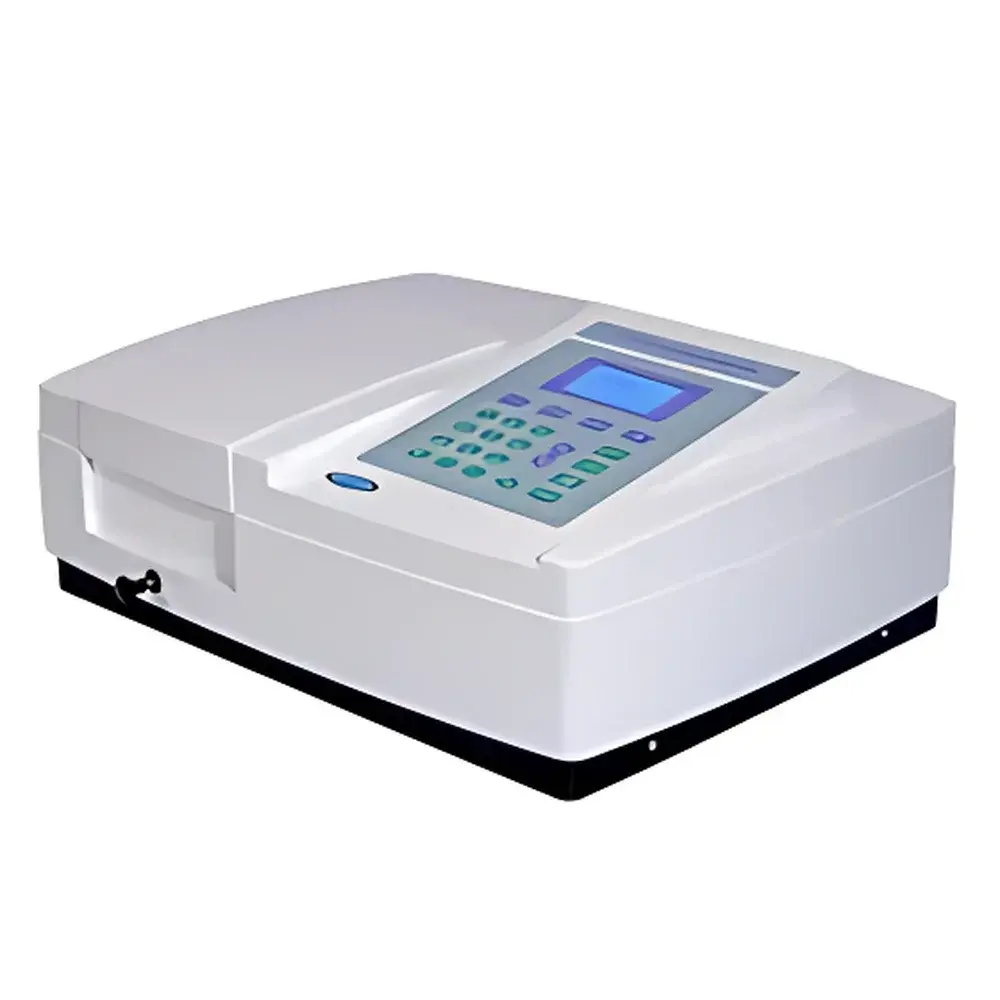
HePu UV-5300 Dual-Beam Ultraviolet-Visible Spectrophotometer
| Brand | HePu (Jihepu) |
|---|---|
| Origin | Shandong, China |
| Model | UV-5300 |
| Wavelength Range | 190–1100 nm |
| Spectral Bandwidth | 2 nm |
| Wavelength Accuracy | ±0.7 nm |
| Wavelength Repeatability | ≤0.2 nm |
| Photometric Accuracy | ±0.3% T |
| Photometric Repeatability | ≤0.2% T |
| Stray Light | ≤0.08% T |
| Baseline Flatness | ±0.002 A |
| Drift | ±0.002 A/h (at 500 nm) |
| Noise Level | ±0.001 A/h |
| Detector Type | Silicon Photodiode Array |
| Optical System | Dual-Beam |
| Light Sources | Long-life Tungsten and Deuterium Lamps |
| Display | 128 × 64 Dot-Matrix LCD |
| Data Interface | USB |
| Power Supply | AC 220 V/50 Hz or 110 V/60 Hz |
| Dimensions | 460 × 380 × 180 mm |
| Weight | 18 kg |
Overview
The HePu UV-5300 Dual-Beam Ultraviolet-Visible Spectrophotometer is engineered for precision quantitative and qualitative analysis across research laboratories, quality control environments, and educational institutions. Based on the dual-beam optical architecture, the instrument continuously compares sample and reference beam intensities in real time—minimizing errors induced by source fluctuation, detector drift, or environmental variation. It operates across a broad spectral range (190–1100 nm), enabling reliable measurement of electronic transitions in organic molecules, transition metal complexes, biomolecules (e.g., nucleic acids and proteins), and nanomaterials. The system employs a high-stability tungsten lamp for the visible–NIR region and a deuterium lamp for the UV region, both mounted in plug-in sockets to facilitate rapid, alignment-free lamp replacement. An imported precision grating and fully sealed optical path ensure exceptional stray light suppression (≤0.08% T), critical for accurate low-transmittance measurements and high-dynamic-range absorbance applications.
Key Features
- Dual-beam optical design with real-time background correction and enhanced photometric stability
- High-resolution 128 × 64 dot-matrix LCD display supporting simultaneous readout of wavelength, transmittance (%T), absorbance (A), concentration (C), and calibration curve status
- Synchronous sine-bar wavelength drive mechanism ensuring high wavelength accuracy (±0.7 nm) and repeatability (≤0.2 nm)
- 24-bit high-speed analog-to-digital conversion delivering superior signal resolution and dynamic response
- Automated wavelength calibration and self-diagnostic correction routines for long-term operational reliability
- Modular lamp design with tool-free tungsten and deuterium lamp replacement—no optical realignment required
- Sealed optical chamber with optimized grating and detector geometry to maintain ultra-low stray light performance
Sample Compatibility & Compliance
The UV-5300 accommodates standard 10-mm square cuvettes (quartz, glass, or plastic), as well as micro-volume adapters and optional flow cells for continuous monitoring. Its photometric accuracy (±0.3% T) and linearity (0–3 A) meet routine requirements for ASTM E275, ISO 6223, and USP spectrophotometric validation protocols. While not pre-certified for GMP or FDA 21 CFR Part 11 compliance out-of-the-box, the instrument supports audit-ready operation when paired with HePu’s UV-5300PC scanning software—including user access control, electronic signatures, and full audit trail logging for method parameters, calibration events, and raw data exports. All firmware and hardware configurations adhere to IEC 61010-1 safety standards for laboratory electrical equipment.
Software & Data Management
The optional UV-5300PC scanning software provides comprehensive instrument control and data processing capabilities under Windows OS. It enables full-spectrum scanning, kinetic assays, multi-wavelength quantitation, DNA/protein concentration calculation (using built-in extinction coefficients), and spectral derivative analysis. Up to 200 sample datasets and 200 calibration curves can be stored internally and recalled by numeric ID; all data are exportable in CSV or TXT format via USB interface. The software supports GLP-compliant reporting templates with automatic timestamping, operator ID tagging, and metadata embedding (e.g., lamp usage hours, wavelength calibration date). Raw absorbance/time or absorbance/wavelength arrays are preserved without interpolation, ensuring traceability for regulatory review.
Applications
- Quantitative determination of analytes in pharmaceutical formulations (e.g., assay of active ingredients per USP monographs)
- Enzyme kinetics and ligand-binding studies requiring high-temporal-resolution absorbance monitoring
- Water quality analysis (e.g., nitrate, phosphate, COD estimation via colorimetric methods)
- Quality assurance of dyes, pigments, and optical filters through spectral transmittance profiling
- Educational instruction in analytical chemistry, biochemistry, and materials science laboratories
- Stability-indicating assays for degradation product detection under forced stress conditions
FAQ
Does the UV-5300 support GLP-compliant data integrity requirements?
Yes—when used with the UV-5300PC software and configured with password-protected user roles, electronic signatures, and enabled audit trail logging, the system supports core GLP principles for data generation and retention.
Can the instrument perform kinetic measurements over extended time periods?
Yes—the system supports time-scan mode with user-defined intervals (100 ms to 60 s per point) and up to 10,000 data points per run, with internal storage preserving full time-series absorbance traces.
Is external PC connectivity mandatory for basic photometric measurements?
No—standalone operation is fully functional using the front-panel controls and LCD interface; the PC is required only for advanced scanning, curve fitting, or regulated data archiving.
What maintenance is recommended to sustain wavelength accuracy?
Annual verification using NIST-traceable holmium oxide and didymium filters is recommended; the instrument’s built-in auto-calibration routine corrects minor deviations during startup.
Are quartz cuvettes required for all measurements?
Quartz is mandatory for measurements below 340 nm; for visible-region work (≥340 nm), high-quality optical glass or UV-transparent plastic cuvettes may be used depending on required precision and solvent compatibility.




