
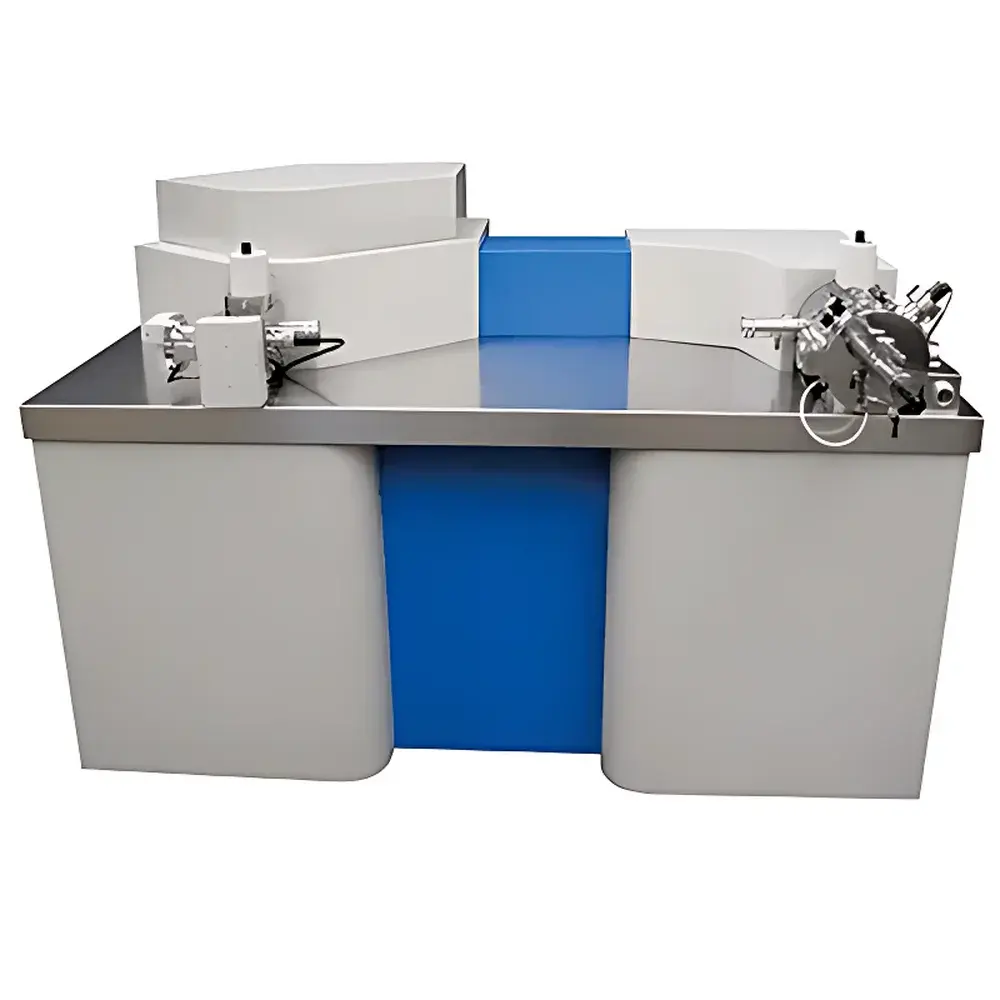
Autoconcept GD90 High-Resolution Glow Discharge Mass Spectrometer
| Brand | MSI |
|---|---|
| Origin | United Kingdom |
| Model | Autoconcept GD90 |
| Type | High-Resolution GDMS |
| Element Coverage | >70 elements (Li to U) |
| Detection Limit | Sub-ppt to sub-ppb (matrix-dependent) |
| Resolution | R ≥ 4,000 (10% valley definition) |
| Ion Source | Pulsed DC and RF modes (for conductive & insulating samples) |
| Mass Analyzer | Double-focusing magnetic sector |
| Sample Form | Solid discs, wafers, foils (diameter: 1–25 mm |
| thickness | ≤5 mm) |
| Depth Profiling Capability | Yes, with sputter rate calibration |
| Isotopic Ratio Precision | ≤0.1% RSD (for major isotopes, ≥10⁴ cps) |
Overview
The Autoconcept GD90 High-Resolution Glow Discharge Mass Spectrometer (GDMS), engineered by MSI in the United Kingdom, is a double-focusing magnetic sector mass spectrometer optimized for ultra-trace elemental and isotopic analysis of solid materials. It employs pulsed glow discharge ionization—a soft, controlled sputtering process—where atomization (sputtering from the solid cathode) and ionization (in the plasma region) occur in spatially separated zones. This physical decoupling minimizes polyatomic interferences and suppresses matrix-dependent signal suppression or enhancement, enabling quantitative accuracy without certified reference materials (CRMs) for many applications. Unlike laser ablation or solution-based ICP-MS techniques, GDMS directly analyzes bulk solids—including metals, alloys, semiconductors, ceramics, and insulators (with optional RF source)—without dissolution, digestion, or chemical pretreatment. Its high mass resolution (R ≥ 4,000 at 10% valley definition) resolves isobaric overlaps (e.g., 56Fe+ vs. 40Ar16O+, 80Se+ vs. 40Ar2+) critical for high-purity material certification.
Key Features
- Double-focusing magnetic sector mass analyzer delivering high mass resolution and mass accuracy (≤1 ppm mass error) for unambiguous isotope identification.
- Dual-mode ion source: Pulsed DC mode for conductive samples (metals, alloys); RF mode (13.56 MHz) for insulators (SiO2, Al2O3, doped wafers) and layered dielectrics.
- Sub-ppt detection limits for most elements (e.g., 0.3 ppt for Cu in Si, 0.8 ppt for Cr in stainless steel), validated per ASTM E2891–21 guidelines for GDMS performance verification.
- Automated depth profiling with real-time sputter rate calibration using interferometric monitoring or reference layer standards; capable of nm-scale depth resolution in multilayer stacks.
- Comprehensive interference database embedded in acquisition software—covering 70+ elements and their known polyatomic, oxide, and argide species—supporting intelligent peak deconvolution and background correction.
- Minimal sample preparation: Flat, polished discs (Ø 1–25 mm, ≤5 mm thick) suffice; no acid cleaning or vacuum degassing required for routine analysis.
Sample Compatibility & Compliance
The GD90 accommodates a broad spectrum of solid-state materials relevant to advanced manufacturing and metrology: high-purity metals (e.g., 6N Ti, 7N Cu), nuclear-grade zirconium alloys, silicon and GaAs wafers, thin-film photovoltaic absorbers (CIGS), sapphire substrates, and oxide-coated superalloys. Its RF source option enables direct analysis of borosilicate glass, fused quartz, and polymer-coated substrates—eliminating the need for conductive coating. The system complies with ISO/IEC 17025:2017 requirements for testing laboratories, supports full audit trails per FDA 21 CFR Part 11 (electronic records/signatures), and facilitates GLP/GMP-aligned workflows through configurable user roles, method locking, and raw data immutability. All spectral acquisitions are traceable to NIST SRM 2136 (high-purity copper) and IRMM-016 (silicon isotopic standard).
Software & Data Management
Acquisition and evaluation are performed via MSI’s GD-Analyzer Suite—a Windows-based platform featuring real-time spectral visualization, automated peak integration, isotope ratio calculation (with dead-time and abundance sensitivity correction), and depth profile reconstruction (concentration vs. depth, sputter time, or absolute depth). Raw data (.raw, .dat) and processed reports (.pdf, .xlsx) are stored in a relational database with version-controlled method templates. The software includes built-in uncertainty propagation per GUM (JCGM 100:2018), supports batch processing of multi-sample sequences, and exports metadata-compliant files compatible with LIMS integration (ASTM E1482–22). Optional modules include spectral library matching (for unknown inclusion identification) and automated QC flagging against predefined control chart limits.
Applications
- Quality assurance of electronic-grade silicon and compound semiconductors (GaAs, InP), including dopant uniformity mapping and interstitial oxygen/carbon quantification.
- Impurity certification of aerospace titanium alloys and Ni-based superalloys per AMS 2249 and ASTM E3061–17.
- Depth-resolved analysis of diffusion barriers (TiN, TaN), ALD films, and electroplated Cu interconnects in advanced packaging.
- Trace contaminant screening in recycled rare-earth magnets (NdFeB) and battery cathode precursors (NMC, LFP).
- Isotopic fingerprinting of geological reference materials and nuclear fuel simulants for safeguards verification.
FAQ
What sample forms are acceptable for GDMS analysis on the GD90?
Solid planar samples—discs, wafers, or foils—with diameters between 1 mm and 25 mm and thickness up to 5 mm. Surface roughness should be ≤0.1 µm Ra; no conductive coating is needed for metals; RF mode eliminates coating requirements for insulators.
Does the GD90 require matrix-matched standards for quantification?
No. Due to minimal matrix effects inherent to the GD plasma, relative sensitivity factors (RSFs) derived from pure element standards (e.g., NIST SRM 2136, IRMM-016) are applicable across diverse matrices, significantly reducing CRM dependency.
Can the GD90 perform isotopic ratio measurements with certified uncertainty?
Yes. With internal normalization, Faraday cup detection, and abundance sensitivity correction, it achieves ≤0.1% RSD for major isotope ratios (e.g., 208Pb/206Pb) under optimized conditions, meeting ISO 17034 and EURACHEM guidelines.
How is depth resolution calibrated during sputter profiling?
Via in situ interferometry (optional add-on) or ex situ SIMS/TEM cross-section validation; sputter rates are recorded per material and discharge condition and stored in the method database for reproducible depth scaling.
Is remote operation and cybersecurity supported?
Yes. The system supports TLS 1.2-encrypted remote desktop access, role-based authentication, and network isolation configuration compliant with IEC 62443-3-3 for industrial control systems.






