OHAUS CPJ603 Pioneer Jewelry Balance
| Brand | OHAUS |
|---|---|
| Origin | USA |
| Model | CPJ603 |
| Capacity | 600 g |
| Readability | 1 mg |
| Pan Size | 120 mm diameter |
| Power Supply | AC adapter or optional rechargeable battery |
| Interface | RS232 standard, optional second display |
| Compliance | ISO/IEC 17025 compatible operation, supports GLP/GMP documentation via data export |
Overview
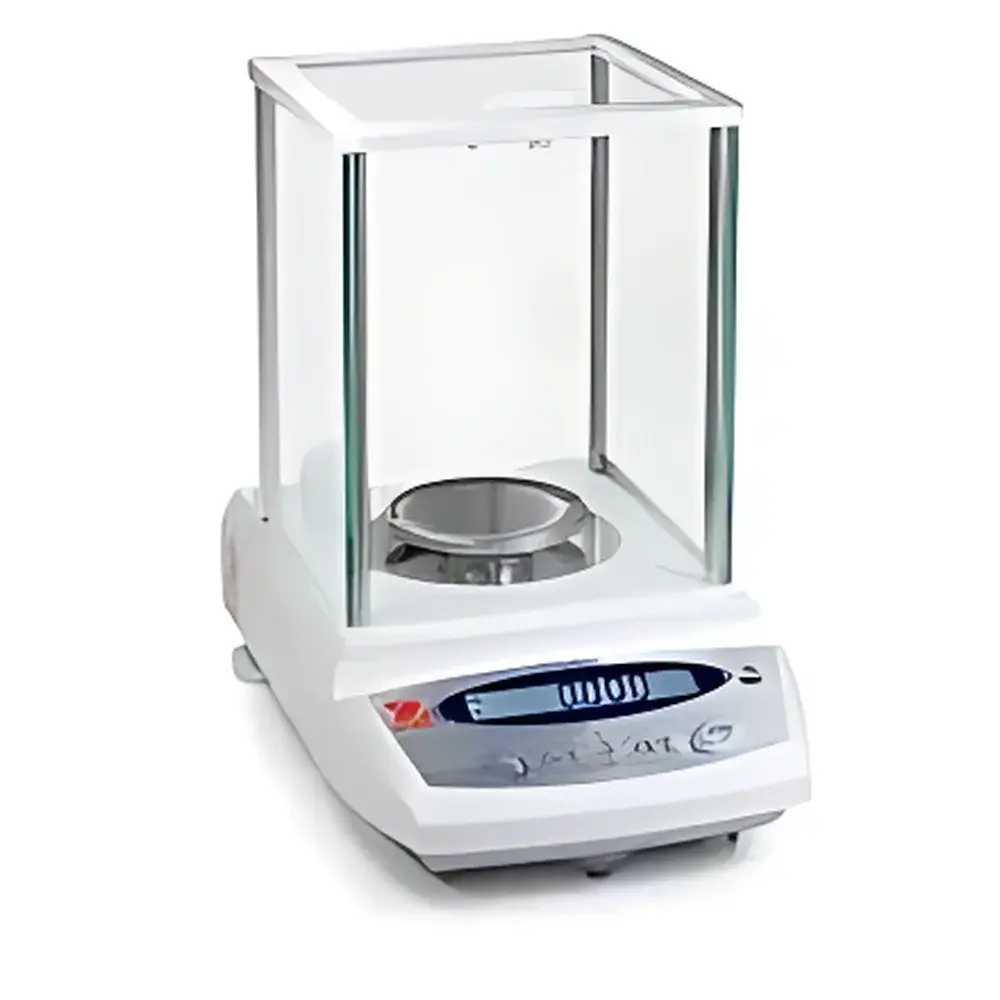
The OHAUS CPJ603 Pioneer Jewelry Balance is a precision analytical balance engineered specifically for high-value, low-mass applications in gemological laboratories, jewelry manufacturing, precious metal trading, and fine watchmaking workshops. Operating on electromagnetic force restoration (EMFR) principle, the CPJ603 delivers stable, repeatable measurements at 1 mg readability with a 600 g capacity—optimized for small-format samples where resolution, environmental resilience, and traceable calibration are critical. Its mechanical architecture features a monolithic aluminum draft shield base, integrated leveling bubble positioned at the front for ergonomic adjustment, and a rigid stainless-steel weighing pan designed to minimize thermal drift and mechanical hysteresis. Unlike general-purpose analytical balances, the CPJ603 incorporates jewelry-specific ergonomics—including tactile keypad layout, front-accessible shield assembly, and multi-unit native support—without compromising metrological integrity.
Key Features
- Front-mounted leveling bubble for rapid, tool-free horizontal alignment—critical for maintaining measurement accuracy on non-ideal lab surfaces.
- Modular five-panel glass draft shield: tool-free disassembly enables full access to the weighing chamber for cleaning, calibration verification, or oversized sample accommodation.
- Backlit LCD with high-contrast character rendering ensures legibility under variable ambient lighting, including dimmed gemology workstations or retail display environments.
- Metal-finish control panel with engraved key labels enhances durability and provides tactile feedback during gloved operation—common in vault handling or cleanroom workflows.
- Built-in below-balance hook for density determination (via Archimedes’ principle), suspended weighing, and magnetic susceptibility testing of mounted stones.
- Adaptive environmental filtering: three-tier digital filter settings (Low/Medium/High) dynamically suppress noise from air currents, HVAC turbulence, or operator-induced vibrations—preserving stability without sacrificing response time.
Sample Compatibility & Compliance
The CPJ603 accommodates irregularly shaped, polished, or heat-sensitive items—including unset diamonds, calibrated gemstones, gold alloys, platinum ingots, and micro-finished watch components—within its 120 mm diameter weighing pan. Its zero-tracking algorithm compensates for minor temperature gradients or static charge accumulation common when handling insulative materials like sapphire or cubic zirconia. The balance meets ISO 9001 process control requirements and supports traceable calibration through internal weight verification protocols. When connected to compliant peripherals (e.g., certified thermal printers or LIMS-integrated PCs), it facilitates audit-ready documentation aligned with ISO/IEC 17025 clause 7.7 (result reporting) and FDA 21 CFR Part 11 electronic record controls—provided user-configured audit trails and electronic signatures are implemented externally.
Software & Data Management
Standard RS232 serial interface enables direct connection to label printers, barcode scanners, or laboratory information management systems (LIMS). Data output follows ASCII protocol with configurable delimiters and timestamping. Optional secondary display unit mirrors real-time mass readings and application-mode status (e.g., “% mode active”), enabling dual-operator verification or integration into production line dashboards. While the CPJ603 does not include embedded software, its firmware supports GLP-compliant data export formats (CSV, TXT) with metadata fields including date/time stamp, operator ID (manually entered), balance ID, and net/gross/tare flags—facilitating downstream validation per ASTM E2656 (Standard Guide for Validation of Balance Performance).
Applications
- Jewelry appraisal and insurance valuation requiring NIST-traceable mass assignment per carat (ct) or troy ounce (ozt).
- Batch verification of precious metal scrap prior to refining—leveraging percentage mode for alloy homogeneity assessment against master reference samples.
- Component counting in watch movement assembly using optimized average piece weight (APW) calculation, minimizing cumulative error across batches of screws, jewels, or springs.
- Density characterization of synthetic vs. natural gemstones via immersion weighing, supported by built-in hook and programmable tare memory.
- QC inspection in plating lines, where milligram-level deposition mass must be verified pre- and post-electroplating on substrates up to 600 g.
FAQ
Does the CPJ603 support internal calibration?
No—the CPJ603 requires external calibration using Class M1 or better weights; it does not feature motorized internal calibration mechanisms.
Can the balance operate on battery power?
Yes—optional rechargeable battery pack enables portable use in vaults, trade shows, or field appraisal scenarios; runtime exceeds 8 hours under typical intermittent usage.
Is the RS232 interface compatible with modern Windows/macOS systems?
Yes—when paired with a USB-to-serial adapter (e.g., FTDI chipset), the balance communicates reliably with data acquisition software such as OHAUS ACUITY or third-party tools supporting ASCII serial input.
What is the maximum height clearance inside the draft shield?
With all five panels installed, vertical clearance from pan surface to top shield is 220 mm—sufficient for most mounted rings, pendants, or crucibles used in assay preparation.
How does the auto-zero tracking function interact with temperature drift?
Auto-zero tracking resets the displayed value to zero only when no load is present and the signal variance falls below a predefined threshold over a 3-second window—preventing false zeroing during slow thermal equilibration.