
Tibidabo Scientific Industries LaueRealTime Single-Crystal Orientation System

| Brand | Tibidabo Scientific Industries |
|---|---|
| Origin | United Kingdom |
| Manufacturer Type | Authorized Distributor |
| Origin Category | Imported |
| Model | Custom-Configurable |
| Instrument Type | X-ray Laue Crystal Orientation System |
| Power | 50 W |
| X-ray Energy Range | 5–29 keV |
| Beam Spot Size | 450 µm (standard), 250 µm (fine-focus option) |
| Detector Active Area | 155 mm × 105 mm |
| Detector Resolution | 2570 × 1710 pixels |
| Pixel Size | 61 µm × 61 µm |
| Exposure Time (Si reference) | 1–3 s |
| Angular Accuracy | ±0.1° |
| Cooling | Air-cooled X-ray source |
| Configurations | Vertical, Horizontal, Grain Mapping |
Ask about pricing, availability and specifications.
Overview
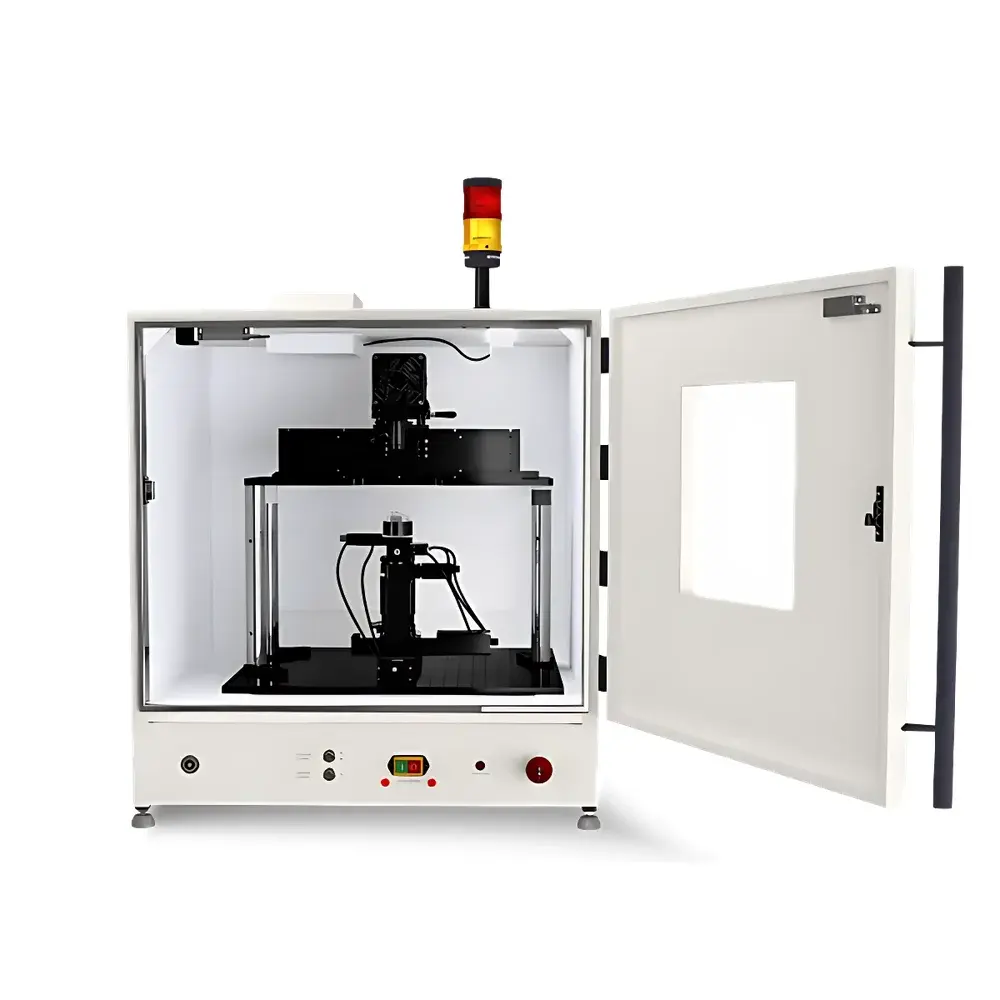
The Tibidabo Scientific Industries LaueRealTime Single-Crystal Orientation System is a high-precision, real-time X-ray Laue diffraction instrument engineered for rapid and accurate crystallographic orientation determination of single crystals. Operating on the principle of back-reflection Laue diffraction, the system captures polychromatic X-ray diffraction patterns from stationary or dynamically repositioned crystals under fixed geometry. Unlike monochromatic techniques such as Bragg-Brentano scanning, Laue diffraction leverages a broadband X-ray spectrum (5–29 keV) to simultaneously excite multiple lattice planes, enabling instantaneous orientation indexing without goniometer sweeps. This makes it especially suited for industrial environments where throughput, repeatability, and operator independence are critical—such as semiconductor wafer metrology, turbine blade crystallographic alignment, photovoltaic ingot slicing, and gemological verification. The system integrates a high-brightness, air-cooled microfocus X-ray source (50 W), a large-area, high-sensitivity CCD detector with 2570 × 1710 pixels (61 µm pitch), and fully synchronized motion control hardware—all coordinated through a purpose-built software platform compliant with GLP-aligned data integrity practices.
Key Features
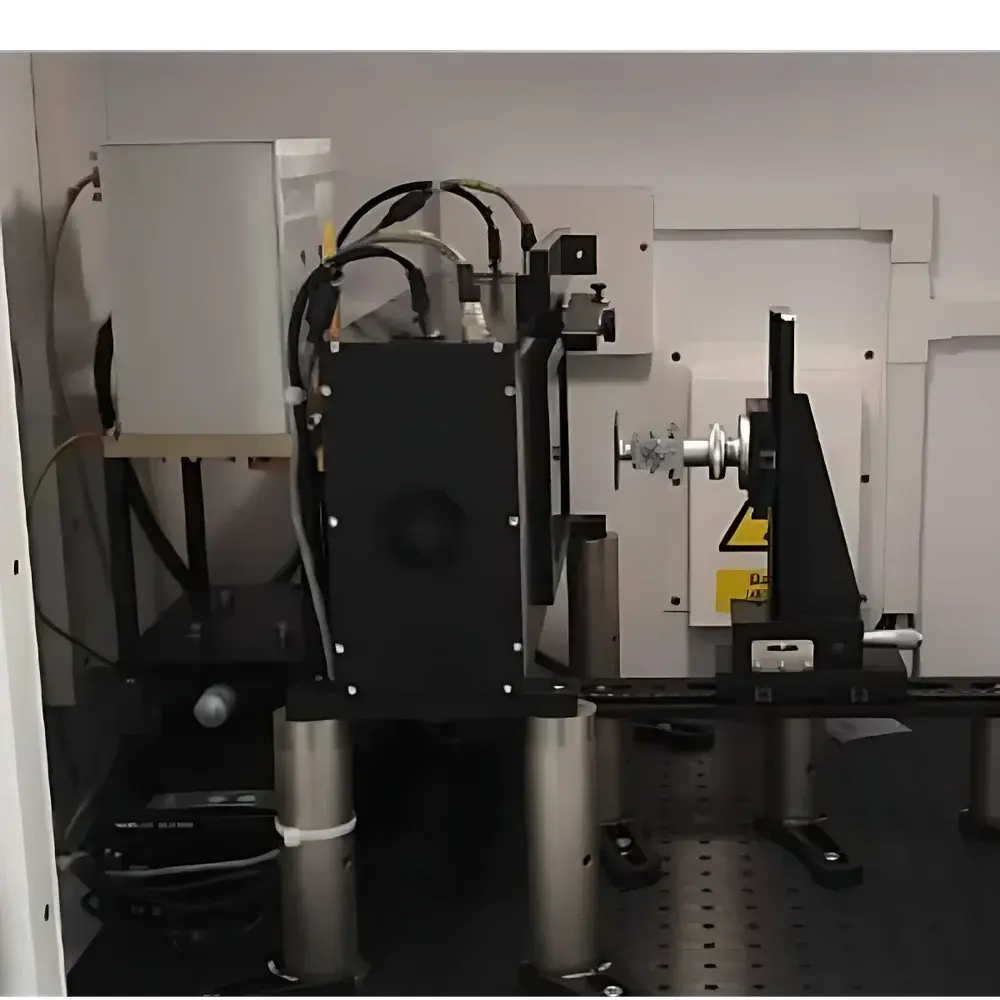
- Three configurable geometries: vertical (gravity-assisted sample loading), horizontal (cutting-machine-aligned beam path), and grain mapping (automated crystallographic texture analysis)
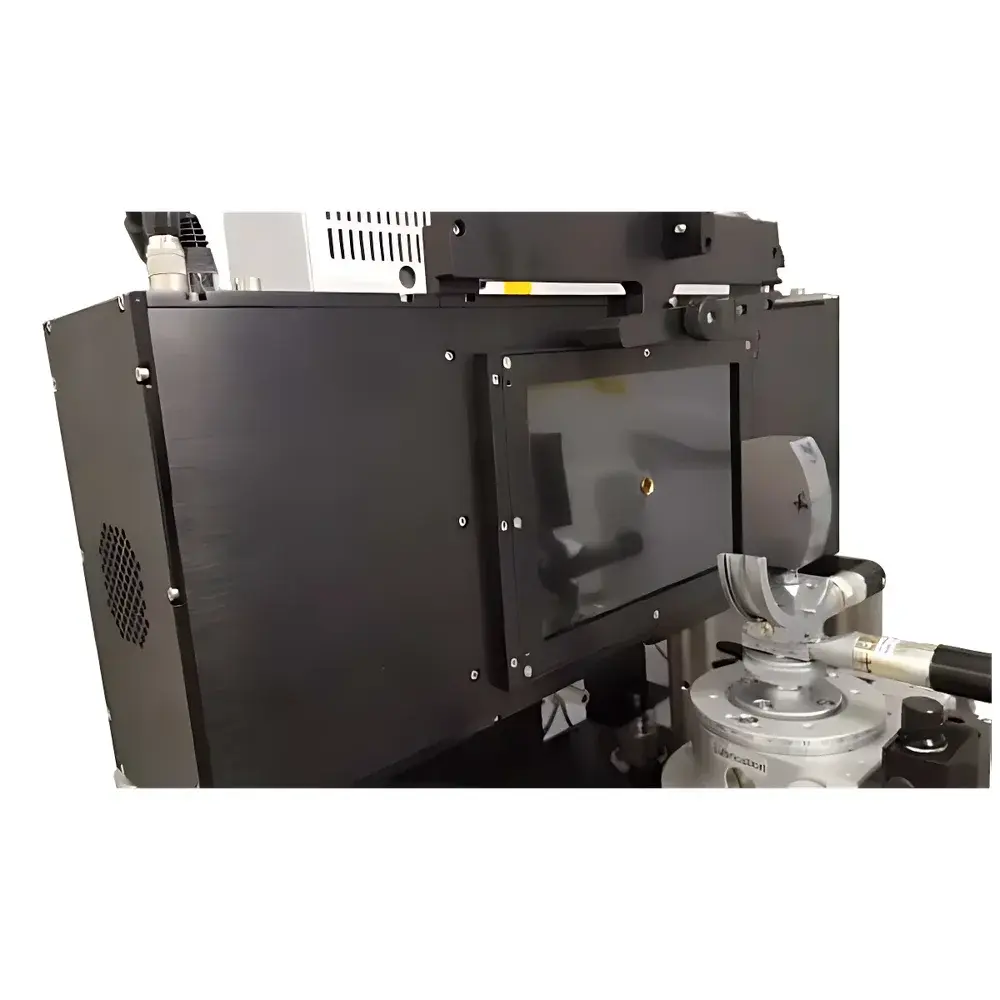
- Large-format back-reflection CCD detector with 155 mm × 105 mm active area and quantum efficiency optimized for 5–29 keV photons
- Air-cooled microfocus X-ray source eliminating need for external chillers; standard beam spot size 450 µm, down to 250 µm with fine-focus option
- Fully motorized XYZ translation stage and precision goniometer (optional 5-axis configuration); manual override available for calibration or maintenance
- Onboard high-resolution optical camera with calibrated distance measurement tools for sub-millimeter sample positioning in vertical mode
- Integrated laser-guided distance sensor (upgradable in vertical configuration) for automatic detector-to-sample distance optimization and Laue pattern simulation correction
- Compact, plug-and-play cabinet design—no custom bench integration or auxiliary infrastructure required
- High-throughput screening mode supporting sequential analysis of multiple isolated crystals or spatially distributed regions on large components (e.g., Ni-based superalloy turbine blades)
Sample Compatibility & Compliance
The LaueRealTime system accommodates samples ranging from sub-millimeter seed crystals to 300 mm-diameter silicon wafers and multi-centimeter metallic or ceramic components. Its flexible mounting interface supports both freestanding crystals (in vertical mode) and vacuum-chuck or kinematic fixtures (in horizontal/mapping modes). All hardware and software modules comply with ISO/IEC 17025:2017 requirements for testing laboratories, and the software architecture supports audit-trail logging, user-access controls, and electronic signature capabilities aligned with FDA 21 CFR Part 11 and EU Annex 11 guidelines. Raw Laue images are stored in vendor-neutral CFL format; processed orientation data (Euler angles, misorientation maps, confidence metrics) export to CSV with timestamped metadata for traceable QA/QC reporting.
Software & Data Management
- LaueAnalysis Suite provides full hardware orchestration: synchronized control of X-ray source, detector acquisition, stage motion, and optical alignment camera
- Automated spot detection and indexing using reference lattice parameters; no manual pattern fitting or distortion correction required
- Real-time error vector calculation relative to target crystallographic axes—displayed as angular deviation arrows overlaid on Laue pattern
- Batch processing pipeline for multi-region orientation mapping, including grain boundary identification and misorientation histogram generation
- Macro scripting interface (Python-based) enables automated workflows—for example, unattended wafer scanning with pass/fail logic based on predefined orientation tolerance bands
- Remote diagnostics and software update capability via secure TLS-encrypted connection; zero downtime firmware hot-swapping supported
- Data provenance tracking includes operator ID, instrument serial number, environmental temperature/humidity logs, and X-ray exposure history
Applications
- Semiconductor manufacturing: real-time orientation verification prior to wafer slicing, epitaxial growth substrate alignment, and defect-aware crystallographic yield mapping
- Aerospace materials: orientation-controlled machining of single-crystal turbine blades and directional solidification monitoring of Ni-based superalloys
- Photovoltaics: ingot orientation screening for optimal sawing plane selection and minimization of kerf loss in multicrystalline Si
- Optical and laser crystal fabrication: precise cut-angle alignment for phase-matching in nonlinear optical devices (e.g., BBO, LBO, KTP)
- Gemology and mineralogy: non-destructive crystal system identification and strain mapping in natural and synthetic gemstones
- Research crystallography: rapid pre-characterization of grown crystals before synchrotron or laboratory XRD experiments
- Quality assurance labs: standardized orientation certification per ASTM F3090 (Standard Practice for Crystallographic Orientation Determination Using Laue Diffraction)
FAQ
What is the minimum detectable crystal volume for reliable orientation indexing?
For Si reference crystals, reliable indexing is achieved with volumes ≥0.1 mm³ at 1–3 s exposure. Sub-µm grain resolution is possible in mapping mode using fine-focus optics and signal-averaging protocols.
Can the system be integrated into an automated production line?
Yes—Ethernet/IP and Modbus TCP interfaces enable OEM-level integration with PLCs and MES systems. Trigger signals support synchronized acquisition during robotic handling or conveyor-based positioning.
Is calibration traceable to national standards?
Detector pixel calibration and angular scale validation are performed using NIST-traceable Si(111) and quartz reference standards; full calibration reports are generated per IEC 61000-4-30 compliance.
Does the software support multi-user role-based access?
Yes—administrator, operator, and viewer roles with configurable permissions for method editing, data export, and system configuration changes.
What maintenance is required for the air-cooled X-ray source?
No routine coolant servicing; annual anode wear assessment and filament life monitoring are recommended. Source lifetime exceeds 10,000 hours under typical duty cycles.