
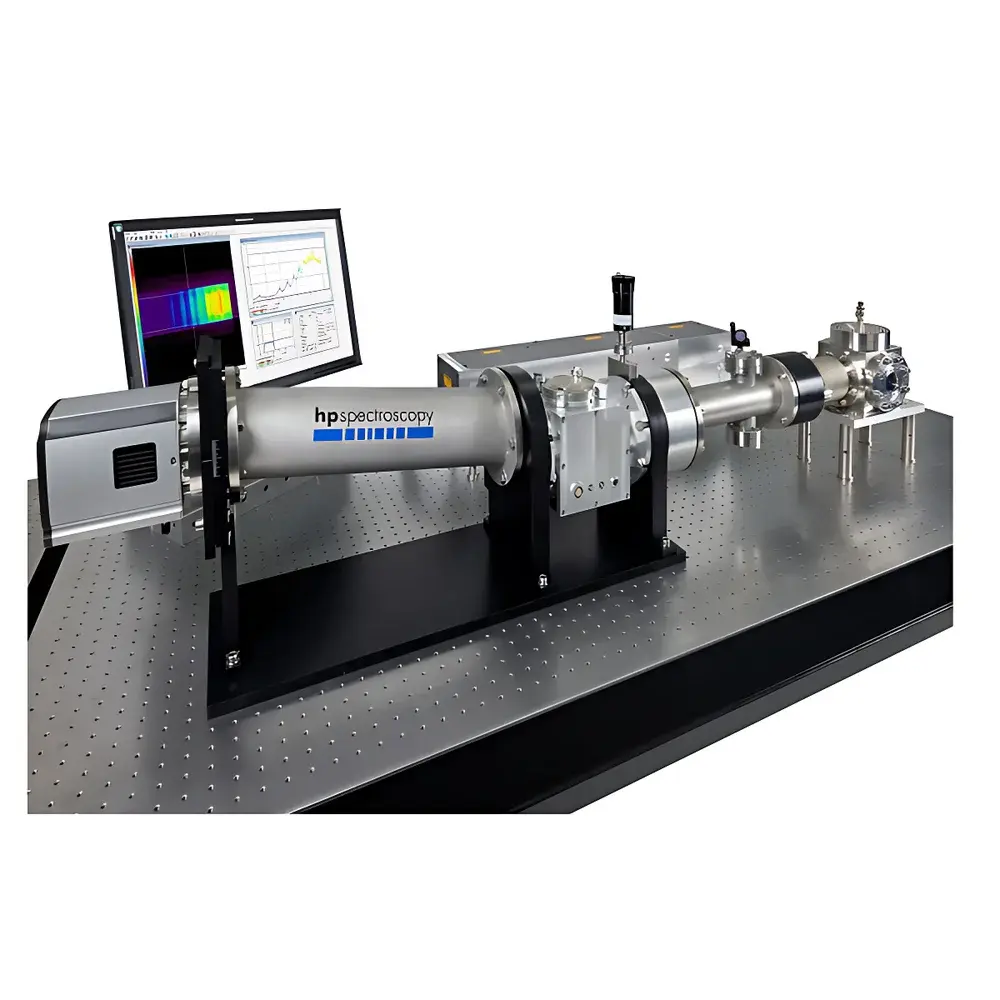
HP Spectroscopy proXAS Desktop Soft X-ray NEXAFS Spectrometer
| Brand | HP Spectroscopy |
|---|---|
| Origin | Germany |
| Manufacturer Type | Authorized Distributor |
| Origin Category | Imported |
| Model | proXAS |
| Price Range | USD 280,000 – 700,000 |
| X-ray Energy Range | 200–1200 eV (1–6 nm) |
| Elemental Coverage | C, N, O, Ca, Ti, and other light elements at K-edges |
| Minimum Detectable Elemental Content | Low percent-level (mass %) |
| Acquisition Time per XAFS Scan | Minutes |
| Source Repetition Rate | 25 Hz |
| Source Power Stability | ±1.5% RMS |
| Spectrometer Type | Aberration-Corrected Flat-Field Grating Spectrometer |
| Spectral Resolution | R = 1500 (λ/Δλ) |
| Sample Handling | Motorized Multi-Sample Carousel |
| Footprint | 1.5 m × 1.0 m |
| Software Suite | Integrated Control, Spectral Calibration, Background Subtraction, Edge Alignment, and Reference-Based Chemical State Fitting |
Overview
The HP Spectroscopy proXAS is a fully integrated, benchtop-scale near-edge X-ray absorption fine structure (NEXAFS) spectrometer engineered for laboratory-based soft X-ray spectroscopy in the 200–1200 eV photon energy range (corresponding to wavelengths of 1–6 nm). Unlike conventional XAFS systems requiring access to synchrotron radiation facilities, the proXAS eliminates dependence on beamtime allocation by delivering synchrotron-comparable spectral fidelity using a laser-driven, debris-free extreme ultraviolet (XUV) plasma source. Its core measurement principle relies on element-specific X-ray absorption near-edge structure analysis—probing unoccupied electronic states through dipole-allowed transitions from core levels (e.g., C 1s → π*, N 1s → σ*, O 1s → σ*)—enabling quantitative determination of chemical bonding, oxidation state, coordination geometry, and orbital hybridization in heterogeneous solid, thin-film, and surface-adsorbed samples. Designed for routine operation in university labs, national institutes, and industrial R&D centers, the proXAS supports rapid, non-destructive, and vacuum-compatible chemical-state mapping without sample derivatization or conductive coating.
Key Features
- Laser-driven XUV plasma source with no electrode erosion or particulate contamination—ensuring long-term spectral stability and minimal maintenance.
- Aberration-corrected flat-field grating spectrometer with resolving power R = 1500 across the full 200–1200 eV range, enabling clear separation of pre-edge features and multiple absorption resonances.
- High-repetition-rate (25 Hz) pulsed operation synchronized with gated detection, facilitating signal averaging while preserving temporal resolution for dynamic studies.
- Motorized multi-sample carousel accommodating up to 12 standard 25 mm diameter substrates or custom holders—optimized for high-throughput screening of catalytic films, polymer blends, or mineral thin sections.
- Compact footprint (1.5 m × 1.0 m) compatible with standard Class 1000 cleanroom or vibration-isolated optical tables; operates under UHV conditions (base pressure < 5 × 10⁻⁸ mbar).
- Real-time photon flux monitoring and closed-loop intensity normalization to compensate for source drift during extended acquisitions.
Sample Compatibility & Compliance
The proXAS accepts electrically insulating and conductive samples—including polymers, oxides, carbon allotropes, biological tissues, geological thin sections, and functionalized nanoparticles—without mandatory metallization. Samples are mounted in ambient air or inert gas prior to load-lock transfer into the analysis chamber, minimizing surface contamination. The system complies with ISO 14644-1 Class 5 cleanroom integration standards and meets electromagnetic compatibility requirements per EN 61326-1. All vacuum components conform to ASTM E595 outgassing specifications for space-qualified instrumentation. Data acquisition workflows support audit-trail generation aligned with GLP principles, and raw spectral metadata (energy calibration, pulse count, dwell time, sample ID) is embedded in HDF5-formatted output files for traceability.
Software & Data Management
The proXAS is controlled via a dedicated Windows-based software suite featuring modular architecture: (i) Instrument Control Module for real-time parameter adjustment (grating angle, detector gain, sample position); (ii) Calibration Engine supporting energy referencing against known absorption edges (e.g., Cu L₃ at 931.2 eV, Si L₂,₃ at 99.8/100.2 eV); (iii) Preprocessing Toolkit with Shirley background subtraction, edge-step normalization, and energy alignment using internal reference spectra; (iv) Chemical-State Analysis Library containing >120 reference NEXAFS spectra for C-, N-, O-, Ca-, and Ti-bearing compounds (e.g., CaCO₃, TiO₂ anatase/rutile, polyimide, hemoglobin). Export formats include ASCII, CSV, and NeXus-compliant HDF5. Software supports optional integration with third-party chemometric platforms (e.g., Python-based scikit-learn or MATLAB) via API hooks.
Applications
- Surface Science: Quantification of functional group distribution (e.g., carboxyl vs. carbonyl density) on graphene oxide or self-assembled monolayers via C K-edge dichroism.
- Geochemistry: In situ redox speciation of Fe and Mn in clay minerals and ferromanganese nodules under controlled pO₂ environments.
- Materials Chemistry: Tracking Ni oxidation state evolution in LiNiₓMnᵧCo_zO₂ cathodes during electrochemical cycling using Ni L-edge NEXAFS.
- Soft Matter & Biomaterials: Conformational analysis of protein secondary structure at interfaces via amide π* resonance intensities in N K-edge spectra.
- Catalysis Research: Operando monitoring of adsorbate bonding configurations (e.g., CO vs. carbonate on Cu/ZnO) during CO₂ hydrogenation reactions.
FAQ
Does the proXAS require liquid nitrogen or cryogenic cooling?
No—the detector is thermoelectrically cooled to –20 °C, eliminating dependency on cryogens.
Can the system be upgraded for time-resolved measurements?
Yes—optional pump-probe synchronization modules support sub-100 ps temporal resolution when paired with femtosecond laser excitation sources.
Is elemental quantification supported?
Quantitative analysis is performed relative to certified reference standards; absolute concentration requires complementary techniques (e.g., XRF or ICP-MS) for matrix-matched calibration.
What vacuum pumping configuration is used?
A two-stage system: turbomolecular pump (200 L/s) backed by a dry scroll pump, achieving base pressure < 5 × 10⁻⁸ mbar within 90 minutes after venting.
Are training and application support included with purchase?
Yes—HP Spectroscopy provides on-site installation, 5-day operator training, and 12 months of remote application assistance with priority response for method development queries.





