
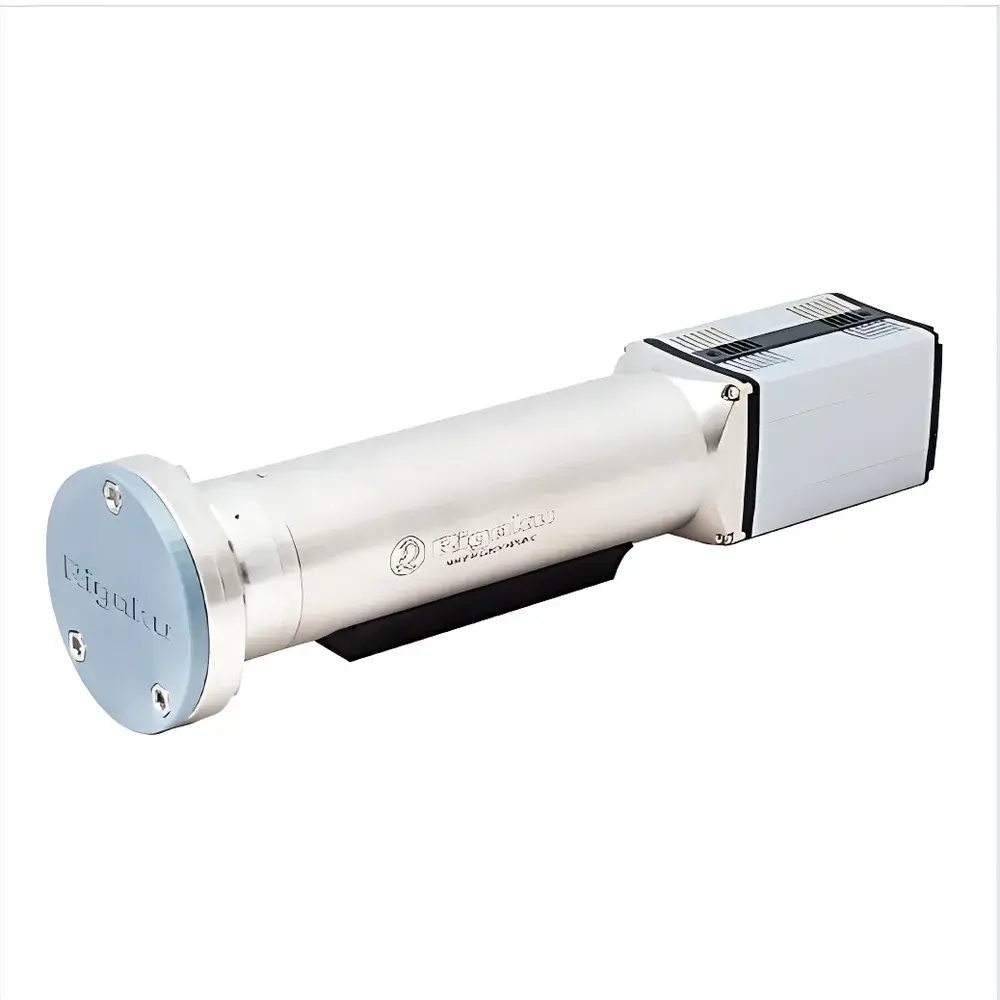
RITE XSight™ LC Lens-Coupled High-Resolution X-ray Camera
| Brand | RITE |
|---|---|
| Origin | Czech Republic |
| Manufacturer Type | Authorized Distributor |
| Origin Category | Imported |
| Model | XSight™ LC |
| Pricing | Upon Request |
| Effective Pixels | 3300 × 2500 |
Overview
The RITE XSight™ LC Lens-Coupled High-Resolution X-ray Camera is an engineered solution for high-fidelity, two-dimensional (2D) X-ray imaging in demanding micro- and sub-micron applications. Unlike fiber-optic-coupled or scintillator-integrated detectors, the XSight™ LC employs a direct lens-coupling architecture between the scintillator and a scientific-grade CCD sensor. This optical coupling preserves spatial fidelity across the full field of view while minimizing geometric distortion and photon spread—critical for quantitative metrology, synchrotron-based phase-contrast imaging, laboratory-scale micro-CT, and high-resolution X-ray microscopy. Developed by Rigaku Innovative Technologies Europe s.r.o. (RITE), headquartered in Prague and operating as Rigaku’s European center for X-ray optics design and manufacturing since 2008, the XSight™ LC integrates precision optical engineering with robust mechanical packaging optimized for integration into vacuum-compatible, radiation-hardened, or benchtop X-ray systems.
Key Features
- Lens-coupled optical path ensures minimal point-spread function (PSF) degradation, enabling true spatial resolution down to 250 nm—as verified using ISO 12233-based resolution test targets under 8 keV X-ray illumination.
- Compact, monolithic housing constructed from radiation-shielded aluminum alloy; includes integrated M6 threaded mounting interfaces on the base plate for rigid mechanical alignment with goniometers, rotation stages, or CT sample holders.
- USB 3.0 interface provides full-frame readout at sustained bandwidths up to 400 MB/s—eliminating the need for external frame grabbers, dedicated acquisition computers, or active cooling units.
- Modular lens unit system supports five interchangeable lens configurations (C-mount compatible), each calibrated for specific magnification, working distance, and depth-of-field trade-offs—enabling seamless adaptation from macro-scale radiography (6 µm resolution) to nano-scale feature analysis (250 nm resolution).
- Scientific CCD sensor options include both 3300 × 2500 and 2048 × 2048 pixel formats, offering flexibility in field-of-view versus pixel-level signal-to-noise ratio (SNR) optimization.
Sample Compatibility & Compliance
The XSight™ LC is designed for use with sealed-tube microfocus X-ray sources (e.g., 50–160 kV), rotating anode systems, and synchrotron beamlines operating in the 5–30 keV range. Its scintillator selection (Gd₂O₂S:Tb or CsI:Tl variants) is matched to common X-ray energies for optimal conversion efficiency and modulation transfer function (MTF) performance. The camera complies with CE marking requirements for electromagnetic compatibility (EMC Directive 2014/30/EU) and low-voltage safety (LVD Directive 2014/35/EU). While not intrinsically certified for GLP or GMP environments, its deterministic USB-based acquisition protocol and metadata-embedded TIFF output format support audit-ready workflows compliant with ISO/IEC 17025 and FDA 21 CFR Part 11 when deployed with validated software and procedural controls.
Software & Data Management
Acquisition is managed via RITE’s cross-platform XSight Control Suite (Windows/Linux/macOS), supporting real-time histogram monitoring, flat-field correction, dark-current subtraction, and multi-frame averaging. All images are saved in uncompressed 16-bit TIFF format with embedded EXIF-style metadata—including exposure time, gain setting, lens ID, scintillator type, and X-ray tube parameters. The SDK provides C/C++ and Python APIs for integration into custom CT reconstruction pipelines (e.g., TomoPy, ASTRA Toolbox) or automated QA/QC scripts. Time-stamped acquisition logs and user-defined annotation fields facilitate traceability in regulated metrology applications.
Applications
- Micro-computed tomography (micro-CT) of electronic packages, additive-manufactured metal parts, and geological core samples requiring sub-5 µm voxel resolution.
- In-line X-ray inspection for semiconductor packaging, battery electrode layer uniformity assessment, and composite material delamination detection.
- Phase-contrast imaging at third-generation synchrotrons where lens coupling minimizes coherence loss compared to fiber-optic tapers.
- High-precision dimensional metrology of MEMS devices and microfluidic chips using calibrated edge-detection algorithms.
- Time-resolved radiography of dynamic processes such as fluid flow in porous media or thermal expansion in thermally cycled materials.
FAQ
What X-ray energies is the XSight™ LC optimized for?
The camera is calibrated for operation between 5 keV and 30 keV, with peak quantum efficiency achieved using Gd₂O₂S:Tb scintillators at ~8–15 keV and CsI:Tl at higher energies (>20 keV).
Can the XSight™ LC be used in vacuum environments?
No—the optical coupling assembly and USB electronics are rated for ambient air operation only; vacuum-compatible variants require custom sealing and feedthrough integration.
Is hardware-triggered acquisition supported?
Yes—TTL-compatible external trigger input is provided for synchronization with motorized stages, pulsed X-ray sources, or laser pump-probe experiments.
Does the system support binning or region-of-interest (ROI) readout?
Yes—both 2×2 hardware binning and arbitrary rectangular ROI selection are implemented in firmware to improve frame rate or SNR without sacrificing spatial registration accuracy.
How is calibration maintained across different lens units?
Each lens unit is factory-characterized for MTF, distortion, and effective pixel size; calibration profiles are loaded automatically upon lens recognition via EEPROM identification.



