
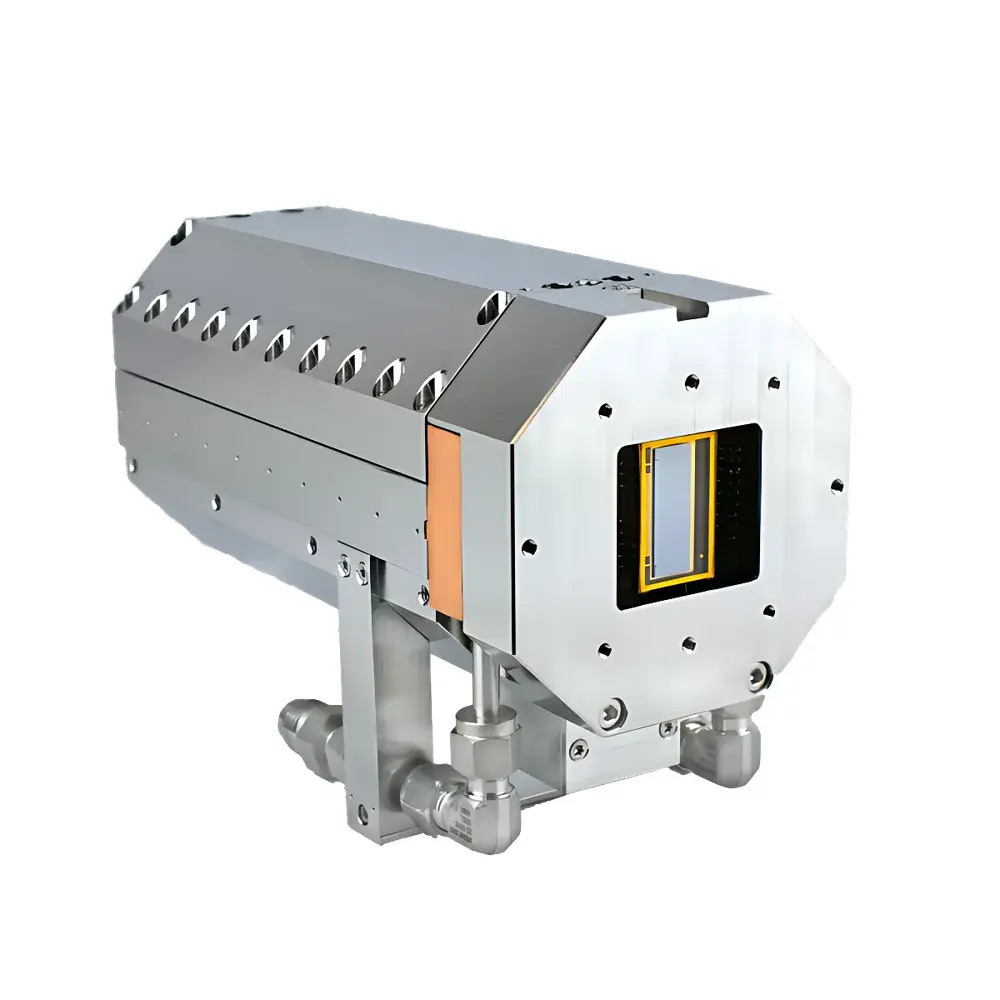
greateyes LOTTE-s Series EUV and Soft X-ray In-Vacuum CCD Camera
| Brand | greateyes |
|---|---|
| Origin | Germany |
| Model | LOTTE-s 1k256 BI |
| Effective Pixels | 1024 × 256 |
| Pixel Size | 13 µm × 13 µm |
| Readout Frequencies | 50 kHz, 250 kHz, 1 MHz, 3 MHz, 5 MHz (view mode) |
| ADC Resolution | 18-bit |
| Cooling Temperature | -100 °C (water-cooled) |
| Vacuum Compatibility | ≤10⁻⁹ mbar (UHV) |
| Flange | CF DN100 |
| QE Peak | up to 98% |
| Sensor Types | FI, BI, DD, BI UV1 |
| Dark Current @ -100 °C | ≤0.0004 e⁻/pix/s (DD), ≤0.00025 e⁻/pix/s (BI UV1) |
| Readout Noise | 4.2 e⁻ rms @ 50 kHz (BI), 3.5 e⁻ rms @ 50 kHz (BI UV1) |
| Linearity | >99% |
| Data Interface | Gigabit Ethernet |
| Software | greateyes Vision (Windows 7/10), SDKs for LabVIEW, EPICS, Python, Linux, Tango |
Overview
The greateyes LOTTE-s Series is a high-performance, in-vacuum scientific CCD camera engineered specifically for demanding detection applications in the extreme ultraviolet (EUV, 10–124 nm), vacuum ultraviolet (VUV, 124–200 nm), and soft X-ray (0.1–2 keV) spectral ranges. Built upon decades of detector physics expertise from Humboldt University Berlin, the LOTTE-s platform integrates back-illuminated (BI) and deep-depletion (DD) CCD architectures with ultra-low-noise electronics and cryogenic thermo-electric cooling down to –100 °C. Its operation within sealed, UHV-compatible vacuum chambers eliminates atmospheric absorption and window-related losses—enabling direct photon detection with quantum efficiency (QE) exceeding 98% at key EUV wavelengths. The camera employs a true 18-bit analog-to-digital conversion architecture, preserving the full dynamic range of the sensor while maintaining linearity better than 99%. Designed for synchrotron beamlines, laser-plasma diagnostics, space-borne spectrometers, and laboratory-scale EUV lithography testbeds, the LOTTE-s delivers high spatial resolution, exceptional signal fidelity, and long-term measurement stability under rigorous experimental conditions.
Key Features
- In-vacuum operation with CF DN100 flange and knife-edge sealing, rated for ultra-high vacuum environments down to 10⁻⁹ mbar; bakeable to +80 °C for in-situ chamber conditioning
- Back-illuminated and deep-depletion CCD options—including UV-enhanced BI UV1 variant—optimized for peak QE across EUV/VUV bands without phosphor or scintillator conversion losses
- Water-cooled Peltier stage achieving stable sensor temperatures from –100 °C to –20 °C; integrated thermal monitoring at both sensor die and thermoelectric hot side
- Flexible readout architecture supporting selectable speeds from 50 kHz to 5 MHz (5 MHz available in non-integrating “live view” mode), enabling optimization between temporal resolution and read noise
- Ultra-low read noise: as low as 3.5 e⁻ rms at 50 kHz (BI UV1), scalable to <6 e⁻ rms even at 3 MHz—critical for single-photon counting and weak-signal spectroscopy
- 18-bit digitization with on-chip correlated double sampling (CDS), delivering >99% linearity and effective dynamic range exceeding 260,000:1
- Compact mechanical footprint (90 × 90 × 235 mm) and lightweight design (5.0 kg), facilitating integration into constrained optical paths and multi-axis end-stations
Sample Compatibility & Compliance
The LOTTE-s Series is designed for direct imaging and spectroscopic analysis of photons in the EUV through soft X-ray regime, with no requirement for entrance windows or vacuum feedthrough optics. Its sensor variants—including standard BI, deep-depletion (40 µm epitaxial layer), and UV-optimized BI UV1—are selected based on spectral cutoff, fringing suppression, and charge collection depth requirements. All models comply with CE marking directives for electromagnetic compatibility (EMC) and low-voltage equipment. The vacuum interface conforms to ISO-KF and CF flange standards (CF DN100); knife-edge sealing meets DIN 28403 specifications for UHV integrity. While not certified to FDA 21 CFR Part 11, the system supports audit-trail-capable data acquisition when used with validated greateyes Vision software configurations compliant with GLP/GMP-aligned laboratory practices. Sensor defect grading adheres to ISO 14524:2022 criteria, with Grade 0 or Grade 1 sensors supplied as standard.
Software & Data Management
Control and acquisition are managed via greateyes Vision—a native Windows application (compatible with Windows 7 and 10) offering real-time preview, exposure sequencing, region-of-interest (ROI) binning, dark-frame subtraction, and non-uniformity correction. A comprehensive software development kit (SDK) provides DLL-based drivers for Windows, with documented APIs for LabVIEW, EPICS IOC integration, Python (via ctypes), and Tango control systems. Linux support is available through open-source greateyes-libusb bindings. All communication occurs over Gigabit Ethernet using TCP/IP with deterministic packet framing; metadata (exposure time, temperature, gain, timestamp) is embedded in each FITS or TIFF frame header. Raw image data streams are lossless and fully bit-preserving—ensuring traceability for quantitative radiometric analysis and inter-laboratory comparison studies.
Applications
- Synchrotron-based EUV reflectometry and grazing-incidence spectroscopy
- Laser-produced plasma diagnostics (LPP) for next-generation lithography source development
- Space instrumentation calibration and ground testing for solar physics missions (e.g., Solar Orbiter/EUI, DKIST)
- Tabletop high-harmonic generation (HHG) beamline imaging and spectral reconstruction
- Atomic and molecular physics experiments requiring single-photon sensitivity in VUV/EUV
- Materials science studies of band structure and core-level excitations using soft X-ray absorption spectroscopy (XAS)
FAQ
Is the LOTTE-s compatible with existing UHV chamber feedthroughs?
Yes—the standard CF DN100 flange includes D-sub connectors for TTL trigger/exposure signaling and 6 mm water-in/water-out ports; custom flange geometries and electrical feedthrough configurations are available upon request.
Can the camera operate continuously at –100 °C?
Yes, provided a stable chilled-water supply (12–18 °C, ≥2 L/min flow rate) is maintained; the system includes thermal runaway protection and real-time sensor die temperature feedback.
What is the maximum sustainable frame rate for full-frame acquisition?
At 1 MHz readout, the LOTTE-s 1k256 achieves ~380 fps full-frame; at 3 MHz, it reaches ~1,100 fps—subject to host PC bandwidth and buffer management.
Does greateyes provide calibration certificates for QE and linearity?
Yes—NIST-traceable absolute QE curves and linearity verification reports are available as optional deliverables, measured at PTB (Physikalisch-Technische Bundesanstalt) or NPL-accredited facilities.
Are there radiation-hardened variants for long-term beamline use?
While not formally radiation-hardened per MIL-STD-883, LOTTE-s cameras have demonstrated >10⁴ Gy tolerance in soft X-ray environments when operated at cryogenic temperatures; extended lifetime operation is supported by redundant sensor biasing and in-situ pixel defect mapping.




