
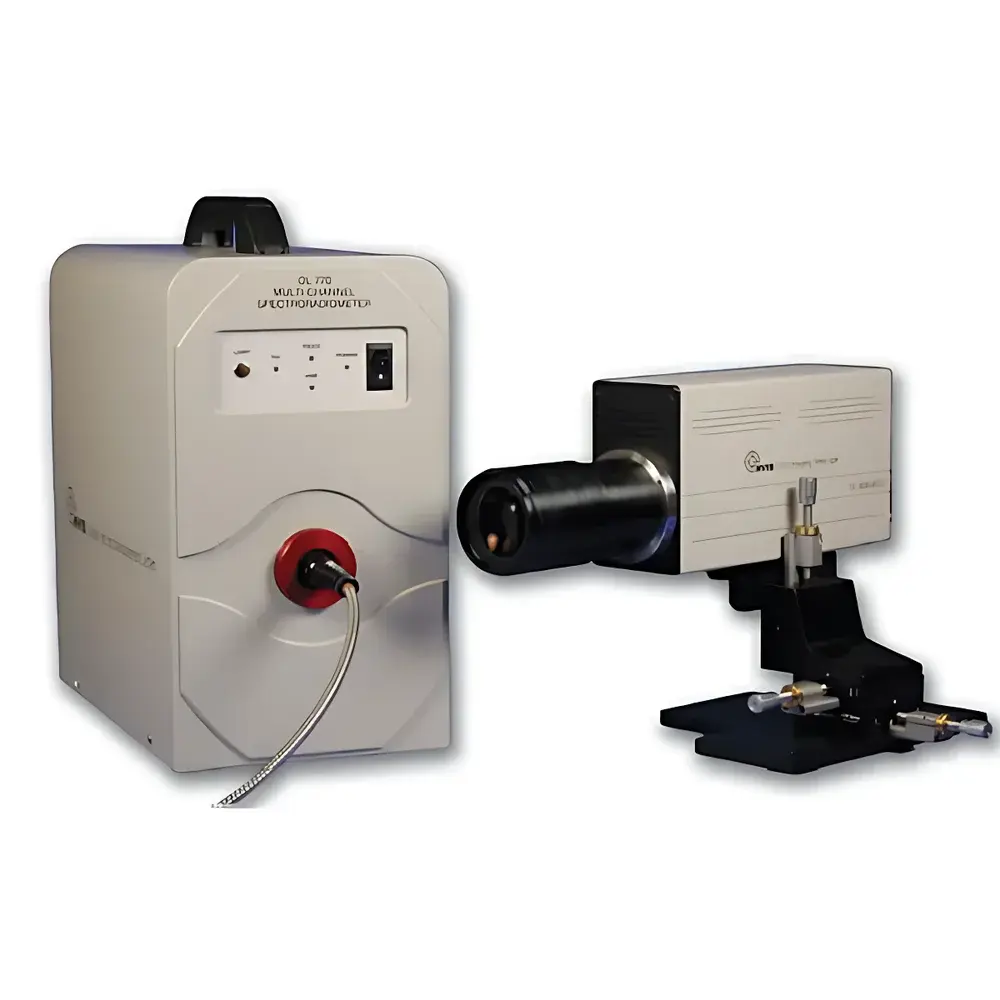
OL770NVS Night Vision Compatibility Test System
| Brand | Optronic Laboratories |
|---|---|
| Origin | USA |
| Model | OL770NVS |
| Spectral Range | 380–930 nm (standard), optional 380–1100 nm (NIR) |
| Luminance Range | 2×10⁻⁴ to 1500 cd/m² |
| Luminance Accuracy | <1% |
| Chromaticity Accuracy (u′v′) | <0.0003 |
| Chromaticity Repeatability | ±0.00015 (x), ±0.0002 (y) |
| Wavelength Accuracy | ±0.5 nm |
| Optical Bandwidth (FWHM) | 10 nm |
| Radiance Sensitivity | 1.0×10⁻¹² W·sr⁻¹·m⁻²·nm⁻¹ |
| Stray Light Level | <2.5×10⁻⁴ |
| Zero Drift | <0.01% |
| Integration Time | 0.02–60 s |
| Slit Width | 350 µm |
| Fiber Coupling | SMA 905, 600-µm core silica fiber, stainless steel jacket, standard length 1.5 m (2.0 m / 3.0 m optional) |
| Detector | Thermoelectrically Cooled CCD Array |
| Grating | Aberration-Corrected Concave Flat-Field |
| Compliance | MIL-STD-3009, MIL-L-85762A, NVIS Class A & B (Ga/Gb) Weighting |
Overview
The OL770NVS Night Vision Compatibility Test System is a purpose-engineered, spectroradiometric measurement platform designed for rigorous validation of display and lighting systems under night vision imaging system (NVIS) requirements. Built upon the proven OL770 multi-channel spectroradiometer architecture, the OL770NVS integrates a high-resolution imaging lens assembly (OL620-NVS) and synchronized software suite to enable simultaneous spatially resolved radiance, chromaticity, and NVIS-weighted photometric analysis. Its core measurement principle relies on calibrated, thermoelectrically cooled CCD-based spectroscopy coupled with real-time image-guided targeting—ensuring traceable, NIST-traceable characterization of luminance (cd/m²), CIE 1931/1976 chromaticity coordinates (x,y; u′,v′), correlated color temperature (CCT), spectral radiant exitance, dominant wavelength, purity, and NVIS-specific weighted radiances (NVISa and NVISb). The system operates across the visible-to-near-infrared spectrum (380–930 nm standard; 380–1100 nm with NIR grating option), meeting the full spectral response envelope required by MIL-STD-3009 and MIL-L-85762A for cockpit, avionics, and tactical display certification.
Key Features
- Integrated imaging-spectroradiometric architecture: Combines OL770’s high-stability, cooled CCD spectroradiometer with OL620-NVS through-focal-plane CCD imaging optics for precise target alignment and region-of-interest (ROI) selection.
- Real-time visual feedback: OL620-NVS provides live through-the-lens viewing and snapshot capture synchronized with spectral data acquisition—enabling rapid focus verification and spatial registration of measurement points.
- Automated NVIS compliance evaluation: Software applies MIL-STD-3009-defined spectral weighting functions (Ga for Gen II/III image intensifiers, Gb for filtered white phosphor displays) and evaluates pass/fail status against user-defined or standards-mandated thresholds.
- High-fidelity optical coupling: OL770-7Q-DMS fiber probe features 600-µm core silica fiber, SMA 905 terminations with indexing pins, and stainless-steel armored jacket—optimized for low-loss, vibration-resistant transmission between OL620-NVS and OL770 main unit.
- Precision mechanical positioning: OL622-NVS XYZ alignment stage provides sub-10-µm linear resolution in all three axes, aluminum baseplate with ¼”-20 threaded mounting holes, and tool-free thumb-screw attachment for repeatable instrument setup.
- Robust thermal and electronic stability: Internal Peltier-cooled CCD detector maintains <±0.1°C temperature control; zero drift <0.01% over 60-minute operation; stray light rejection <2.5×10⁻⁴.
Sample Compatibility & Compliance
The OL770NVS supports direct measurement of emissive sources including OLED, LCD, LED, electroluminescent (EL), and CRT displays; illuminated control panels; aircraft instrument backlights; HUD combiners; and NVIS-filtered lighting fixtures. It accommodates both point-source and extended-area targets via adjustable working distance (enabled by OL622-NVS stage) and variable integration time (0.02–60 s). All measurements comply with ASTM E308 (computing CIE tristimulus values), CIE S 014/E:2006 (spectral irradiance/radiance), and ISO/CIE 11664 series (colorimetry). Software enforces full audit trail functionality per FDA 21 CFR Part 11 requirements—including electronic signatures, operator logs, parameter change history, and immutable data export. Calibration certificates are issued with NIST-traceable reference standards and uncertainty budgets per ISO/IEC 17025.
Software & Data Management
OL770-423-NVS application software provides a modular, Windows-compatible interface with dual-mode operation: manual interactive mode and automated batch testing. Key capabilities include dynamic CIE chromaticity diagram overlay with user-definable specification boundaries; side-by-side comparison of multiple DUTs against MIL-STD-3009 Class A/B limits; real-time pass/fail flagging with root-cause diagnostics (e.g., “excessive red content in I3W band”, “u′v′ deviation >0.00025”); and direct export to Microsoft Excel (.xlsx) and Word (.docx) formats with embedded spectra, images, and metadata. The API supports LabVIEW, MATLAB, and Python integration via COM/ActiveX and TCP/IP protocols—facilitating custom test sequencing, statistical process control (SPC), and integration into automated production test cells. All raw spectral data is stored in vendor-neutral .spc format compliant with IEC 61290-12-3.
Applications
- Aerospace & defense: Certification of NVIS-compliant cockpit displays per MIL-STD-3009 Rev. C and NATO STANAG 4290.
- Avionics manufacturing: In-line verification of backlight spectral power distribution (SPD) and NVIS-a/b radiance ratios during final assembly.
- Human factors engineering: Quantitative assessment of display legibility under night vision goggle (NVG) conditions across varying ambient illuminance levels.
- R&D laboratories: Development and validation of NVIS filters, phosphor formulations, and LED spectral tuning algorithms.
- Regulatory testing labs: Third-party conformance testing for DO-160 Section 22 (lighting), RTCA/DO-297 (integrated modular avionics), and EASA CS-25 Appendix H.
FAQ
What standards does the OL770NVS explicitly support?
The system implements full computational compliance with MIL-STD-3009 (2021), MIL-L-85762A (1992), and associated NVIS spectral weighting curves (Ga and Gb) as defined in ANSI/NEMA FL 1-2020 Annex B.
Can the OL770NVS measure both luminance and radiance simultaneously?
Yes—the system reports absolute photopic luminance (cd/m²) and spectrally resolved radiance (W·sr⁻¹·m⁻²·nm⁻¹) from the same acquisition, with calibration traceable to NIST SRM 2241 and 2242.
Is the software validated for regulated environments?
OL770-423-NVS includes 21 CFR Part 11-compliant audit trails, electronic signature workflows, and configuration-controlled versioning—validated per GAMP 5 for use in GLP and GMP settings.
What is the minimum measurable luminance level?
The system achieves a radiance sensitivity of 1.0×10⁻¹² W·sr⁻¹·m⁻²·nm⁻¹, corresponding to ~2×10⁻⁴ cd/m² at peak photopic response (555 nm) with 10-s integration.
How is calibration maintained across field deployments?
Optronic Laboratories provides annual recalibration services with full uncertainty analysis; users may perform field verification using optional OL770-CAL-REF portable calibration source (NIST-traceable tungsten-halogen lamp with integrated ND filters).




