
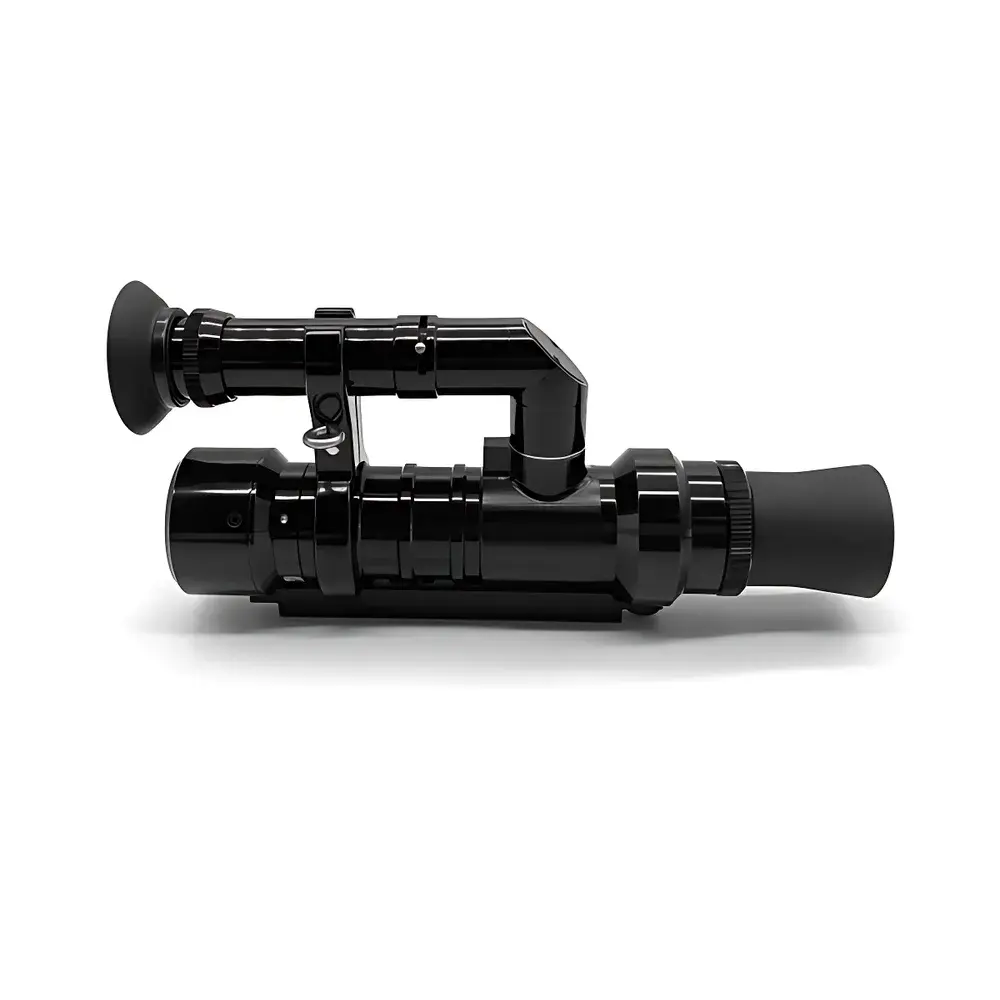
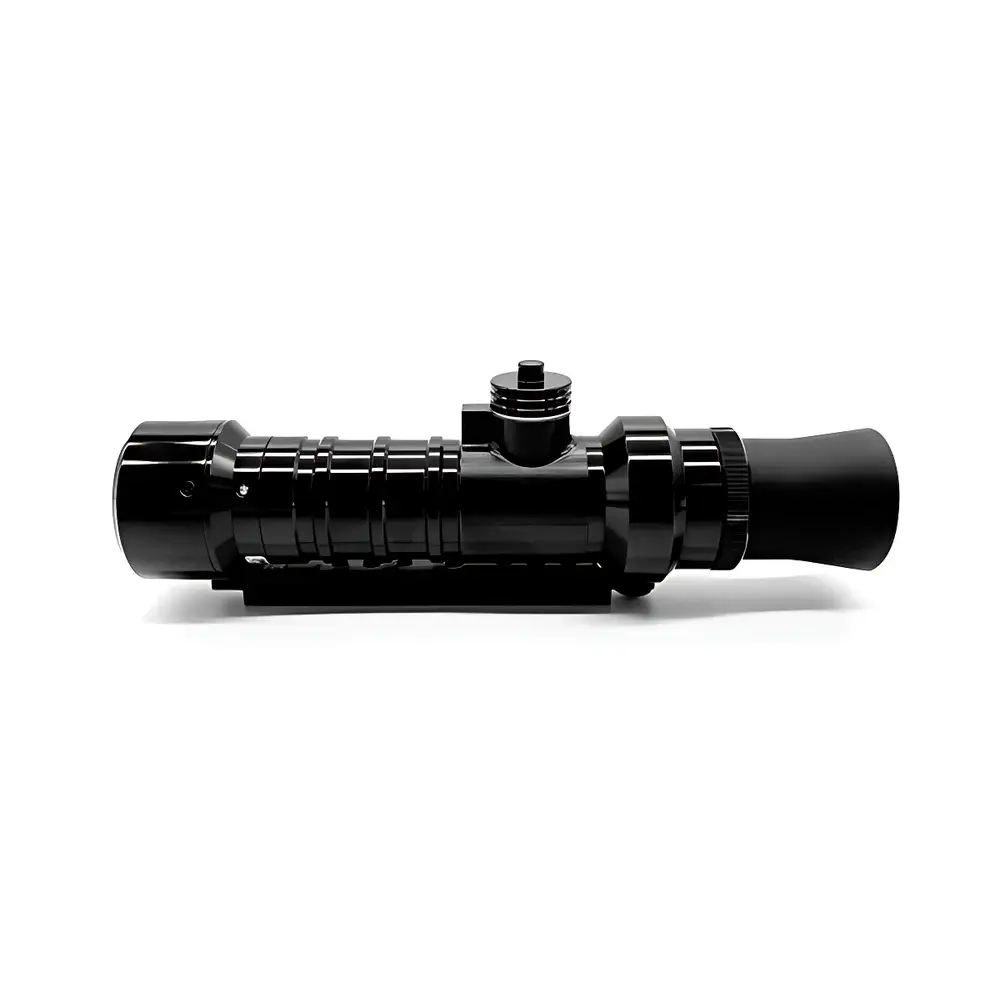
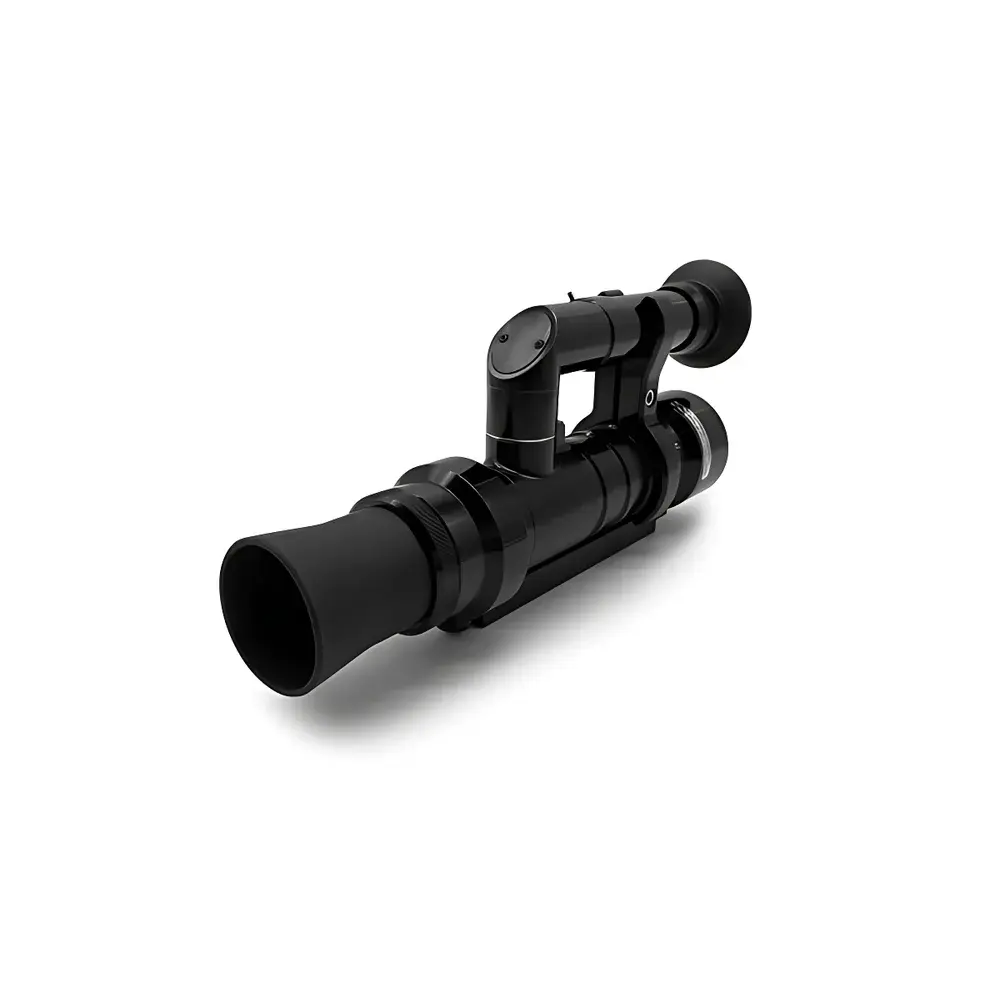
Colorimetry Research CR 250 Spectroradiometric Luminance and Chromaticity Meter
| Brand | Colorimetry Research (CRI) |
|---|---|
| Origin | USA |
| Model | CR 250 |
| Spectral Range | 380–780 nm |
| Detector | 256-pixel CMOS image sensor |
| Spectral Bandwidth | 4 nm |
| Spectral Accuracy | ±0.3 nm |
| Spectral Resolution | 1.6 nm/pixel |
| Luminance Range | 0.02–154,000 cd/m² (nits) |
| Luminance Accuracy | ±2% |
| Luminance Repeatability | ≤1% |
| Chromaticity Accuracy | ±0.0015 in CIE 1931 x,y coordinates |
| Chromaticity Repeatability | ±0.0005 in CIE 1931 x,y coordinates |
| Polarization Error | ≤0.5% |
| Digital Resolution | 16-bit |
| Objective Lens | 40 mm f/2.8 |
| Focus Range | 200 mm to ∞ |
| Fixed Aperture Options | 3°, 2°, 1°, 0.5°, 0.25°, 0.125° (selected at time of order) |
| Field of View | 10° |
| Viewfinder | Patent-pending removable & rotatable optical viewfinder (VO-201 optional) |
| Synchronization Frequency | 10–10,000 Hz |
| Exposure Time | 0.02–30 s |
| Power Supply | 5 V DC, 120 mA (600 mW) via USB 2.0 |
| Communication Interfaces | USB 2.0, Ethernet, RS-232 |
| Weight | 0.45 kg (base unit) |
Overview
The Colorimetry Research CR 250 is a high-fidelity, portable spectroradiometric luminance and chromaticity meter engineered for traceable photometric and colorimetric characterization across demanding industrial and laboratory environments. Unlike filter-based tristimulus colorimeters, the CR 250 employs a linear 256-pixel CMOS image sensor coupled with a precision diffraction grating to acquire full spectral radiance data from 380 nm to 780 nm at 1.6 nm/pixel resolution. This spectral acquisition enables first-principles calculation of CIE 1931 XYZ tristimulus values, chromaticity coordinates (x,y), correlated color temperature (CCT), Duv, general color rendering index (CRI Ra), TM-30-20 metrics (Rf, Rg), luminance (cd/m²), optical density, and reflectance/transmittance ratios — all derived directly from measured spectral irradiance or spectral radiance without interpolation or calibration transfer assumptions. Its optical architecture supports “what-you-see-is-what-you-measure” alignment via a patent-pending rotatable and detachable optical viewfinder, ensuring unambiguous spatial registration between measurement spot and target surface — critical for display uniformity mapping, LED binning, and roadway luminaire photometric validation.
Key Features
- True spectroradiometric core: 256-channel CMOS sensor with 4 nm FWHM spectral bandwidth and ±0.3 nm wavelength calibration traceability to NIST standards.
- Modular optical interface: Interchangeable fixed-angle apertures (0.125° to 3°) selected at time of order; optional VO-201 viewfinder enables real-time visual targeting and mechanical rotation for off-axis measurements.
- High dynamic range photometry: Measures luminance from 0.02 cd/m² (low-brightness OLED blacks) to 154,000 cd/m² (sunlit signage), with ≤1% repeatability and ±2% absolute accuracy per CIE Publication 127 and IES LM-79 Annex A protocols.
- Robust environmental operation: Optional low-temperature heating module maintains sensor and optical path stability down to –20 °C, enabling field deployment for outdoor lighting audits and winter-season display qualification.
- Multi-interface synchronization: Supports hardware-triggered acquisition via TTL sync input (10–10,000 Hz), facilitating integration into automated test stands, flicker analysis systems, and pulsed LED characterization setups.
- USB 2.0 + Ethernet + RS-232 triple connectivity ensures compatibility with legacy lab infrastructure, embedded controllers, and networked QA/QC workstations without driver dependency.
Sample Compatibility & Compliance
The CR 250 is optimized for planar, semi-diffuse, and Lambertian-emitting surfaces typical of flat-panel displays (LCD, OLED, MicroLED), architectural and roadway luminaires, automotive lighting modules, and reflective/transmissive optical filters. Its fixed-aperture design conforms to CIE S 023/E:2014 definitions for luminance measurement geometry and supports compliance with IEC 62341-6-3 (OLED displays), IEC 62471 (photobiological safety), and EN 13201-3 (road lighting class verification). When configured with the 1° or 0.5° aperture, it satisfies the angular subtense requirements for small-source luminance assessment under ISO/CIE 11664-1:2019. All factory calibrations are performed under GLP-compliant conditions and include uncertainty budgets compliant with ISO/IEC 17025:2017 Annex A.5 for photometric and colorimetric quantities.
Software & Data Management
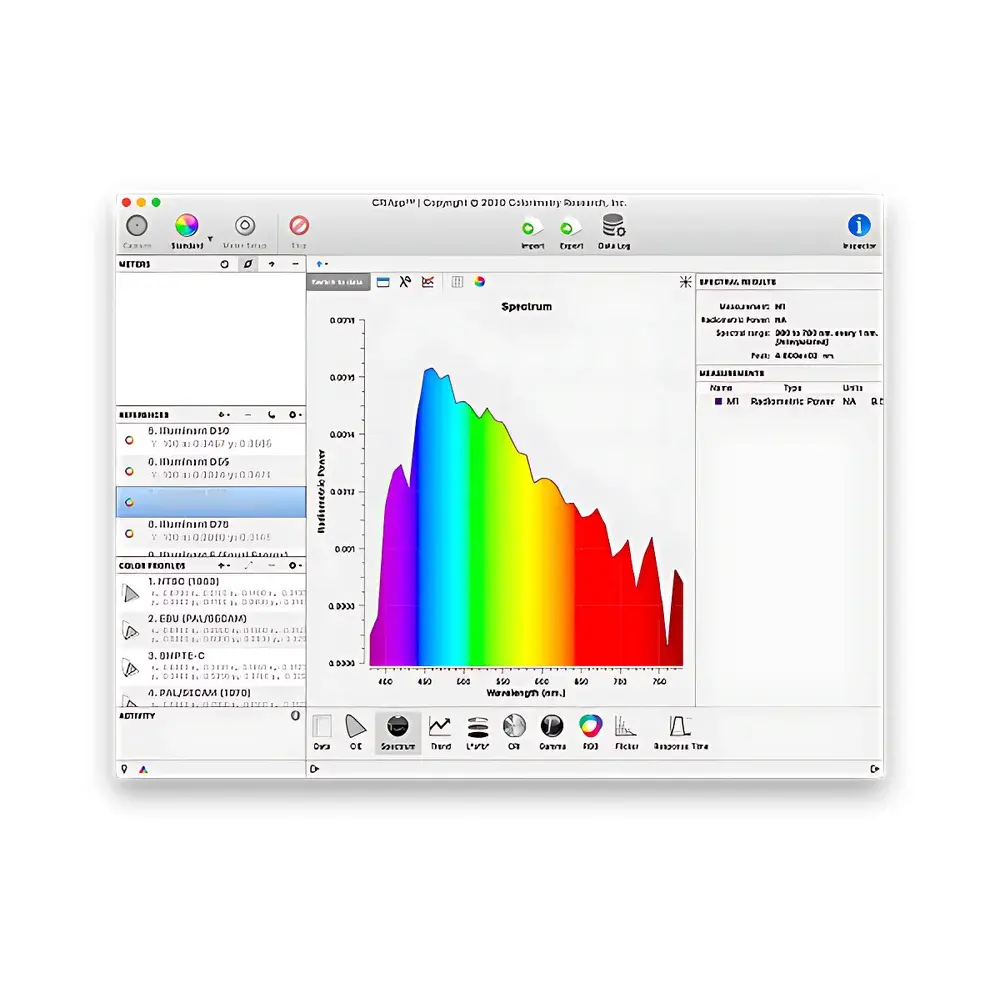
The CR 250 operates natively with Colorimetry Research’s CR-Suite software (Windows 10/11), which provides real-time spectral visualization, batch measurement scripting, and export of calibrated spectral data in industry-standard formats (CSV, XML, CIE 15:2018-compliant .cie). The software implements audit-trail logging per FDA 21 CFR Part 11 requirements, including user authentication, electronic signatures, and immutable record retention for regulated environments. Raw 16-bit spectral frames are stored losslessly, enabling post-acquisition reprocessing with updated CIE observer functions or custom weighting curves. API support (C++, Python, LabVIEW) allows integration into automated test sequences governed by ASTM E308-22 or ISO 13406-2 workflows.
Applications
- Display manufacturing: Pixel-level luminance uniformity mapping, white point drift tracking over burn-in cycles, and HDR tone-mapping verification per SMPTE ST 2084.
- LED product development: Binning by CCT and CRI Ra, thermal derating analysis, and phosphor degradation monitoring via spectral shift detection.
- Outdoor lighting certification: Roadway luminance profiling per CIE 115:2010, glare evaluation using UGR calculations, and mesopic photometry extension via CIE 205:2013 models.
- Automotive HUD and instrument cluster validation: High-contrast luminance ratio (Lmax/Lmin) measurement under variable ambient illumination, and chromaticity shift quantification across viewing angles.
- Materials science: Bidirectional reflectance distribution function (BRDF) sampling at discrete angles using manual goniometric positioning, and optical density validation of neutral density filters per ISO 9050.
FAQ
What spectral calibration standards are used for the CR 250?
Each unit undergoes wavelength and radiometric calibration using NIST-traceable tungsten-halogen and deuterium lamps, with spectral responsivity verified against a primary standard spectroradiometer accredited to ISO/IEC 17025.
Can the CR 250 measure pulsed or modulated light sources?
Yes — its programmable exposure time (0.02–30 s) and external TTL trigger input enable synchronous capture of PWM-driven LEDs, OLEDs, and automotive adaptive driving beams at frequencies up to 10 kHz.
Is the viewfinder parallax-corrected for close-range measurements?
The VO-201 viewfinder incorporates dual-axis mechanical adjustment and is factory-aligned to the optical axis at 500 mm; parallax error remains below 0.05° within the 200 mm–1 m focus range.
Does the CR 250 support automatic aperture switching?
No — aperture selection is fixed per unit configuration at time of order to maintain optical throughput consistency and minimize stray light; users requiring multiple FOVs must select separate instruments or use calibrated neutral density filters.
How is polarization sensitivity mitigated in the optical path?
The CR 250 employs a depolarizing diffuser upstream of the grating and achromatic lens elements with <0.5% polarization-dependent responsivity across the visible band, validated per CIE 145:2001 Annex E.





