
SpectraVal 1511 Touchscreen Spectroradiometer
| Origin | Germany |
|---|---|
| Manufacturer Type | Authorized Distributor |
| Origin Category | Imported |
| Model | SpectraVal 1511 |
| Price Range | USD 6,800 – 13,600 (FOB Hamburg) |
| Wavelength Range | 380–780 nm (NIR variant: up to 1000 nm) |
| Optical Bandwidth (FWHM) | 4.5 nm (HiRes variant: 2.0 nm) |
| Spectral Resolution | 1 nm |
| Field of View | 1.8° (6 mm diameter at 20 cm |
| Luminance Range | 0.2–180,000 cd/m² (Illuminant A), 0.2–140,000 cd/m² (typical white LED) |
| Luminance Accuracy | ±3% (@ 100 cd/m², Illuminant A) |
| Luminance Repeatability | ±1% |
| Chromaticity Accuracy | ±0.002 in CIE 1931 xy (Illuminant A) |
| Chromaticity Repeatability | ±0.0005 in CIE 1931 xy (Illuminant A) |
| CCT Repeatability | ±20 K (Illuminant A) |
| Wavelength Accuracy | ±0.5 nm |
| Operating Temperature | 10–40 °C |
| Relative Humidity | <85% RH at 35 °C |
| Dimensions | 140 × 80 × 70 mm |
| Weight | 400 g |
| Power Supply | USB 5 V or internal rechargeable Li-ion battery |
| Interface | Bluetooth 5.0 + USB-C + optional LAN (SpectraVal 1511-LAN variant) |
| Shutter Type | Piezoelectric fast shutter for dark current compensation |
| Targeting Aid | Integrated Class 1 laser pointer |
| Software Support | DLL libraries & SCPI-compliant serial command set |
Overview
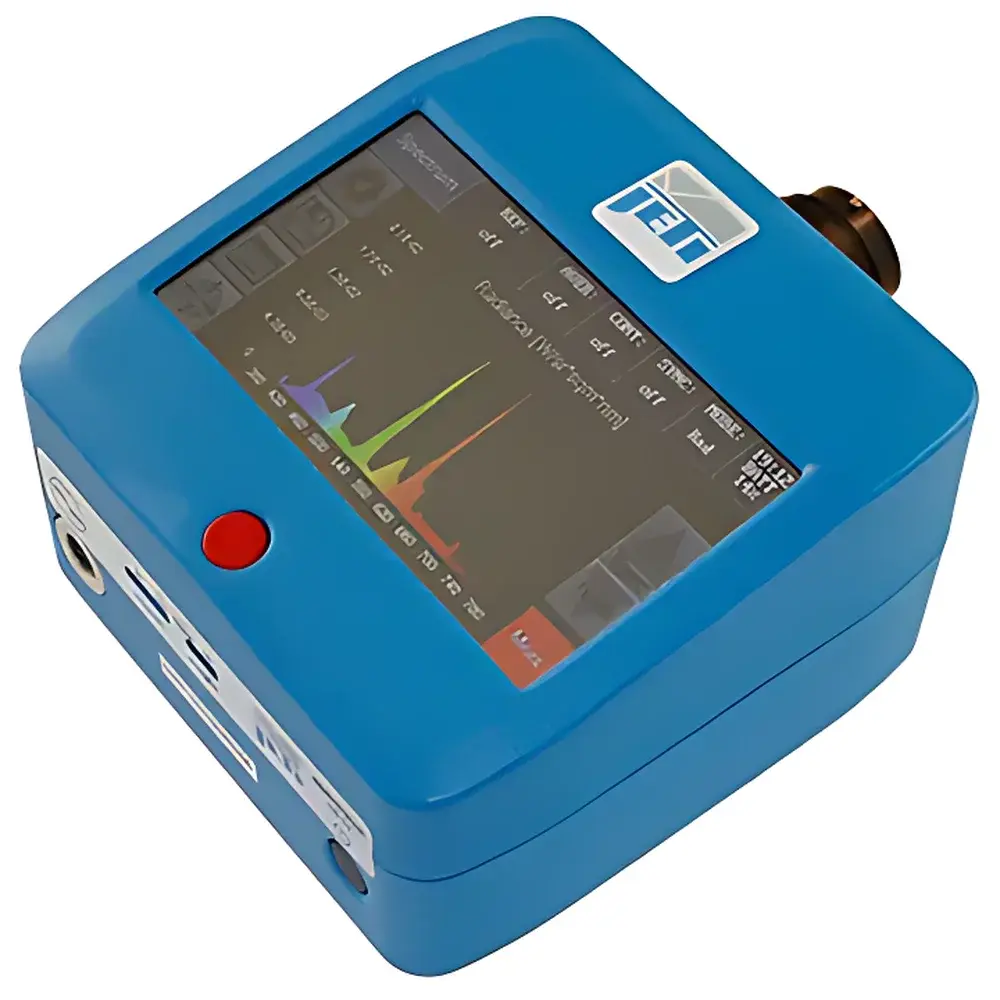
The SpectraVal 1511 Touchscreen Spectroradiometer is a precision-engineered, portable instrument designed for traceable spectral radiance and luminance measurement across the visible spectrum (380–780 nm), with optional NIR extension to 1000 nm. Based on grating-based Czerny–Turner optical architecture and thermally stabilized CCD detection, it delivers calibrated spectral data compliant with CIE S 026/E:2015, IEC 62471, and ISO/CIE 19476:2014 standards. Unlike filter-based colorimeters, the SpectraVal 1511 captures full spectral power distribution (SPD) — enabling post-acquisition calculation of photometric, radiometric, colorimetric, and circadian metrics without hardware reconfiguration. Its integrated 5-inch capacitive touchscreen enables real-time spectral visualization, live chromaticity plotting (CIE 1931 xy, u’v’), and immediate computation of correlated color temperature (CCT), dominant wavelength, purity, CRI (Ra, R1–R15), CQS, TM-30 (Rf, Rg), PAR (400–700 nm), and melanopic EDI (α-opic irradiance). The device is calibrated against NIST-traceable standards at the manufacturer’s DIN EN ISO/IEC 17025 accredited laboratory in Germany.
Key Features
- High-fidelity spectral acquisition with 1 nm data interval and ±0.5 nm wavelength accuracy, ensuring metrological integrity for display calibration and lighting validation
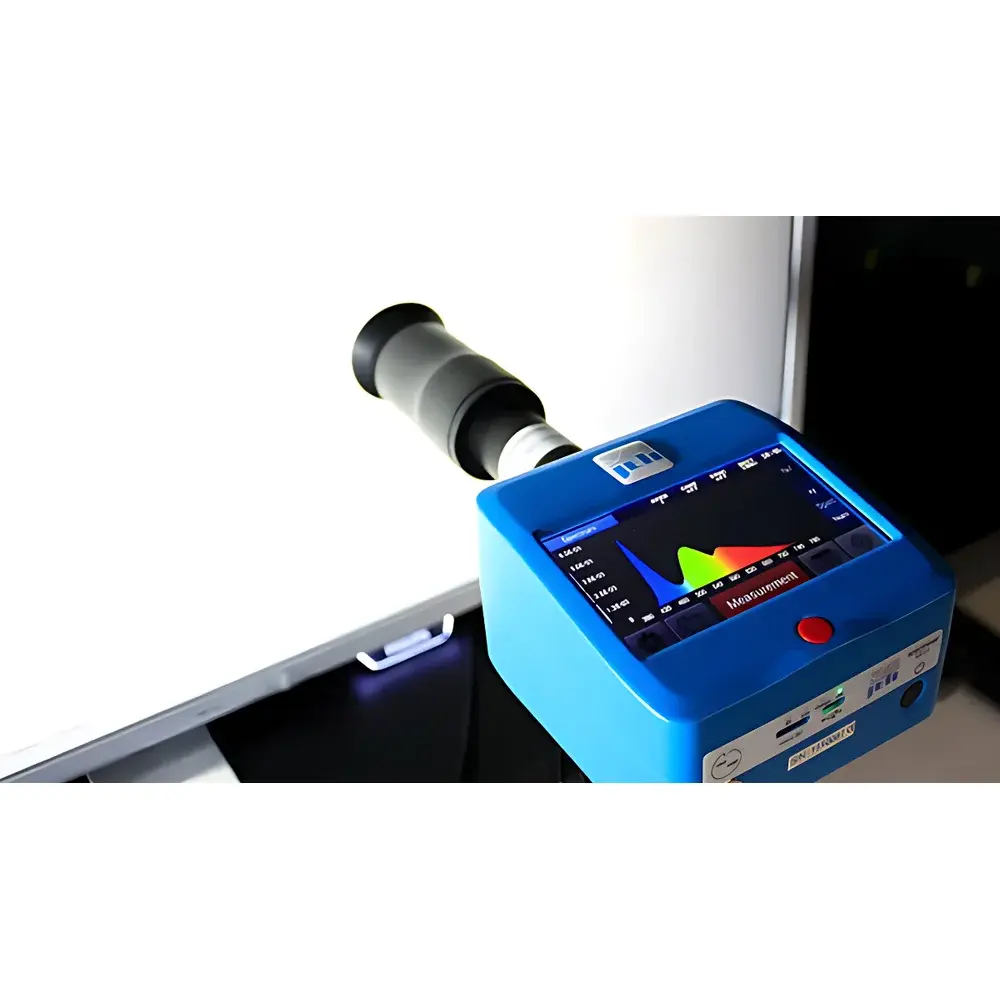
- Integrated Class 1 laser targeting system for precise spatial registration — critical for small-area measurements on OLED microdisplays, AR/VR waveguides, and automotive HUDs
- Piezoelectric shutter eliminates thermal drift and enables automatic dark-signal subtraction, improving low-light repeatability (<0.0005 Δxy)
- Dual-mode operation: USB-powered for lab integration or battery-operated (up to 4.5 h continuous use) for field deployment in production line audits or site-based lighting assessments
- Robust mechanical design (IP52-rated enclosure) with aluminum-magnesium alloy housing, optimized for thermal stability across 10–40 °C ambient conditions
- Bluetooth 5.0 + USB-C + optional Gigabit Ethernet interface supports seamless integration into automated test benches and Industry 4.0 MES environments
Sample Compatibility & Compliance
The SpectraVal 1511 accommodates emissive sources ranging from ultra-low-brightness OLED pixels (≥0.2 cd/m²) to high-dynamic-range (HDR) displays and projection systems (up to 140,000 cd/m²). Its 1.8° field of view corresponds to a 6 mm measurement spot at 20 cm — suitable for pixel-level verification on smartphones and tablets. The instrument complies with international regulatory and quality frameworks including IEC 61000-6-3 (EMC), IEC 61000-6-1 (immunity), and RoHS 2011/65/EU. Firmware and calibration records support GLP/GMP audit trails; raw spectral data export (ASCII .csv, .spc) ensures full traceability for FDA 21 CFR Part 11–compliant workflows when used with validated software environments.
Software & Data Management
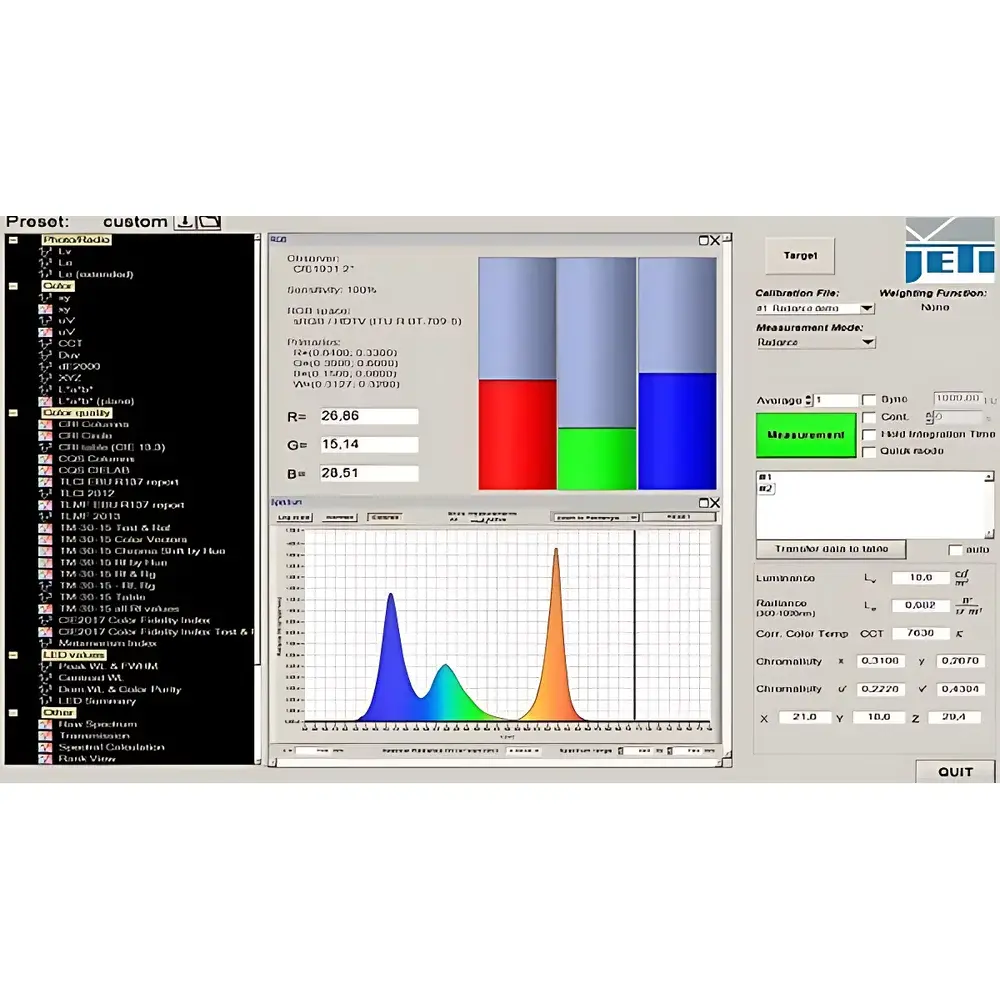
Bundled SpectraVal Control Suite v4.x provides real-time instrument control, spectral visualization, and standardized report generation (PDF, Excel). The SDK includes Windows/Linux/macOS-compatible dynamic link libraries (DLLs) and a complete SCPI command set — enabling direct integration with LabVIEW, Python (PyVISA), MATLAB, and custom C++/C# applications. All spectral datasets embed EXIF-style metadata: timestamp, integration time, calibration ID, ambient temperature, and user-defined sample tags. Data archiving supports hierarchical folder structures synchronized with network drives or cloud storage via WebDAV. Optional SpectraVal Cloud Analytics module enables multi-site comparative analysis, trend monitoring, and statistical process control (SPC) charting aligned with ISO 22000 and IATF 16949 requirements.
Applications
- Display manufacturing: OLED, LCD, MicroLED, and Mini-LED panel characterization — including uniformity mapping, gamut verification (DCI-P3, Rec.2020), and temporal flicker analysis (via external trigger sync)
- Lighting R&D and QA: LED module binning, phosphor consistency evaluation, and TM-30–based spectral quality assessment for horticultural, medical, and human-centric lighting
- Automotive electronics: Instrument cluster, head-up display (HUD), and ambient lighting validation per UNECE R149 and SAE J1711
- Academic and metrology labs: Teaching spectroradiometry principles, validating reference lamps, and supporting inter-laboratory comparison studies under CCQM frameworks
- Regulatory testing: Photobiological safety (IEC 62471), blue light hazard (IEC TR 62778), and energy labeling compliance (EU 2019/2015)
FAQ
Is the SpectraVal 1511 calibrated before shipment?
Yes — each unit undergoes full spectral calibration at the manufacturer’s ISO/IEC 17025-accredited facility in Germany, with certificate of calibration (including uncertainty budget) provided digitally and physically.
Can it measure pulsed or modulated light sources?
Yes — with external TTL trigger input and adjustable integration time (1 ms to 10 s), it supports accurate measurement of PWM-driven LEDs and scanning laser displays.
What is the recalibration interval recommendation?
Annual recalibration is recommended for ISO/IEC 17025 traceability; however, built-in self-check routines (dark scan, reference lamp validation) allow daily verification of stability.
Does it support third-party software like LightTools or ASAP?
Yes — via ASCII spectral export (.csv) and programmable SCPI interface, enabling bidirectional data exchange with optical simulation platforms for source modeling and system-level analysis.
How is traceability maintained across firmware updates?
Each firmware version is validated against primary standards; calibration coefficients are digitally signed and stored in tamper-evident memory, preserving metrological continuity per ILAC P10:2022 guidelines.






