
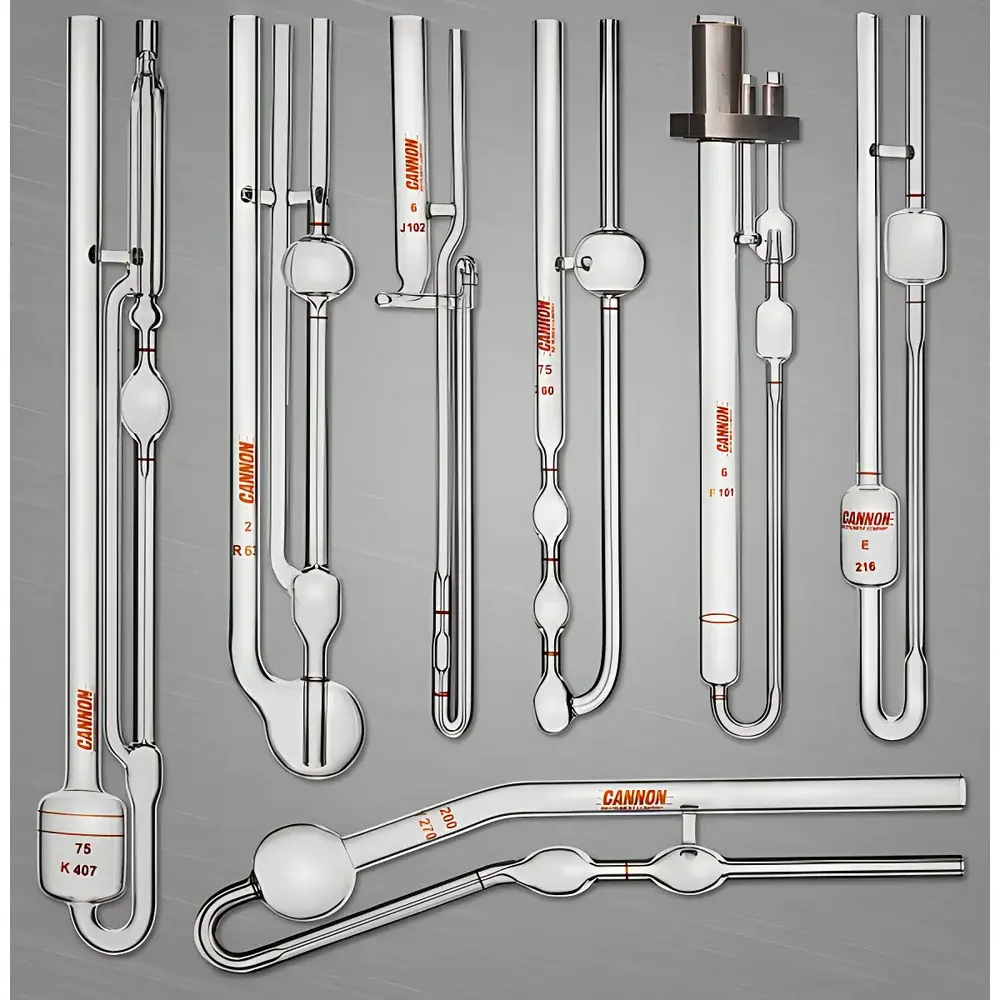
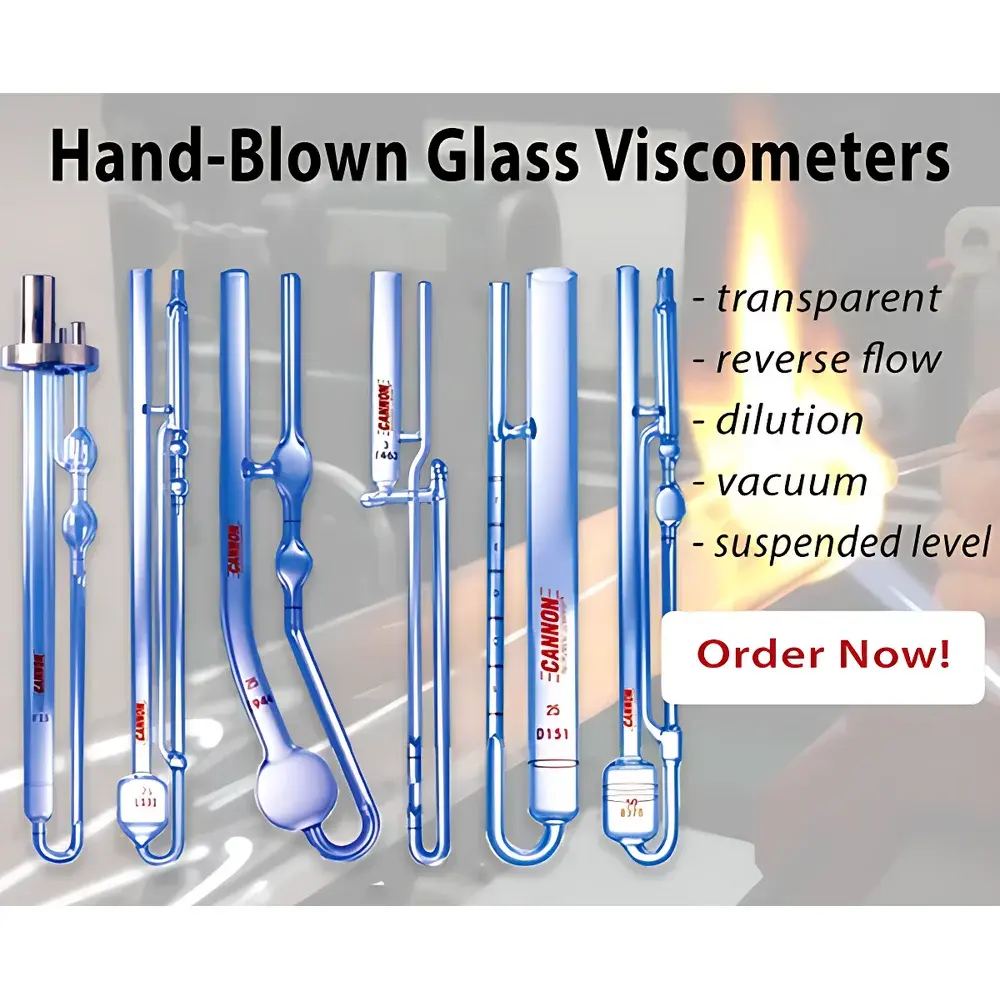
Cannon Modified Koppers Reversed-Flow Vacuum Viscometer Model 9724-W
| Brand | Cannon |
|---|---|
| Origin | USA |
| Manufacturer Type | Authorized Distributor |
| Product Origin | Imported |
| Model | 9724-W |
| Instrument Type | Capillary Viscometer |
| Viscosity Range | 42–200,000 poise |
| Calibration Standard | ASTM D2171 |
| Operating Temperature | 60 °C (140 °F) |
| Minimum Sample Volume | 2 mL |
| Required Bath Depth | 178 mm (7 in) |
| Vacuum Requirement | 300 mmHg (mercury column) |
| Capillary Configuration | Two-piece (sample reservoir + calibrated capillary) |
| Calibration Certificate | Included |
| Holder | Optional (Cat. No. 9726-N30) |
Overview
The Cannon Modified Koppers Reversed-Flow Vacuum Viscometer Model 9724-W is a precision-engineered capillary viscometer designed specifically for the standardized determination of kinematic viscosity of asphalt binders and other highly viscous bituminous materials at 60 °C (140 °F). It operates on the principle of reversed-flow capillary viscometry under controlled vacuum, as defined in ASTM D2171 – Standard Test Method for Viscosity of Asphalts by Vacuum Capillary Viscometer. Unlike conventional gravity-driven capillary instruments, this design employs a vacuum differential to draw the sample upward through a calibrated capillary tube, enabling accurate measurement of high-viscosity fluids that would otherwise fail to flow under gravity alone. The instrument’s two-piece architecture—comprising a separate sample reservoir and a precisely dimensioned capillary section—ensures consistent meniscus control, minimizes thermal convection artifacts, and supports repeatable timing across multiple runs. Its compliance with ASTM D2171 makes it suitable for use in asphalt specification testing, pavement material quality assurance, and regulatory submissions requiring traceable, standards-based rheological data.
Key Features
- ASTM D2171-compliant reversed-flow vacuum capillary configuration for high-viscosity asphalt testing at 60 °C
- Multiple calibrated capillary variants (Bulbs B–D) covering a broad dynamic range from 42 to 200,000 poise
- Two-piece modular design: detachable sample reservoir and interchangeable calibrated capillary tubes
- Requires precise vacuum application of 300 mmHg at the capillary top using mercury or certified vacuum source
- Minimal sample requirement of only 2 mL—critical for limited or expensive asphalt binder samples
- Validated calibration certificate traceable to NIST standards, including expanded uncertainty reporting per ISO/IEC 17025 guidelines
- Designed for immersion in thermostatically controlled liquid baths with minimum depth of 178 mm (7 in) to ensure uniform temperature distribution along the capillary
Sample Compatibility & Compliance
This viscometer is optimized for homogeneous, non-volatile, thermally stable bituminous materials—including paving-grade asphalts, polymer-modified binders (PMBs), and oxidized bitumens—within the specified viscosity range. It is not intended for volatile solvents, emulsions, or particulate-laden suspensions. All models comply with the dimensional, procedural, and reporting requirements of ASTM D2171, including capillary constant verification, timing methodology, temperature tolerance (±0.1 °C), and vacuum stability criteria. The instrument supports GLP-aligned laboratory workflows: calibration certificates include serial-numbered traceability, date of certification, environmental conditions during calibration, and statement of measurement uncertainty. For regulated environments subject to FDA 21 CFR Part 11 or ISO 17025 accreditation, documentation and calibration records meet audit-ready requirements when maintained with associated SOPs and equipment logs.
Software & Data Management
The Model 9724-W is a manual, analog viscometer and does not incorporate embedded electronics or digital interfaces. Viscosity calculation follows the standard equation: η = C × t, where η is dynamic viscosity in poise, C is the instrument-specific capillary constant (provided in poise/sec at 300 mmHg), and t is the efflux time in seconds measured via stopwatch. Users are expected to record timing data manually and apply corrections for temperature deviation (if operating outside nominal 60 °C) using ASTM D2171 Annex A1. While no proprietary software is bundled, laboratories commonly integrate results into LIMS platforms or Excel-based QA/QC templates aligned with ASTM reporting formats. Calibration constants for each bulb type (B–D) are supplied in tabular form and cross-referenced to catalog numbers for unambiguous selection and audit trail integrity.
Applications
- Quality control testing of asphalt binders per AASHTO M226 and ASTM D2171 specifications
- Viscosity grading of Performance Graded (PG) asphalt binders during production and acceptance testing
- Research and development of modified asphalt formulations, including SBS- and crumb rubber–modified systems
- Comparative viscosity analysis across aging conditions (e.g., RTFO and PAV residue testing)
- Supporting pavement design inputs for mechanistic-empirical (MEPDG) modeling frameworks
- Third-party verification and interlaboratory round-robin studies requiring standardized high-viscosity measurement
FAQ
What vacuum source is required for operation?
A stable, calibrated vacuum source delivering exactly 300 mmHg (±1 mmHg) at the capillary inlet is mandatory. Mercury manometers remain the reference standard; certified digital vacuum regulators with NIST-traceable calibration are acceptable alternatives.
Is a bath thermostat included with the instrument?
No. The 9724-W requires integration with an external thermostatic liquid bath capable of maintaining 60 °C ±0.1 °C over a minimum depth of 178 mm. Circulating oil baths with PID control and platinum resistance thermometers (PRTs) are recommended.
Can the same capillary be used for different viscosity ranges?
No. Each capillary (Bulb B, C, or D) is uniquely calibrated for a specific viscosity subrange. Selection must be based on anticipated efflux time (ideally 200–600 seconds per ASTM D2171) to minimize timing error contribution.
What is the purpose of the optional holder (Cat. No. 9726-N30)?
The holder provides vertical alignment, immersion depth control, and mechanical stability during bath insertion. It ensures consistent positioning relative to the bath’s temperature gradient and prevents capillary contact with bath walls or heater elements.
Does the calibration certificate satisfy ISO/IEC 17025 requirements?
Yes—the certificate includes measurement uncertainty, traceability statement to NIST, environmental conditions, and technician signature. Full compliance requires the end-user to maintain associated records (e.g., bath calibration, vacuum gauge verification) per their accredited scope.



