
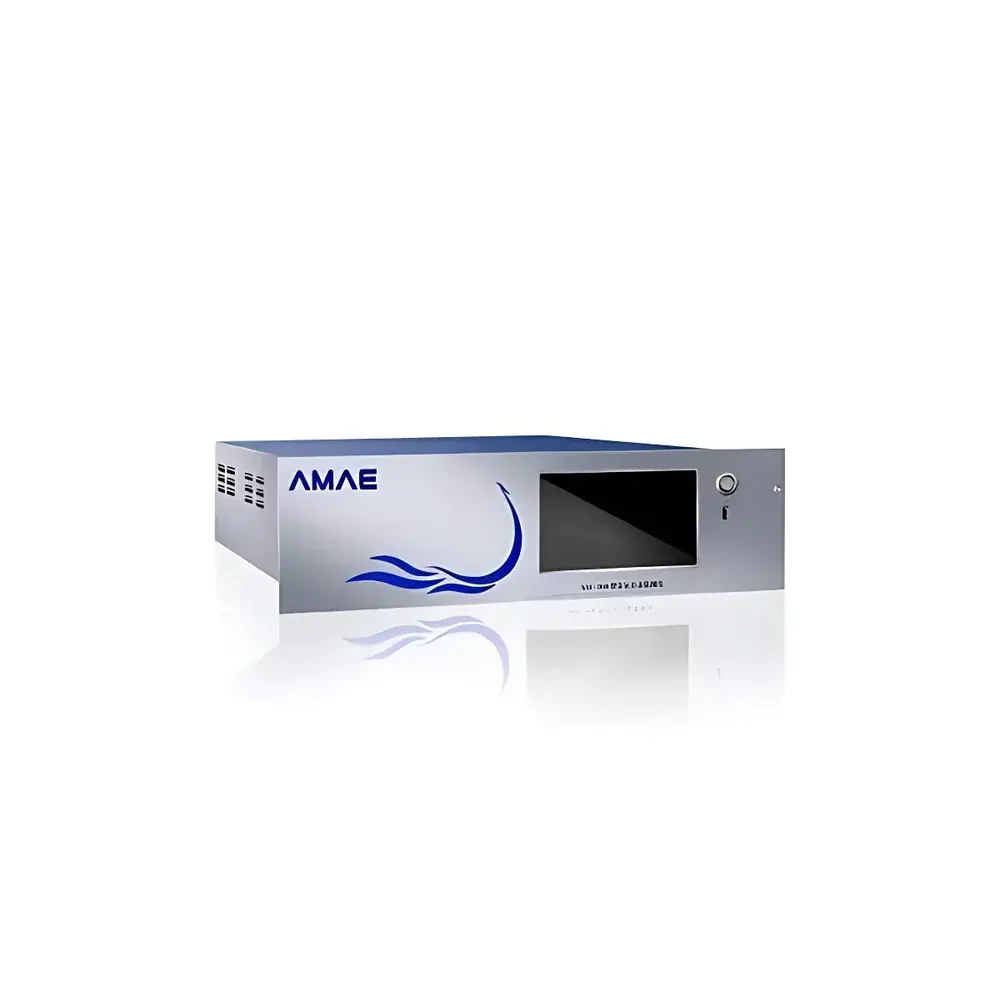
AM-1046 NOx Automatic Analyzer by Guoji Instruments (AMAE)
| Brand | Guoji Instruments (AMAE) |
|---|---|
| Origin | Jiangsu, China |
| Manufacturer Type | Authorized Distributor |
| Country of Origin | China |
| Model | AM-1046 |
| Pricing | Upon Request |
| Measurement Principle | Alternating Flow Modulation Low-Pressure Chemiluminescence Detection (CLD) |
| Measurands | NO, NO₂, NOₓ |
| Range | 0–0.1 / 0.2 / 0.5 / 1.0 ppm (field-expandable) |
| LOD | 0.1 ppb (2σ, ≤0.2 ppm range) or 0.1% F.S. (2σ, >0.2 ppm range) |
| Accuracy | ±0.1% F.S. |
| Linearity | ±1.0% F.S. |
| Zero Drift | ±0.5 ppb/day or ±1.0% F.S./day |
| Span Drift | ±1.0% F.S./day |
| Response Time (T₉₀) | ≤80 s |
| Sample Flow Rate | ~0.8 L/min |
| Dimensions (L×W×H) | 483 mm × 545 mm × 133 mm |
Overview
The AM-1046 NOx Automatic Analyzer is a high-stability, low-maintenance chemiluminescence-based gas analyzer engineered for continuous, trace-level quantification of nitrogen monoxide (NO), nitrogen dioxide (NO₂), and total reactive nitrogen oxides (NOₓ) in ambient air and industrial exhaust streams. It employs alternating flow modulation low-pressure chemiluminescence detection (CLD), a well-established optical method standardized under ISO 7935, ASTM D5504, and EN 14211. In this technique, sampled NO reacts with ozone (O₃) in a reaction chamber to form electronically excited NO₂*, which emits photons upon relaxation to the ground state within the 600–1200 nm spectral window. A photomultiplier tube (PMT) detects this chemiluminescent signal, and concentration is derived via calibrated photonic response using the Beer–Lambert relationship—ensuring linear, stoichiometric quantification without spectral interference from common atmospheric constituents. The analyzer operates at reduced pressure (~1–5 kPa) to enhance signal-to-noise ratio and minimize quenching effects, enabling sub-part-per-trillion (ppt) equivalent sensitivity in optimized configurations.
Key Features
- Optically stabilized CLD measurement module with thermally regulated PMT and precision O₃ generator—designed for long-term signal reproducibility and minimal baseline drift.
- Integrated embedded web server supporting HTTP/HTTPS access over Ethernet or Wi-Fi—enabling remote configuration, real-time diagnostics, firmware updates, and secure data retrieval without proprietary software.
- Dynamic on-screen visualization including live process flow diagrams, calibration curve overlays, and time-series concentration plots with configurable averaging windows (1-min to 1-hr).
- Intelligent self-diagnostic engine that monitors critical subsystems (ozone generation efficiency, reaction chamber vacuum integrity, PMT gain stability, sample flow consistency) and provides step-by-step maintenance guidance—including consumables replacement prompts with part numbers and shelf-life tracking.
- Programmable automated calibration sequence compliant with EPA Method 7E and ISO 13964 requirements—supporting zero/span checks at user-defined intervals (e.g., every 1, 4, or 24 hours) using certified gas standards or internal permeation sources.
- Rugged 19-inch rack-mount chassis (483 mm × 545 mm × 133 mm) with EMI-shielded enclosure, conformal-coated PCBs, and wide-temperature operation (5–40 °C ambient) suitable for unattended deployment in field shelters, mobile labs, and CEMS enclosures.
Sample Compatibility & Compliance
The AM-1046 accepts conditioned sample gas streams from standard ambient air samplers, dilution probes (per EPA PS-11), or heated extractive systems for stack monitoring. It complies with key regulatory frameworks governing air quality instrumentation, including ISO/IEC 17025:2017 (for laboratory use), EU Directive 2008/50/EC Annex III (ambient NO₂ reference method equivalence), and Chinese HJ 654-2013 (equivalent performance criteria for NOx analyzers). Its design supports GLP-compliant audit trails when integrated with external data acquisition systems logging operator actions, calibration events, and system faults per FDA 21 CFR Part 11 requirements. All analog and digital I/O interfaces (4–20 mA, RS-232/485, Modbus TCP) are galvanically isolated and meet IEC 61000-4 immunity standards.
Software & Data Management
The onboard Linux-based firmware implements a RESTful API and supports CSV/JSON export via scheduled FTP/SFTP push or manual download. Local storage retains ≥30 days of second-resolution data (concentration, temperature, pressure, flow, diagnostic flags) with cyclic overwrite protection. Optional cloud integration enables TLS-encrypted telemetry to third-party platforms (e.g., ThingSpeak, AWS IoT Core) for centralized dashboarding and anomaly detection. Audit logs record all configuration changes, calibration activities, and user logins with timestamps and IP addresses—fully traceable for regulatory review. Firmware updates include cryptographic signature verification to ensure integrity and authenticity.
Applications
- Ambient air quality monitoring networks (urban, rural, background stations) meeting national AQI reporting requirements.
- CEMS compliance monitoring for thermal power plants, cement kilns, and waste incinerators—configured for extractive hot/wet or dilution sampling per EN 15267.
- Mobile monitoring platforms (vans, drones with payload integration) for spatial mapping of NOₓ plumes near transportation corridors or industrial perimeters.
- Research-grade emission characterization in environmental chambers, combustion test rigs, and catalytic converter development labs.
- Industrial hygiene assessments in chemical manufacturing facilities where NOₓ exposure limits (OSHA PEL: 25 ppm; ACGIH TLV: 1 ppm) require real-time verification.
FAQ
What NOₓ species does the AM-1046 measure independently?
It measures NO directly via CLD, and NO₂ indirectly after catalytic conversion (using a molybdenum or stainless-steel converter) to NO; NOₓ is calculated as the sum.
Is ozone generation internal or external?
Ozone is generated internally via a UV lamp-based ozone generator with real-time UV intensity monitoring and automatic output compensation.
Can the instrument operate unattended for extended periods?
Yes—its auto-calibration capability, fault-tolerant architecture, and 30-day local data retention support fully autonomous operation in remote locations when paired with UPS and cellular backup.
Does it support dual-range or auto-ranging functionality?
Yes—users may configure up to four programmable ranges (0–0.1, 0–0.2, 0–0.5, 0–1.0 ppm); range switching is software-controlled and includes automatic zero/span validation.
What maintenance intervals are recommended for routine operation?
Ozone generator lamp replacement every 12 months; PMT gain verification quarterly; reaction chamber cleaning semiannually; and annual full system performance verification against NIST-traceable standards.







