
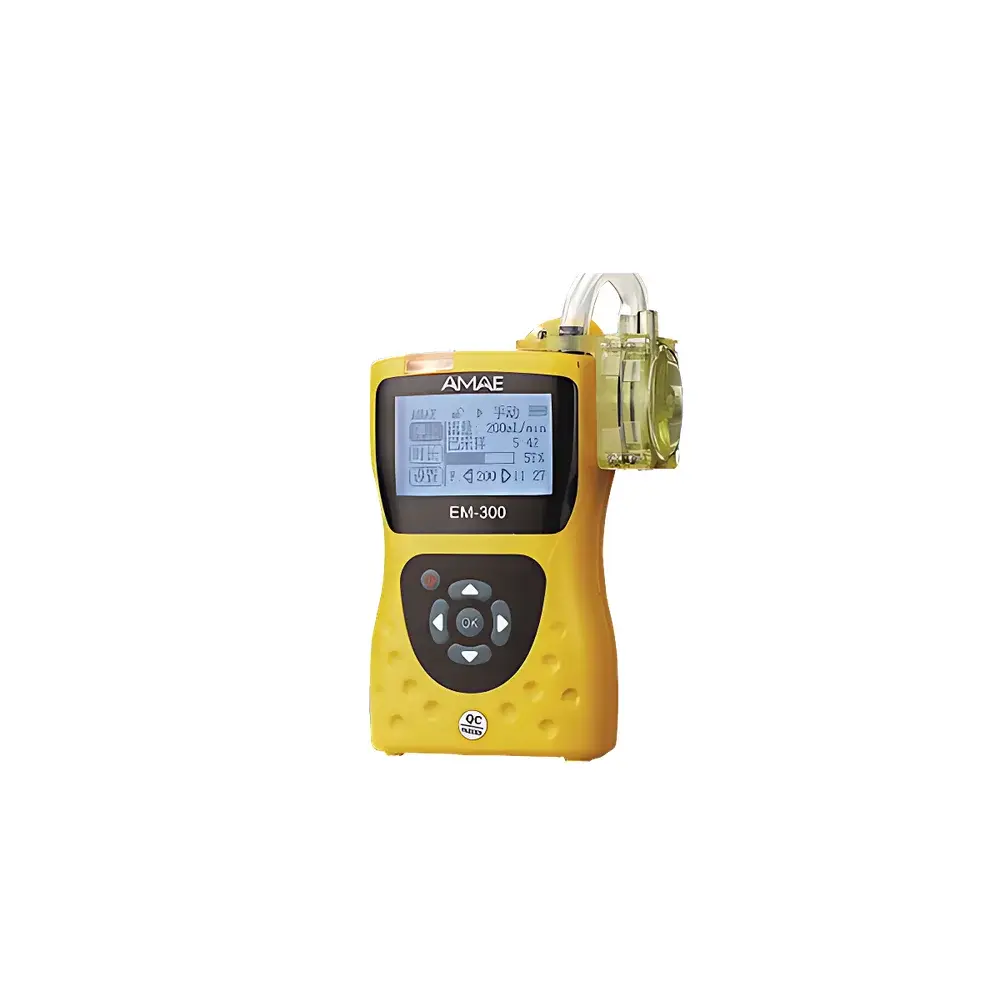
AMAE EM-300 Low-Flow Personal Air Sampler
| Brand | AMAE |
|---|---|
| Origin | Guangdong, China |
| Model | EM-300 |
| Sampling Configuration | Single-Channel |
| Flow Range | 10–200 mL/min |
| Maximum Vacuum Pressure | >4.5 kPa |
| Flow Stability | <3% RSD |
| Flowmeter Accuracy | ±5% FS |
| Service Life at Max Load | >5,000 h |
| Continuous Operation | 40 h at 200 mL/min against 10 kPa backpressure |
| Compliance | Q/AMAE-2019, HJ 583–2010, JJG 956–2013, GB/T 17061–1997 |
Overview
The AMAE EM-300 Low-Flow Personal Air Sampler is an engineered solution for occupational hygiene monitoring, designed to meet stringent requirements for time-weighted average (TWA) exposure assessment of airborne contaminants—including volatile organic compounds (VOCs), acid gases (e.g., hydrogen chloride), and other low-concentration hazardous agents—in workplace environments. Operating on a closed-loop proportional control principle, the EM-300 maintains true constant flow across variable sampling resistances—such as those imposed by sorbent tubes, filters, or diffusion denuders—without reliance on manual adjustment or external regulators. Its core architecture integrates a high-efficiency, brushless micro-diaphragm pump with a precision thermal mass flow sensor, enabling stable operation from 10 mL/min up to 200 mL/min. This range supports both ultra-low-flow (ULF) sampling per ISO 16000-6 and standard NIOSH/OSHA methods requiring extended-duration collection (e.g., 8-hour TWA or 12-hour shift monitoring). The device complies with national metrological verification protocols (JJG 956–2013) and Chinese occupational air sampling standards (GB/T 17061–1997), ensuring traceable, auditable performance in GLP-compliant industrial hygiene laboratories.
Key Features
- True constant-flow control: Real-time feedback loop compensates for battery voltage decay and filter loading, maintaining flow stability <3% RSD across full operating range.
- Extended runtime capability: Delivers 40 hours of continuous operation at 200 mL/min against 10 kPa system resistance—validated under worst-case load conditions per Q/AMAE-2019.
- User-accessible flow calibration: Embedded thermal mass flowmeter supports field recalibration using certified reference flow standards; no proprietary tools or service visits required.
- Intelligent sampling logic: Programmable timer, real-time elapsed time tracking, remaining battery estimation, and auto-shutdown prevent over-sampling or data loss.
- Triple-mode sampling protocol: Supports time-based, volume-based, and interval-triggered sampling—enabling direct calculation of PC-TWA without post-hoc integration.
- Patented particulate protection system: Integrated hydrophobic PTFE pre-filter prevents pump contamination during HCl, SO₂, or aerosol co-sampling; compatible with impingers and multi-bed sorbent tubes.
Sample Compatibility & Compliance
The EM-300 is validated for use with common passive and active sampling media including Tenax TA, Carbopack™ series, silica gel, XAD-2, and quartz fiber filters. It meets mechanical and metrological requirements outlined in HJ 583–2010 for benzene-series analysis via thermal desorption–GC, and satisfies flow accuracy tolerances specified in JJG 956–2013 (±5% FS at 20 mL/min, ±1.0 mL/min absolute error). For regulatory reporting, the instrument’s flow stability and calibration traceability support adherence to OSHA ID-254, NIOSH 1501/1600 series, and EU Directive 2004/108/EC electromagnetic compatibility requirements. All firmware logs include timestamped flow records, supporting audit readiness under ISO/IEC 17025 and China’s CNAS-CL01 accreditation framework.
Software & Data Management
The EM-300 operates autonomously without host software but supports optional USB-C data download via AMAE LogView v2.1—a Windows-based utility that exports CSV-formatted logs containing start/stop timestamps, cumulative volume, average flow rate, battery voltage history, and error flags (e.g., pressure fault, low-flow timeout). Each log entry includes a unique instrument serial number and firmware revision, satisfying FDA 21 CFR Part 11 requirements for electronic record integrity when used in regulated occupational health programs. Calibration events are digitally signed and appended to the log file, providing full chain-of-custody documentation for QA/QC review.
Applications
- Occupational exposure assessment for VOCs (e.g., benzene, toluene, xylene) in petrochemical, pharmaceutical, and printing facilities.
- Long-term monitoring of acid gases (HCl, HF) in semiconductor fabrication cleanrooms and metal plating operations.
- Personal sampling for respirable crystalline silica (RCS) when paired with cyclone inlets and PVC filters.
- Indoor air quality (IAQ) surveys in office buildings and schools, particularly where low-concentration formaldehyde or terpenes require 24–48 h integrated sampling.
- Method validation studies requiring repeatable sub-50 mL/min flow delivery across diverse sorbent bed configurations.
FAQ
Does the EM-300 support multi-point calibration across its full flow range?
Yes—the built-in thermal mass flow sensor allows user-initiated two-point calibration (e.g., at 20 mL/min and 150 mL/min) using NIST-traceable primary standards.
Can it be used with conductive tubing for static-sensitive sampling environments?
Yes—its low-power electronics and grounded chassis design minimize electrostatic discharge risk; recommended tubing materials include conductive Tygon® R-3603 or stainless steel.
Is the flowmeter accuracy verified independently per batch?
Each production lot undergoes factory calibration against a gravimetric flow standard; calibration certificates are supplied with every unit.
What maintenance intervals are recommended for sustained metrological reliability?
Pump diaphragms and inlet filters should be inspected every 500 operating hours; full metrological verification is advised annually or after 2,000 h of cumulative use.
How does the EM-300 handle sudden increases in system backpressure during sampling?
The closed-loop controller dynamically adjusts motor duty cycle within 200 ms to maintain setpoint flow; pressure fault alarms activate only if >12 kPa is sustained for >30 s.
Related Products







