
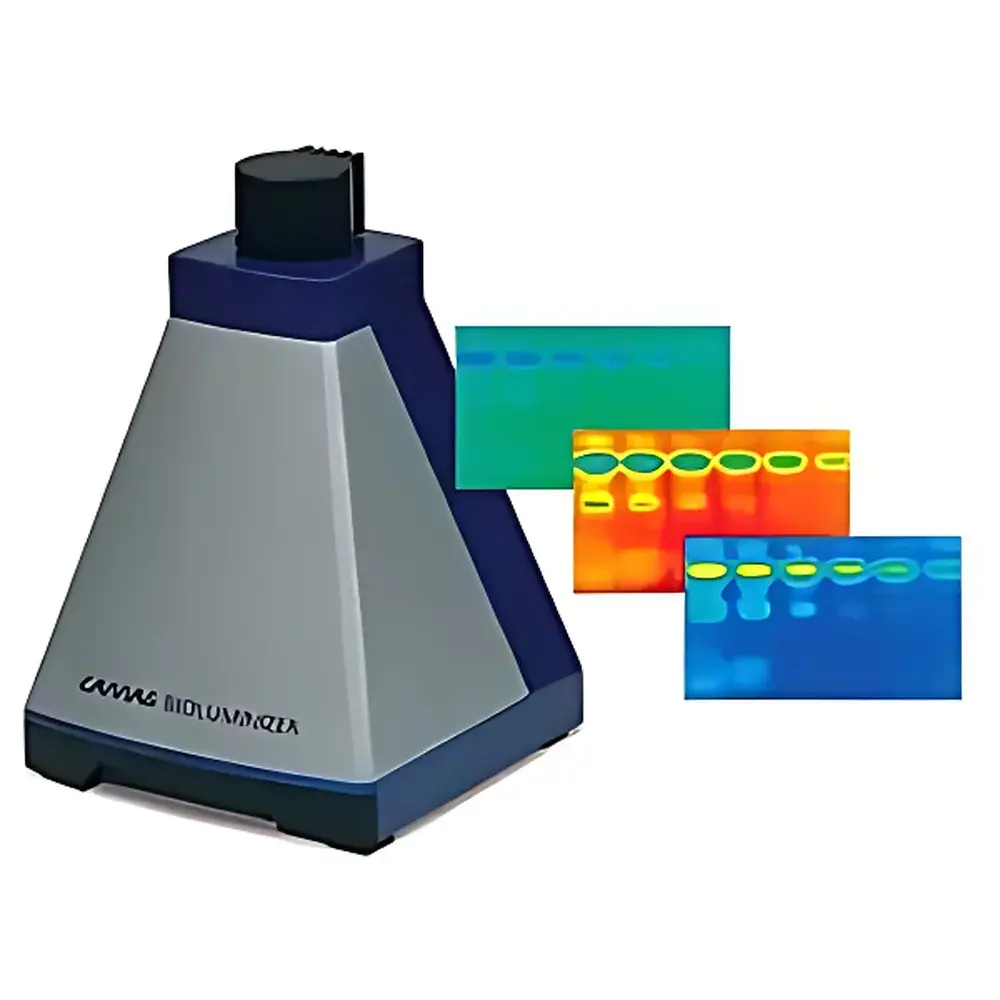
CAMAG BioLuminizer® 2 Bioluminescence Detection System for Thin-Layer Chromatography
| Brand | CAMAG |
|---|---|
| Origin | Switzerland |
| Model | BioLuminizer® 2 |
| Instrument Type | TLC Imaging System |
| Detector Technology | Cooled CCD with 65% Quantum Efficiency |
| Data Depth | 16-bit |
| Pixel Resolution | High Spatial Resolution (Optimized for TLC Plate Detail Capture) |
| Application Focus | Bioluminescent Bioautography Coupled with Planar Chromatography |
Overview
The CAMAG BioLuminizer® 2 is a purpose-built, high-sensitivity bioluminescence detection system engineered specifically for integration with thin-layer chromatography (TLC) workflows. Unlike conventional reflectance or fluorescence scanners, the BioLuminizer® 2 employs a thermoelectrically cooled scientific-grade CCD sensor optimized for low-light quantification—enabling direct, label-free detection of enzymatic or microbial bioluminescent signals generated during bioautographic assays on TLC plates. Its core measurement principle relies on photon capture from transient, low-intensity bioluminescent emissions (typically in the 400–650 nm range), produced when biological probes (e.g., luciferase-expressing bacteria or recombinant enzymes) interact with bioactive compounds separated on the chromatogram. This optical detection modality bridges planar separation science with functional bioactivity profiling—transforming TLC from a purely physicochemical resolution tool into a rapid, spatially resolved activity mapping platform.
Key Features
- Cooled CCD detector with peak quantum efficiency of 65% at ~550 nm—maximizing signal-to-noise ratio for weak, transient bioluminescent emissions.
- 16-bit analog-to-digital conversion enabling linear dynamic range exceeding 65,000 intensity levels—critical for quantitative comparison of zone-specific luminescence intensity across gradients of antimicrobial or enzyme-inhibitory activity.
- High spatial resolution optics calibrated for standard TLC plate formats (e.g., 10 × 10 cm, 20 × 20 cm), preserving morphological fidelity of bioactive bands and enabling precise Rf correlation with biological response.
- Integrated dark chamber with vibration-dampened stage and programmable exposure control (0.1 s to 30 min)—ensuring reproducible acquisition under ambient light–free conditions essential for bioluminescence integrity.
- Hardware synchronization interface compatible with CAMAG’s TLC Visualizer™ and Reprostar™ systems—supporting seamless transition from development to bioautography to digital documentation within a single platform.
Sample Compatibility & Compliance
The BioLuminizer® 2 supports all standard silica gel, reversed-phase (RP-18), and amino-modified TLC plates used in microbiological and enzymatic bioautography protocols. It is routinely deployed in assays employing Bacillus subtilis, Pseudomonas aeruginosa, luciferase-coupled kinase inhibitors, or NAD(P)H-dependent dehydrogenase activity screens. The system complies with laboratory quality frameworks requiring traceable, auditable imaging: raw image files are stored in vendor-neutral TIFF format with embedded metadata (exposure time, binning mode, temperature, plate ID), satisfying GLP documentation requirements. While not a regulated medical device, its operational parameters align with ASTM E2921–22 (Standard Guide for Digital Imaging in Chromatography) and support FDA 21 CFR Part 11–compliant software add-ons when paired with CAMAG’s WinCATS v1.5.3 or later.
Software & Data Management
Controlled via CAMAG’s WinCATS software suite, the BioLuminizer® 2 enables automated acquisition sequencing, background subtraction using rolling-ball algorithms, and ROI-based luminescence intensity quantification per chromatographic band. Integrated calibration tools allow relative light unit (RLU) normalization against internal standards or reference compounds. All image datasets are timestamped, user-logged, and exportable in CSV, PDF, or XML formats for inclusion in electronic lab notebooks (ELN) or LIMS environments. Audit trail functionality records operator actions, parameter changes, and file modifications—meeting GxP-aligned data integrity expectations for preclinical natural product screening and QC labs.
Applications
- Rapid identification and semi-quantitative ranking of antimicrobial, antifungal, or cytotoxic constituents in plant extracts, fermentation broths, or synthetic compound libraries.
- Enzyme inhibition profiling (e.g., acetylcholinesterase, tyrosinase, α-glucosidase) via zymogram-style bioautography on enzyme-incorporated TLC layers.
- Functional dereplication in natural product discovery—correlating Rf values with bioactivity hotspots without prior isolation.
- Validation of TLC method specificity for bioactive markers in herbal monographs (e.g., WHO, European Pharmacopoeia Chapter 2.2.27).
- Academic and industrial high-throughput screening where turnaround time per plate is constrained to minutes rather than hours—enabled by short bioautography incubation (2–120 min) and sub-second image capture.
FAQ
Can the BioLuminizer® 2 detect chemiluminescence as well as bioluminescence?
Yes—the cooled CCD architecture and broad spectral sensitivity (350–1000 nm) support both bioluminescent and chemiluminescent emission detection, though optimal performance is achieved with bioluminescent bioassays due to hardware-tuned gain and noise suppression.
Is it compatible with non-CAMAG TLC plates?
Yes—any commercially available pre-coated or self-prepared TLC plate (glass, aluminum, or polyester-backed) can be imaged, provided surface flatness and thickness fall within mechanical stage tolerances (0.5–3 mm).
Does it require darkroom installation?
No—the integrated light-tight enclosure eliminates the need for external darkroom infrastructure; operation is fully contained and suitable for standard analytical laboratories.
How is calibration verified?
Calibration is performed using NIST-traceable neutral density filters and luminance standards; routine verification includes daily dark-frame acquisition and weekly uniformity checks using a stabilized LED source.
Can image data be reprocessed retrospectively?
Yes—raw 16-bit TIFF files retain full dynamic range and permit post-acquisition adjustment of contrast, gamma, and background correction without loss of quantifiable information.




