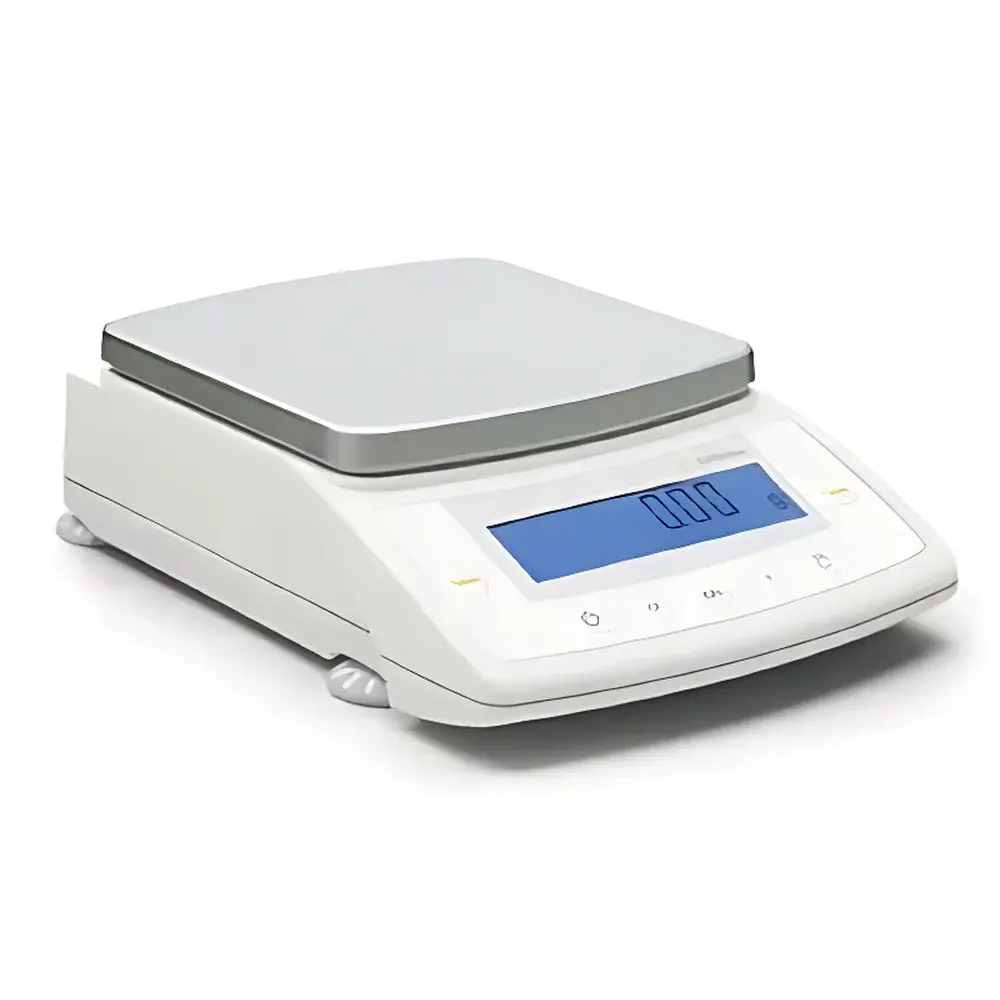
Sartorius CPA623S Precision Balance
| Brand | Sartorius |
|---|---|
| Origin | Germany |
| Model | CPA623S |
| Readability | 1 mg |
| Capacity | 620 g |
| Calibration | Internal, isoCAL |
| Repeatability | ≤ ±0.001 g |
| Linearity | ≤ ±0.002 g |
| Pan Diameter | Ø 110 mm |
| Display | Backlit LCD (Digit Height: 16 mm) |
| Interface | RS-232C |
| ISO/GLP Compliance | Yes |
| Printing Capability | Yes (with optional YDP20-0CE printer or PC connection) |
| Application Modes | Percentage Weighing, Net Totalization, Animal Weighing, Unit Conversion, Piece Counting |
| Sensor Technology | Monolithic Electromagnetic Force Compensation Sensor |
| Optional External Calibration | Yes |
Overview
The Sartorius CPA623S Precision Balance is an ISO/GLP-compliant laboratory weighing instrument engineered for accuracy, repeatability, and long-term stability in routine analytical and quality control environments. Utilizing a monolithic electromagnetic force compensation sensor—a patented design that eliminates mechanical hysteresis and thermal drift—the CPA623S delivers consistent 1 mg readability across its full 620 g capacity range. Its core architecture adheres to fundamental metrological principles defined in OIML R76 and EN 45501, ensuring traceable performance under varying ambient conditions. The balance operates on the principle of electromagnetic force restoration: when mass is placed on the pan, the system generates a counteracting electromagnetic force proportional to the load; this closed-loop measurement ensures high linearity (≤ ±0.002 g) and exceptional repeatability (≤ ±0.001 g). Designed for daily use in regulated laboratories—including those operating under GMP, GLP, or FDA 21 CFR Part 11 requirements—the CPA623S integrates seamlessly into documented workflows without compromising operational efficiency.
Key Features
- Internal motor-driven calibration via isoCAL technology—fully automated, temperature-triggered, and user-initiated calibration with real-time adjustment of zero point and sensitivity
- Backlit LCD display with 16 mm digit height for rapid, unambiguous reading under diverse lighting conditions
- Robust stainless-steel weighing pan (Ø 110 mm) mounted on a vibration-damped base to minimize environmental interference
- RS-232C bidirectional interface supporting direct data transfer to PCs, LIMS, or peripheral printers such as the optional YDP20-0CE
- Built-in application functions including percentage weighing, net totalization, animal weighing (dynamic averaging), unit conversion (g, oz, ct, etc.), and piece counting—configurable without external software
- Electromagnetic compatibility (EMC) certified per IEC 61326-1; IP42-rated housing for protection against dust and incidental splashes
- Compliance-ready documentation features: time-stamped weight records, operator ID prompts (when integrated with external authentication), and audit-trail-capable printouts
Sample Compatibility & Compliance
The CPA623S accommodates a broad spectrum of sample types—from powdered pharmaceutical actives and reference standards to granular chemicals and small biological specimens—within its 620 g capacity and Ø 110 mm pan geometry. Its high-resolution 1 mg readability supports USP and EP 2.1.6 requirements for balance suitability testing in quantitative analysis. All internal calibration events are recorded with timestamps and deviation values, fulfilling ISO/IEC 17025 clause 6.4.8 and ASTM E898-22 recommendations for calibration traceability. When paired with the YDP20-0CE thermal printer or validated PC software, the system generates GLP-compliant reports containing balance ID, calibration status, environmental readings (optional via external sensors), and user-defined metadata—enabling full audit readiness for regulatory inspections.
Software & Data Management
No proprietary software installation is required for basic data export; raw weight values and event logs transmit directly via ASCII protocol over RS-232C. For enhanced traceability, the balance supports configurable print formats compliant with ISO 17025 Annex A3 and FDA 21 CFR Part 11 when used with Sartorius’ DataControl or LabX Lite (via serial-to-USB adapter). Audit trail functionality includes immutable timestamps, operator identification fields (manual entry or barcode-scanned), and change history for calibration parameters. All printed outputs include header information identifying the device model, serial number, firmware version, and calibration due date—ensuring alignment with ALCOA+ data integrity principles.
Applications
- Quantitative preparation of standard solutions and titrant dilutions in analytical chemistry labs
- Weighing of active pharmaceutical ingredients (APIs) during formulation development and QC release testing
- Batch reconciliation and component verification in GMP manufacturing environments
- Gravimetric moisture analysis using pre- and post-drying mass differentials
- Calibration of pipettes and volumetric glassware per ISO 8655-6
- Teaching laboratories requiring robust, intuitive instrumentation for metrology fundamentals instruction
FAQ
Does the CPA623S support external calibration with traceable weights?
Yes—while isoCAL provides fully automated internal calibration, the balance accepts external calibration via Class M2 or better weights. The procedure follows ISO 17025 Annex C and is documented in the user manual.
Is the RS-232C interface compatible with modern Windows/macOS systems?
Yes—using a certified USB-to-RS-232 adapter (e.g., FTDI-based), the interface supports stable communication with current OS versions. Baud rate, parity, and stop bits are configurable via front-panel menu.
Can the CPA623S generate electronic records meeting 21 CFR Part 11 requirements?
Standalone operation does not fulfill Part 11’s electronic signature and audit trail mandates; however, integration with validated Sartorius LabX software enables role-based access control, electronic signatures, and permanent record archiving.
What is the recommended recalibration interval under GLP conditions?
Per ISO/IEC 17025:2017, recalibration frequency must be risk-assessed. Sartorius recommends initial verification at startup, followed by daily zero checks, weekly performance tests, and full isoCAL calibration every 24–72 hours depending on usage intensity and environmental stability.
How does the monolithic sensor improve long-term stability compared to traditional strain-gauge designs?
Unlike multi-component load cells subject to creep and thermal expansion mismatches, the monolithic sensor is machined from a single block of high-purity alloy, eliminating micro-joints and ensuring uniform thermal response—resulting in <0.0005 g/day drift under controlled lab conditions.