
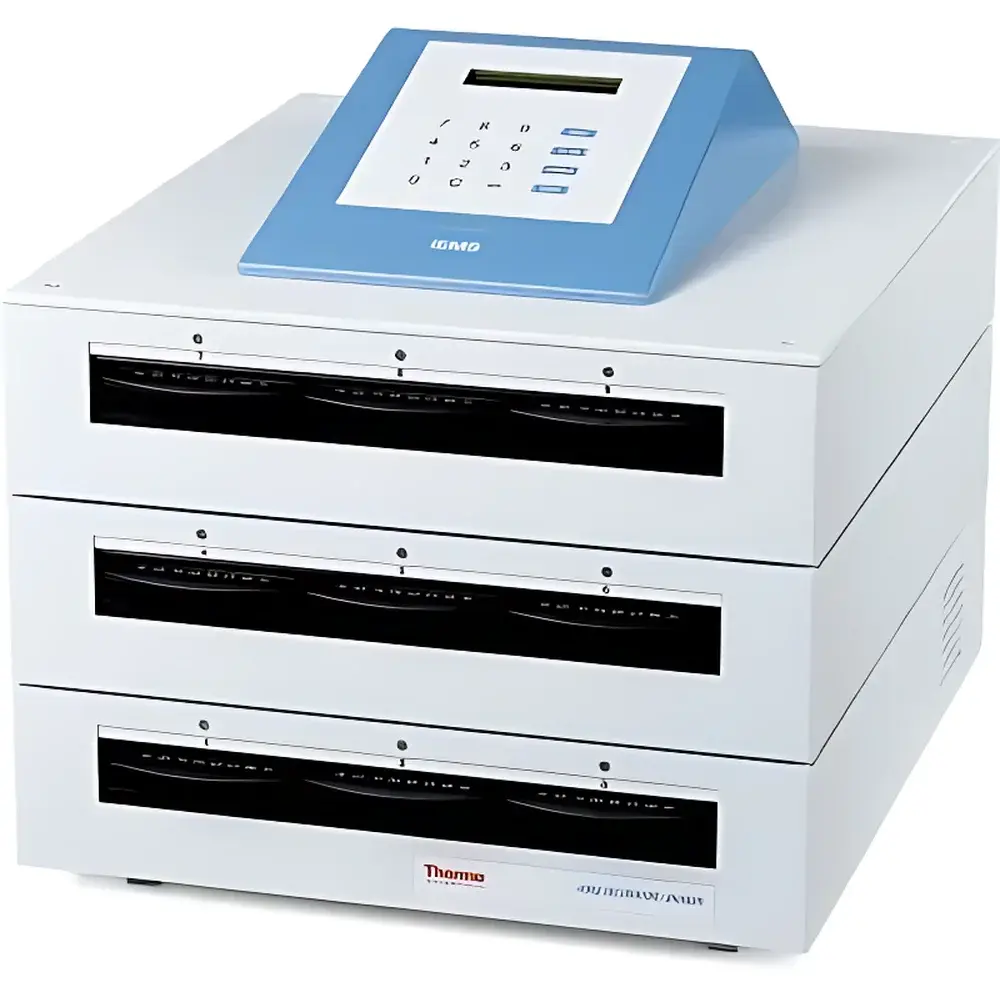
Thermo Fisher Scientific iEMS Microplate Incubator and Shaker
| Brand | Thermo Fisher Scientific |
|---|---|
| Origin | USA |
| Model | iEMS |
| Temperature Range | +14°C to +40°C |
| Incubation Capacity | 9 standard 96-well microplates |
| Temperature Uniformity | <0.3°C across plate |
| Temperature Accuracy | ±0.3°C |
| Resolution | 0.1°C |
| Heating Rate | <20 min (24°C → 37°C) |
| Evaporation Rate | 2 mg/h/well |
| Shaking Mode | Orbital |
| Orbit Diameter | 2 mm (radius 1 mm) |
| Speed Range | 400–1400 rpm in 250-rpm increments (5 discrete settings) |
| Timer Range | Up to 48 h for incubation, shaking, and pause intervals (1-s resolution) |
| Compliance | Designed for GLP/GMP-aligned workflows |
Overview
The Thermo Fisher Scientific iEMS Microplate Incubator and Shaker is an engineered platform for precise, reproducible thermal incubation and orbital mixing of 96-well microplates in enzyme immunoassay (EIA), ELISA, cell-based assays, and kinetic binding studies. It operates on a dual-function principle: independent resistive heating of individual microplates via dedicated aluminum heating adapters, combined with controlled orbital agitation to enhance mass transfer and reaction kinetics. Unlike conventional shared-chamber incubators, the iEMS eliminates inter-plate thermal crosstalk by isolating heat delivery to each plate—enabling parallel processing of up to nine plates under distinct temperature and shaking protocols. Its design targets critical assay performance parameters: minimized edge effects, suppressed well-to-well temperature variance (<0.3°C), and consistent convective mixing—even for high-viscosity samples (e.g., serum-rich matrices or viscous conjugate solutions). The system is optimized for applications where thermal homogeneity and mechanical mixing directly influence signal-to-noise ratio, binding efficiency, and assay reproducibility.
Key Features
- Independent plate-level heating: Each of the nine included aluminum microplate adapters features embedded PTC heaters and PID-controlled thermistors, ensuring uniform thermal distribution without reliance on chamber air convection.
- High-fidelity orbital shaking: 2-mm-diameter orbit (1-mm radius) at five fixed speeds (400, 650, 900, 1150, 1400 rpm), delivering consistent shear profiles across all wells—validated for homogeneous suspension of beads, cells, and precipitated antigens.
- Sub-millidegree thermal uniformity: Plate-wide temperature deviation remains <0.3°C at setpoints between +14°C and +40°C, mitigating edge-well artifacts common in EIA and reducing replicate variability.
- Controlled evaporation management: Sealed lid design and optimized airflow dynamics limit evaporation to ≤2 mg/h per well at 37°C—critical for maintaining assay volume integrity over extended incubations (up to 48 h).
- Granular time control: Independent timers for incubation duration, shaking duration, and pause intervals—all programmable in 1-second increments up to 48 hours—support complex multi-step protocols such as sequential addition assays.
- Rapid thermal response: Achieves stable 37°C setpoint from ambient (24°C) in under 20 minutes, accelerating workflow throughput without compromising stability.
Sample Compatibility & Compliance
The iEMS accommodates standard ANSI/SLAS-compliant 96-well plates—including flat-bottom, U-bottom, V-bottom, and PCR-compatible formats—as well as opaque, clear, and black-walled plates used in absorbance, fluorescence, and luminescence detection. It supports plates sealed with adhesive films, breathable membranes, or optically clear lids. From a regulatory standpoint, the instrument’s deterministic thermal and mechanical behavior, non-volatile parameter storage, and audit-ready event logging (when interfaced with validated third-party software) support alignment with GLP and GMP documentation requirements. While the iEMS itself does not include built-in 21 CFR Part 11 controls, its serial communication interface (RS-232) enables integration into validated laboratory information management systems (LIMS) or electronic lab notebooks (ELN) that enforce user authentication, electronic signatures, and immutable audit trails.
Software & Data Management
The iEMS operates via an intuitive front-panel interface with membrane keypad and LCD display, supporting standalone operation without PC dependency. All configuration parameters—including temperature setpoint, shaking speed, incubation time, shake-on/off sequence, and pause intervals—are stored in non-volatile memory and retained after power cycling. For centralized protocol deployment and data traceability, the device supports ASCII-based RS-232 communication using a documented command protocol. This allows bidirectional control and status polling from custom scripts (Python, LabVIEW) or enterprise-grade laboratory automation suites. When paired with compliant middleware, the iEMS can contribute timestamped operational metadata—including actual vs. setpoint temperature logs, motor activation events, and door-open alerts—to structured assay records in accordance with ALCOA+ principles (Attributable, Legible, Contemporaneous, Original, Accurate, Complete, Consistent, Enduring, Available).
Applications
- Enzyme-linked immunosorbent assays (ELISA/EIA): Accelerated antigen-antibody binding kinetics via simultaneous 37°C incubation and orbital mixing, improving sensitivity and reducing total assay time by up to 30% compared to static incubation.
- Cell-based binding and internalization assays: Maintaining physiological temperatures while agitating adherent or suspension cultures during ligand exposure—minimizing sedimentation and enhancing receptor engagement uniformity.
- High-throughput screening (HTS) pre-incubation steps: Parallel conditioning of multiple plate sets prior to plate reader analysis, ensuring inter-plate comparability in dose-response studies.
- Antibody labeling and conjugation reactions: Controlled thermal activation of NHS-ester or maleimide chemistries with gentle agitation to prevent aggregation of protein reagents.
- Microbial growth monitoring: Supporting early-stage culture expansion in microtiter format prior to OD600 or metabolic dye readout.
FAQ
What is the maximum number of microplates the iEMS can process simultaneously?
The iEMS supports up to nine standard 96-well microplates using its included set of dedicated heating adapters.
Does the iEMS support 384-well plates?
No—the iEMS is engineered exclusively for 96-well format plates conforming to ANSI/SLAS dimensional standards.
Can temperature and shaking be programmed independently for each plate?
No—temperature and shaking parameters are applied uniformly across all active plates; however, individual plates may be omitted from shaking cycles via manual adapter disengagement.
Is calibration certificate included with purchase?
Factory calibration verification is provided; NIST-traceable recalibration services are available through Thermo Fisher Scientific Field Service Engineers.
What safety features prevent overheating or mechanical failure?
Dual redundant thermal cutoffs (hardware and firmware), motor stall detection, and automatic shutdown upon lid removal or sustained temperature deviation >1.0°C beyond setpoint.




