
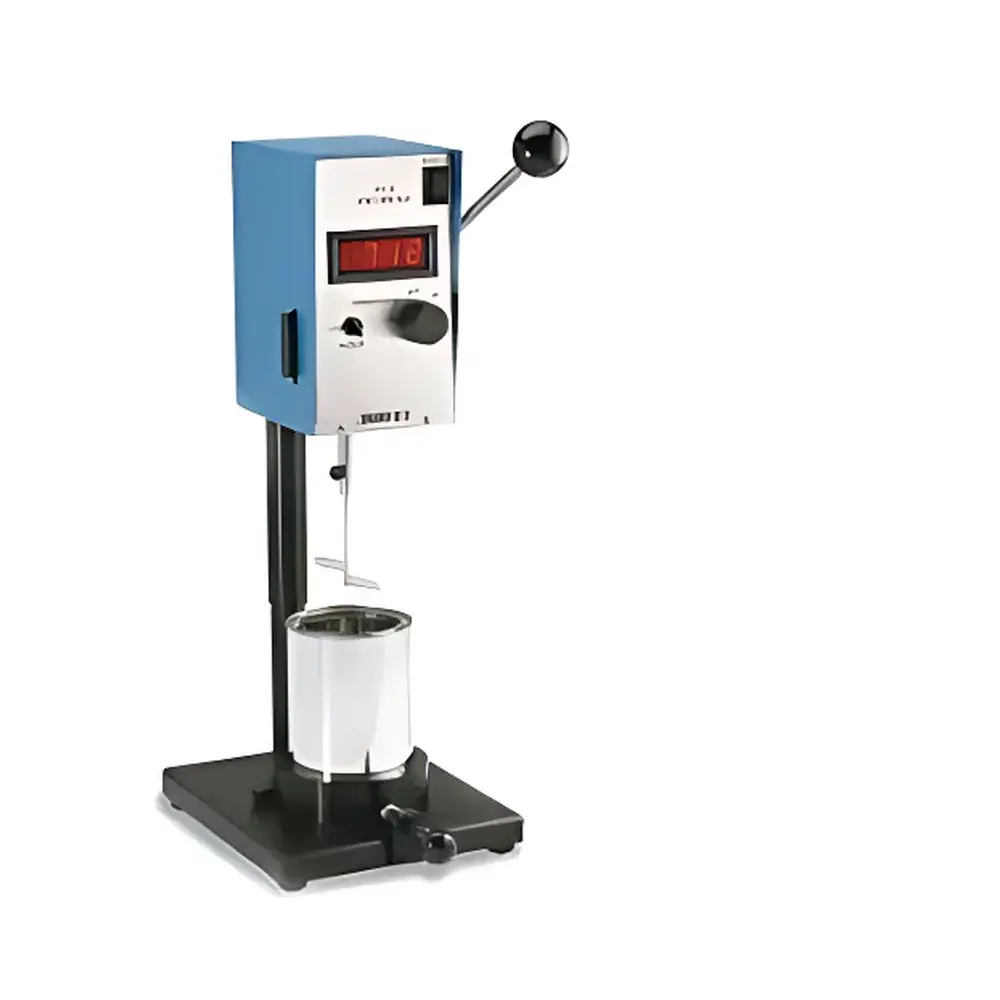
Brookfield KU-2 Krebs Unit Viscometer (Stormer-Type)
| Brand | Brookfield |
|---|---|
| Origin | USA |
| Model | KU-2 |
| Measurement Range | 40–141 KU (32–1099 g, 27–5274 cP) |
| Compliance | ASTM D562 |
| Sample Container Capacity | ½ pint, 1 pint, or 1 quart |
| Display Units | Krebs Units (KU), grams (g), and centipoise (cP) |
| Rotational Speed | Fixed at 200 rpm |
| Standard Rotor | Single Krebs paddle (ASTM-compliant) |
| Interface | RS-232 port for printer connectivity |
| Accessories Included | Instrument base, one Krebs rotor, adjustable container holder |
Overview
The Brookfield KU-2 Krebs Unit Viscometer is a precision-engineered, fixed-speed rotational viscometer designed specifically for the quality control and formulation development of architectural paints, industrial coatings, inks, and related non-Newtonian dispersions. Operating on the classical Stormer principle—where torque resistance of a rotating paddle immersed in a sample is balanced against a calibrated spring mechanism—the KU-2 delivers direct, repeatable measurements in Krebs Units (KU), grams (g), and centipoise (cP). Unlike legacy mechanical Stormer viscometers requiring manual weight loading and timing, the KU-2 employs an electronic torque sensor and microprocessor-based control to eliminate human error, improve reproducibility, and enable stable digital readouts. Its fixed 200 rpm rotation speed complies strictly with ASTM D562, ensuring regulatory alignment across global R&D and production laboratories.
Key Features
- Triple-unit display: Simultaneous real-time readout in Krebs Units (KU), equivalent gram load (g), and calculated centipoise (cP) — eliminating manual conversion and reducing transcription errors.
- Single, standardized Krebs paddle rotor: Fully compliant with ASTM D562 geometry and surface finish specifications; no rotor swapping or calibration drift between tests.
- Integrated container positioning system: Adjustable fixture accommodates standard ASTM sample containers — ½-pint (237 mL), 1-pint (473 mL), and 1-quart (946 mL) — ensuring consistent immersion depth and shear field geometry.
- Zero-mechanical-balance operation: No weights, pulleys, or manual timing required; measurement initiates automatically upon handle engagement and locks data upon stabilization.
- RS-232 serial interface: Enables direct connection to thermal or dot-matrix printers for GLP-compliant hard-copy documentation; supports timestamped output with unit identification.
- Robust industrial housing: Cast-aluminum base and corrosion-resistant components ensure long-term stability in high-humidity or solvent-rich QC environments.
Sample Compatibility & Compliance
The KU-2 is optimized for low-to-medium viscosity dispersions where yield stress and pseudoplastic behavior dominate flow response — typical of waterborne and solventborne architectural paints, latex formulations, pigment concentrates, and screen-printing inks. For highly viscous pastes (e.g., mastics or gel coatings), optional high-torque paddle rotors are available to extend effective range while maintaining ASTM D562 traceability. When testing volatile or air-entrained systems (e.g., high-VOC lacquers), the optional air-removal accessory minimizes bubble interference during immersion. All measurements adhere to ASTM D562 methodology, and instrument performance is verified per Brookfield’s internal calibration protocol traceable to NIST standards. The device meets general requirements for ISO/IEC 17025-compliant labs when operated within defined environmental conditions (23 ± 2°C, <60% RH).
Software & Data Management
While the KU-2 operates as a standalone instrument without proprietary software dependency, its RS-232 output is compatible with standard terminal emulation programs (e.g., Tera Term, PuTTY) and laboratory information management systems (LIMS) supporting ASCII-based serial ingestion. Print outputs include test ID, date/time stamp, measured KU/g/cP values, and operator ID fields — supporting audit readiness under FDA 21 CFR Part 11 when paired with appropriate lab-controlled access and electronic signature workflows. Data logging intervals and formatting can be configured externally via host-system commands; no firmware updates or cloud connectivity are required, preserving operational simplicity and cybersecurity integrity.
Applications
- Batch release testing of architectural paints per ASTM D562 and ISO 2555.
- Formulation screening during R&D to correlate KU values with sag resistance, spatter control, and spray atomization behavior.
- Raw material qualification — e.g., evaluating rheology modifiers, thickeners, or dispersants under standardized shear conditions.
- QC trending for viscosity stability over shelf life (accelerated aging studies).
- Supplier certification audits requiring documented, repeatable KU measurements traceable to international standards.
FAQ
Does the KU-2 require periodic recalibration?
Yes — annual verification against Brookfield-certified reference standards is recommended; full calibration is advised after impact, extended storage, or when measurement drift exceeds ±0.5 KU across three consecutive reference checks.
Can the KU-2 measure non-paint materials like adhesives or sealants?
It is not recommended for highly elastic or thixotropic sealants; the fixed-shear-rate design assumes near-instantaneous structural breakdown. Use a programmable rheometer (e.g., DVNext) for such materials.
Is the RS-232 port compatible with modern USB-only computers?
Yes — with a certified FTDI-based USB-to-serial adapter; drivers must be installed prior to use, and COM port settings must match instrument defaults (9600 baud, 8N1, no flow control).
What is the temperature sensitivity of KU measurements?
KU values vary by ~2–3% per °C; ASTM D562 mandates testing at 23 ± 0.5°C — therefore, ambient temperature control and sample equilibration are critical for inter-lab comparability.
How does the KU-2 differ from the older KU-1+ model?
The KU-2 adds direct cP calculation (based on empirical KU-to-cP correlation curves), improved zero-stability electronics, enhanced rotor mounting rigidity, and updated firmware for smoother data locking and print synchronization.



