
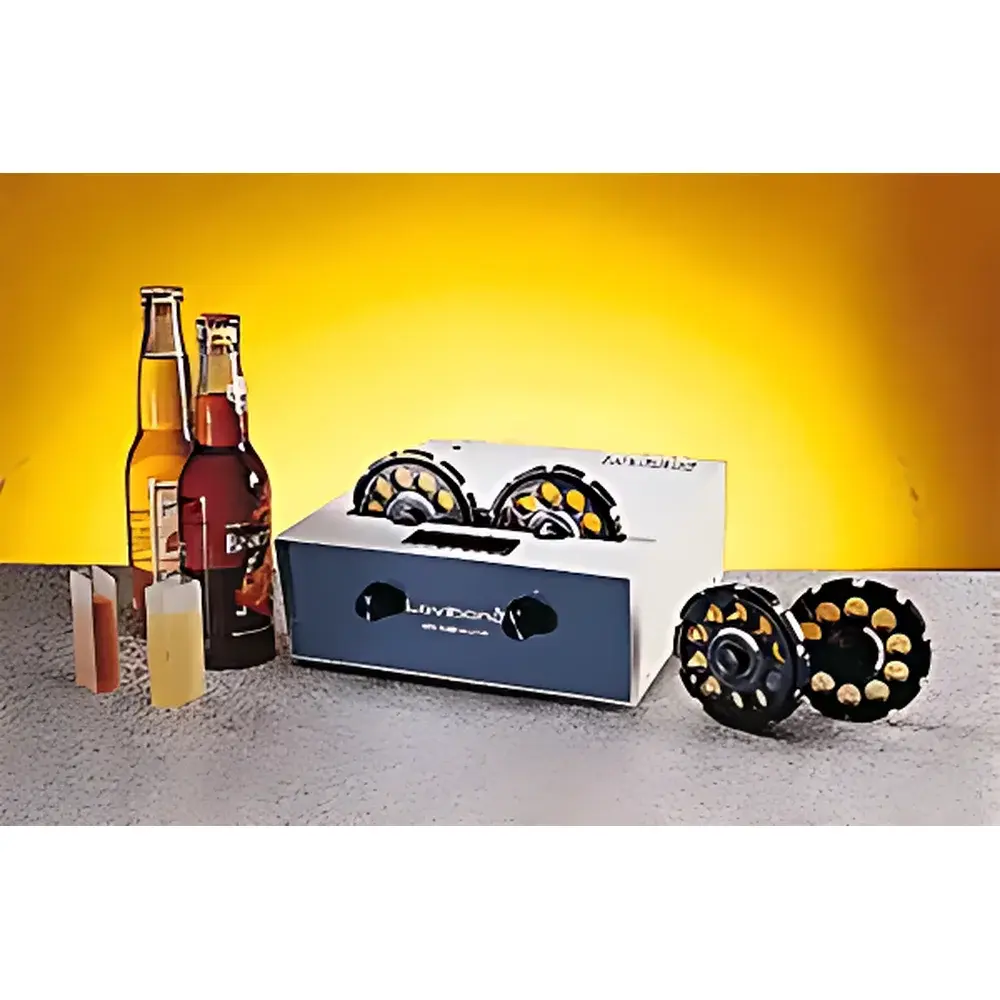
Lovibond AF607 Petroleum Colorimeter (ASTM D1500 / ISO 2049 Compliant)
| Brand | Lovibond (Tintometer) |
|---|---|
| Origin | United Kingdom |
| Model | AF607 |
| Measurement Principle | Visual Comparison Against Fixed Glass Standards |
| Light Source | 12 V, 20 W Tungsten-Halogen Lamp |
| Illuminant | CIE Illuminant C |
| Viewing Mode | Transmittance |
| Housing Material | Mild Steel |
| Power Supply | 12 V DC or 220 V AC |
| Dimensions (W×D×H) | 225 × 250 × 170 mm |
| Weight | 5.5 kg |
| Standard Accessories | Instrument Base, Two Circular Color Discs (0.5–8.0 ASTM Units), Three 33 mm Cylindrical Glass Cells |
| Compliance | ASTM D1500, ISO 2049, IP 196, DIN 51578, BS 5859, AS/NZS 109, JIS K 258, NF T 60-104, NBN T 52-109, FTMS 791-102 |
Overview
The Lovibond AF607 Petroleum Colorimeter is a precision-engineered visual color comparator designed specifically for the quantitative assessment of color in transparent to semi-transparent petroleum products. It operates on the principle of standardized visual transmittance comparison—where the sample is observed side-by-side with calibrated glass color standards under controlled CIE Illuminant C lighting conditions. This methodology ensures traceable, operator-independent results aligned with globally recognized specifications for petroleum product color evaluation. Unlike spectrophotometric instruments, the AF607 delivers direct ASTM D1500 color units without interpolation or algorithmic conversion, making it a reference-grade tool for QC laboratories requiring regulatory compliance and method transparency. Its mechanical design eliminates electronic variability, offering long-term stability and minimal maintenance—critical attributes for routine testing in refinery labs, lubricant manufacturing facilities, and third-party certification centers.
Key Features
- Two interchangeable circular color discs containing 16 permanent, optically stable glass standards covering the full ASTM D1500 scale from 0.5 to 8.0 in 0.5-unit increments—disc 1: 0.5, 1.5, …, 7.5; disc 2: 1.0, 2.0, …, 8.0
- CIE Illuminant C-corrected 12 V, 20 W tungsten-halogen lamp with thermal stabilization, ensuring consistent spectral output over extended operational periods
- Robust mild steel housing with matte black interior finish to eliminate stray light interference and enhance contrast perception
- Dual-voltage compatibility (12 V DC via external adapter or 220 V AC) for flexible deployment across field, mobile, and fixed laboratory environments
- Ergonomic viewing port with adjustable eye-level alignment and anti-glare baffling for reduced operator fatigue during high-volume testing
- No software dependency—fully manual operation supports GLP-compliant audit trails and avoids firmware validation requirements
Sample Compatibility & Compliance
The AF607 is validated for use with refined petroleum fractions including lubricating oils, diesel fuels, kerosene, mineral insulating oils, and solid paraffin waxes (when heated above their cloud point). For turbid or opaque samples, pre-conditioning per ASTM D1500 Section 7.2 is required—typically involving heating to 45 °C or above until clarity is achieved. Samples exceeding the 8.0 ASTM unit upper limit may be diluted with ASTM-grade kerosene (per ASTM D1500 Section 8.2) and retested, with final reporting adjusted for dilution factor. The instrument meets all optical and procedural requirements of ASTM D1500, ISO 2049, IP 196, DIN 51578, and equivalent national standards. Its physical construction and calibration protocol are fully compatible with ISO/IEC 17025-accredited testing environments and support documented traceability to NPL (UK) and NIST-traceable reference materials.
Software & Data Management
The AF607 is a purely analog, non-digital instrument and does not incorporate embedded software, data logging, or connectivity features. This architecture intentionally excludes electronic components that could introduce drift, require calibration verification cycles, or necessitate 21 CFR Part 11 compliance documentation. All measurements are recorded manually in laboratory notebooks or LIMS-integrated worksheets using standardized reporting templates. Users retain full control over data entry, annotation, and revision history—enabling straightforward adherence to GLP and internal QA protocols. Optional accessories include calibrated reference oil sets (e.g., Lovibond Certified Reference Oils, Lot-Traceable) for periodic performance verification, with certificates supplied per ISO/IEC 17025 Clause 6.6.
Applications
- Quality control of base oils and finished lubricants during production and incoming raw material inspection
- Batch release testing of diesel and jet fuel per ASTM D975 and D1655 specifications
- Monitoring oxidation stability in transformer oils through trending of color progression over time
- Regulatory submission support for EPA, REACH, and API licensing where ASTM D1500 compliance is mandatory
- Inter-laboratory proficiency testing programs requiring method equivalence across geographically dispersed sites
- Teaching and method validation in petroleum engineering curricula and ASTM training workshops
FAQ
Is the AF607 suitable for measuring colored solvents or non-petroleum hydrocarbons?
Yes—provided the sample is optically clear at the test temperature and falls within the defined ASTM D1500 applicability scope (e.g., white spirit, naphtha, and certain aromatic blends). Validation against certified reference materials is recommended for non-standard matrices.
Can the glass color standards be recalibrated or replaced?
No—the standards are permanently fused glass elements with factory-certified transmittance values. Replacement is only possible as complete disc assemblies (Lovibond P/N AF607-DISC1 and AF607-DISC2), supplied with new NIST-traceable calibration certificates.
What is the recommended frequency for lamp replacement?
The tungsten-halogen lamp should be replaced every 1,000 operating hours or annually—whichever occurs first—to maintain Illuminant C spectral fidelity per ASTM D1500 Annex A1.
Does the instrument require annual third-party calibration?
No formal calibration is required; however, periodic verification using Lovibond Certified Reference Oils (e.g., CR-0.5, CR-4.0, CR-8.0) is strongly advised per ISO/IEC 17025 Clause 7.7 and internal QA procedures.
How is operator variability minimized during visual assessment?
Through standardized viewing geometry, controlled illumination, neutral background, and mandatory use of the included 33 mm cylindrical cells—which enforce consistent path length and meniscus positioning per ASTM D1500 Section 6.3.





