
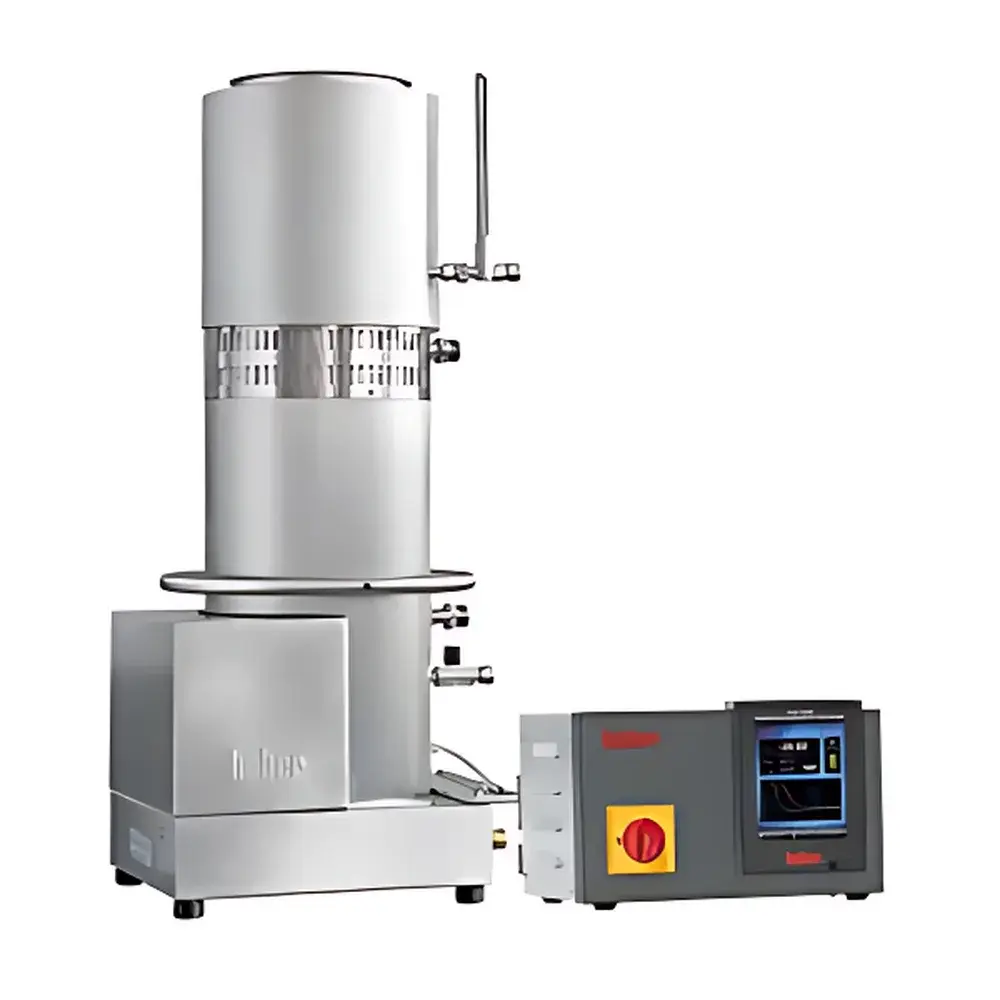
Huber Unistat TR401w HT Dynamic Temperature Control System
| Brand | Huber |
|---|---|
| Origin | Germany |
| Model | Huber Unistat TR401w HT |
| Instrument Type | Circulating Bath Chiller/Heater |
| Circulation Mode | Internal & External |
| Temperature Control | Dual-mode (Heating & Cooling) |
| Bath Volume | 5 L |
| Temperature Range | 50–400 °C (with startup capability down to 15 °C) |
| Temperature Stability | ±0.05 °C |
| Pump Flow Rate | Up to 26 L/min, Max Pressure: 0.8 bar |
| Heating Power | 3.0 kW (standard), 9.0 kW (boost mode) |
| Cooling Capacity | 10 kW (at 100 °C), 10 kW (at 200 °C), 10 kW (at 300 °C), 10 kW (at 400 °C) |
| Cooling Method | Water-cooled |
| Safety Class | III / FL |
| Protection Rating | IP20 |
| Dimensions (W × D × H) | 288 × 379 × 890 mm |
| Weight | 54 kg |
| Electrical Supply | 230 V AC, 1-phase, 50/60 Hz or 400 V AC, 3-phase+N, 50/60 Hz |
| Max Current | 14.5 A |
| Fuse Rating | 16 A |
| Ambient Operating Temperature | 5–40 °C |
| Minimum Fill Volume | 2.3 L |
| Expansion Tank Fill Volume | 5 L |
| Cooling Water Connection | G1/2" AG |
| Required Cooling Water ΔP | ≥3 bar |
| Max Cooling Water Pressure | 6 bar |
| Interface Options | RS232, Ethernet, USB Host/Device (2×), optional analog I/O via Com.G@te module |
Overview
The Huber Unistat TR401w HT is a high-temperature dynamic temperature control system engineered for precision thermal management in demanding laboratory and pilot-scale process applications. Based on Huber’s proprietary thermodynamic control architecture, it integrates heating and cooling within a single sealed hydraulic circuit—eliminating the need for oil changes across its full operational range of 50 °C to 400 °C (with cold-start capability down to 15 °C). Unlike conventional circulators relying on passive heat exchange, the TR401w HT employs active dual-mode thermal regulation: electric resistance heating coupled with a high-efficiency water-cooled refrigeration unit delivering consistent 10 kW cooling capacity across the entire high-temperature operating window. Its closed-loop, oxidation-resistant fluid system extends thermal fluid service life and ensures long-term stability—critical for extended unattended operation in GLP-compliant environments.
Key Features
- Dynamic temperature control with ±0.05 °C stability—validated per ISO 17025 traceable calibration protocols
- Pilot ONE E-grade “Professional” controller featuring a 5.7-inch color touchscreen, multi-touch gesture support, and intuitive graphical interface with real-time trend visualization
- Adaptive self-optimizing control algorithm that automatically adjusts PID parameters based on load dynamics and thermal inertia
- High-flow, variable-speed circulation pump (0–26 L/min, up to 0.8 bar pressure) with soft-start functionality to prevent mechanical stress on glass reactors and jacketed vessels
- Integrated energy management system reducing standby power consumption by up to 35% versus legacy models; optimized compressor cycling minimizes thermal shock to fluids
- Comprehensive safety architecture: triple-level overtemperature protection, flow monitoring, low-fluid detection, and emergency shutdown with hardware-based fail-safe circuitry
- Industrial-grade connectivity suite including dual USB (Host/Device), 10/100 Mbps Ethernet, and RS232—enabling remote supervision, firmware updates, and audit-log export
Sample Compatibility & Compliance
The TR401w HT is designed for direct integration with jacketed reactors (up to 50 L volume), calorimeters, spectroscopic cells, and material testing fixtures requiring precise external thermal coupling. Its sealed, inert hydraulic system supports use with synthetic heat transfer oils rated for continuous operation at 400 °C (e.g., Marlotherm SH, Therminol VP-1). The unit complies with EN 61000-6-2 (immunity) and EN 61000-6-4 (emissions), carries CE marking under the EU Machinery Directive 2006/42/EC, and meets UL/CSA Class 1 Div 2 requirements for non-hazardous locations. For regulated environments, Pilot ONE firmware supports 21 CFR Part 11-compliant electronic signatures and audit trails when configured with network authentication and role-based access control.
Software & Data Management
Native data logging records temperature setpoint, actual bath temperature, pump speed, compressor status, and alarm events at user-defined intervals (1 s to 60 min). Logged data exports directly to CSV or Excel-compatible formats via USB or Ethernet. Optional Huber LabManager software enables centralized fleet monitoring, automated report generation (PDF/HTML), and integration with LIMS platforms via OPC UA or Modbus TCP. All configuration changes—including PID tuning, alarm thresholds, and user permissions—are timestamped and attributed, satisfying ALCOA+ data integrity principles for pharmaceutical and chemical QA/QC workflows.
Applications
- High-temperature reaction kinetics studies in catalysis and polymer synthesis
- Calibration of reference thermometers and temperature sensors per ASTM E74 and ISO/IEC 17025
- Thermal aging tests of composites, adhesives, and electronic encapsulants (IEC 60068-2-14)
- Controlled heating/cooling cycles for rheological characterization of thermosets and elastomers
- Stabilized thermal conditioning of optical benches and interferometric setups requiring sub-0.1 °C drift
- Process validation support for API manufacturing under FDA Process Validation Guidance (2011)
FAQ
What is the minimum recommended thermal fluid volume for safe operation?
The system requires a minimum fill volume of 2.3 L to ensure proper pump priming and sensor immersion; the expansion tank is pre-filled to 5 L.
Can the TR401w HT operate without external cooling water?
No—this model is exclusively water-cooled and requires a continuous supply with ≥3 bar differential pressure and ≤6 bar absolute inlet pressure.
Is remote access possible without third-party software?
Yes—the built-in web server allows browser-based monitoring and basic control via Ethernet; advanced functions require Huber LabManager.
Does the system support external temperature feedback from a process vessel?
Yes—via optional Com.G@te module, enabling cascade control using Pt100 input from an external probe.
What maintenance intervals are recommended for long-term reliability?
Annual verification of refrigerant charge, pump seal integrity, and controller calibration is advised; fluid analysis every 2,000 operating hours.



