
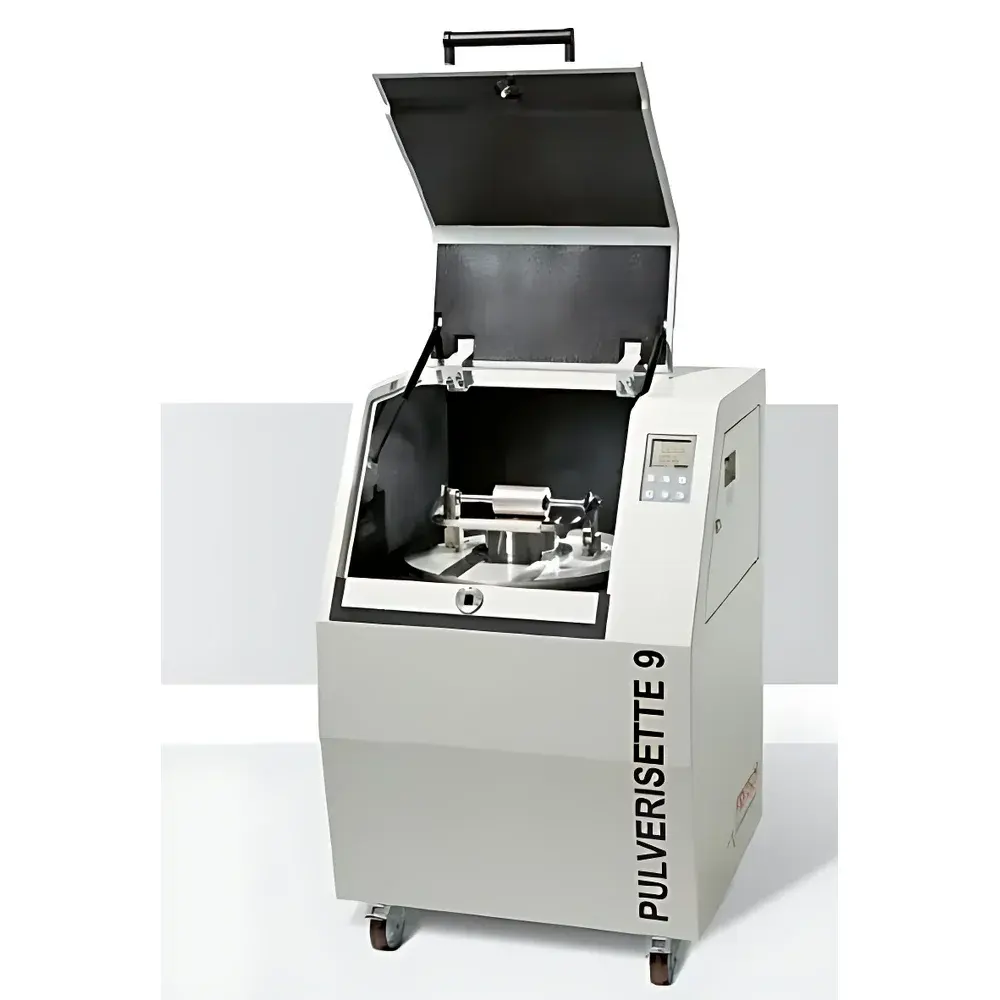
FRITSCH Pulverisette 9 High-Energy Vibratory Cup Mill
| Brand | FRITSCH |
|---|---|
| Origin | Germany |
| Model | Pulverisette 9 |
| Maximum Rotational Speed | 1150 rpm |
| Final Particle Size | 10–20 µm |
| Maximum Feed Size | 12 mm |
| Batch Capacity | 250 mL |
| Net Weight | 250 kg |
| Gross Weight | 365 kg |
| Dimensions (W×D×H) | 60 × 80 × 110 cm |
| Input Power | 2000 W |
| Voltage | 100–240 V, 1~ |
| Frequency | 50–60 Hz |
| Grinding Principle | Horizontal vibratory motion with centrifugal acceleration |
| Grinding Modes | Dry and wet |
| Grinding Vessel Materials | Hardened chromium steel, tungsten carbide, agate |
| Warranty | 1 year |
Overview
The FRITSCH Pulverisette 9 is a high-energy vibratory cup mill engineered for rapid, reproducible size reduction of brittle, hard, and heterogeneous solid materials. Unlike conventional planetary or rotor mills, the Pulverisette 9 operates on a horizontal vibratory principle: a rotating disc drives a spring-loaded grinding chamber in controlled lateral oscillation. This induces high-frequency centrifugal acceleration—up to 1150 rpm—causing grinding elements (grinding rings and plungers) to undergo intense rolling, impact, and shear motion within a sealed vessel. The resulting mechanical energy transfer enables sub-20 µm final particle sizes in as little as 1–3 minutes, making it especially suited for sample preparation prior to X-ray fluorescence (XRF), Fourier-transform infrared (FTIR), X-ray diffraction (XRD), and elemental analysis workflows. Its unique frequency-converter-controlled drive allows real-time adjustment of vibration intensity, ensuring optimal energy input regardless of sample mass, hardness, or density—a feature exclusive to this model in the vibratory cup mill category.
Key Features
- Frequency-converter-driven motor with microprocessor-based speed regulation (0–1150 rpm), enabling precise control over impact energy and process repeatability
- High-load vibratory architecture delivering up to 30 g acceleration force, optimized for rapid comminution of refractory minerals, alloys, ceramics, and geological specimens
- Interchangeable grinding vessels in three standard volumes (50 mL, 125 mL, 250 mL) and material options: hardened chromium steel (general-purpose), tungsten carbide (ultra-hard abrasives), and agate (trace-metal-free, low-contamination applications)
- Patented anti-torsion locking system with end-position guidance ensures secure, vibration-dampened vessel clamping and eliminates misalignment during operation
- Hermetically sealed grinding chambers prevent cross-contamination and sample loss—critical for regulatory-compliant QA/QC labs conducting ISO/IEC 17025 or GLP audits
- Dual-mode capability: validated for both dry grinding and wet dispersion milling using solvents or suspending media (e.g., ethanol, isopropanol, aqueous surfactant solutions)
- Integrated safety interlocks, thermal overload protection, and automatic shutdown upon lid opening or abnormal vibration detection
Sample Compatibility & Compliance
The Pulverisette 9 accommodates a broad spectrum of sample types—including brittle ores, sintered metal powders, ceramic oxides, plant tissues, soil aggregates, polymer composites, and moisture-sensitive pharmaceutical intermediates—without requiring pre-drying or cryogenic treatment. Its robust mechanical design meets CE marking requirements and complies with IEC 61000-6-2 (EMC immunity) and IEC 61000-6-4 (EMC emission) standards. For regulated environments, the instrument supports audit-ready documentation when paired with FRITSCH’s optional LabSoft software (compliant with FDA 21 CFR Part 11 for electronic records and signatures). Routine calibration verification can be performed using certified reference materials traceable to NIST or BAM standards, supporting adherence to ASTM D7250 (standard practice for particle size analysis) and ISO 13320 (laser diffraction particle sizing).
Software & Data Management
While the base Pulverisette 9 operates via intuitive front-panel controls, integration with FRITSCH LabSoft v5.0 enables full digital workflow management. The software logs all critical process parameters—including actual rpm, elapsed time, vibration amplitude, and thermal sensor readings—with timestamped entries stored in encrypted SQLite databases. Export formats include CSV, PDF, and XML for LIMS compatibility. Audit trails record user login events, parameter modifications, and emergency stops—meeting GLP/GMP data integrity requirements. Optional barcode scanning allows sample ID auto-assignment, reducing manual entry errors during high-throughput mineralogical screening.
Applications
- Geochemical laboratories preparing rock, slag, and ore samples for XRF and ICP-MS analysis
- Ceramic R&D facilities homogenizing zirconia, alumina, and silicon carbide feedstocks
- Environmental testing labs processing contaminated soils and sediments for heavy metal extraction
- Agricultural research institutes milling grain, forage, and compost for nutrient profiling
- Materials science departments generating nanostructured precursors from bulk intermetallics or battery cathode materials
- Pharmaceutical QC labs performing content uniformity testing on tablet blends using agate vessels to avoid iron contamination
FAQ
What types of samples are unsuitable for the Pulverisette 9?
Samples with extreme elasticity (e.g., raw rubber, thermoplastic polymers above Tg), highly fibrous biomass without pre-cutting, or those containing volatile organic compounds at ambient temperature may require cryogenic pre-treatment or alternative milling strategies.
Can the Pulverisette 9 achieve sub-10 µm particle sizes?
While typical endpoint resolution is 10–20 µm, sub-10 µm results are achievable under optimized conditions—e.g., extended run times (>5 min), tungsten carbide vessels, low-mass batches (<50 g), and wet grinding with dispersants—but require method validation per ISO 13320 Annex B.
Is remote monitoring supported?
Yes—via optional Ethernet interface and LabSoft Remote Access module, enabling real-time status viewing, parameter adjustment, and alarm notifications through secure HTTPS connections.
How often does the grinding vessel require replacement?
Service life depends on sample abrasiveness and cumulative runtime; tungsten carbide vessels typically exceed 500 h of operation on quartz-rich ores, while agate vessels are recommended for ≤200 h in medium-hardness applications to maintain dimensional accuracy.
Does FRITSCH provide application-specific method development support?
Yes—FRITSCH Application Laboratories in Idar-Oberstein offer fee-based method optimization, including grinding parameter mapping, contamination profiling, and inter-laboratory reproducibility studies aligned with ISO 5725.
Related Products



