
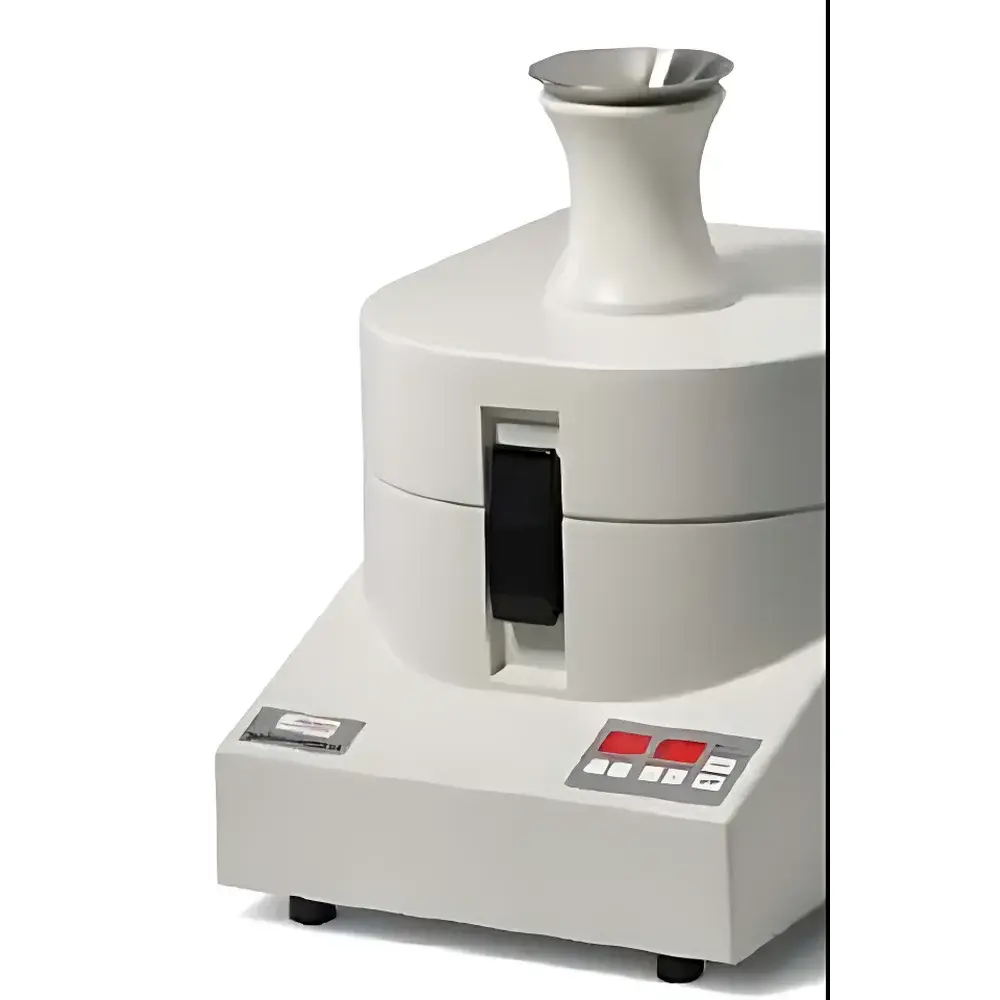
FRITSCH Pulverisette 14 Variable-Speed High-Speed Rotor Mill
| Brand | FRITSCH |
|---|---|
| Origin | Germany |
| Model | Pulverisette 14 |
| Final Particle Size | ≤40 µm |
| Max. Throughput | 5 L/h |
| Max. Feed Size | 10 mm |
| Rotational Speed | 6,000–20,000 rpm |
| Input Power | 1,150 W |
| Voltage | 100–120 / 200 / 240 V, 1~ |
| Frequency | 50–60 Hz |
| Net Weight | 23 kg |
| Gross Weight | 25 kg |
| Dimensions (W×D×H) | 31×48×47 cm |
| Grinding Components Material | Stainless Steel, Pure Titanium, Titanium-Coated Stainless Steel |
| Cooling | Forced Air Flow |
| Tool-Free Component Exchange | Yes |
| Iron-Free Grinding Kit Available | Yes |
Overview
The FRITSCH Pulverisette 14 is a high-performance, variable-speed rotor mill engineered for rapid, reproducible size reduction of soft to medium-hard, fibrous, brittle, and temperature-sensitive materials. Operating on the principle of high-velocity impact combined with shear and friction forces, it employs a precision-machined rotating rotor equipped with sharp-edged cutting elements that strike, slice, and compress samples against an interchangeable insert sieve. This tri-modal mechanical action—impact, shear, and attrition—ensures efficient comminution while minimizing thermal load. Unlike planetary ball mills or cryogenic grinders, the Pulverisette 14 achieves analytical-grade fineness (≤40 µm) without requiring liquid nitrogen in most applications; however, for thermolabile polymers (e.g., PVC, PP, PE), pharmaceutical tablets, or elastomeric substances, optional pre-cooling via cryogenic treatment remains compatible and effective. Its robust architecture supports continuous operation under full load, delivering consistent particle size distribution across batches—a critical requirement for QC laboratories adhering to ISO 17025 or GLP-compliant workflows.
Key Features
- Variable rotational speed control from 6,000 to 20,000 rpm enables precise optimization of energy input for diverse sample matrices—from delicate plant tissues to resilient synthetic resins.
- Tool-free, modular design allows rapid exchange of rotors, collection trays, and insert sieves (available in stainless steel, pure titanium, or titanium-coated variants) to prevent cross-contamination and support method-specific validation.
- Integrated forced-air cooling system maintains stable operating temperatures inside the grinding chamber, mitigating thermal degradation during extended runs—particularly essential for volatile organics, APIs, and enzymatic substrates.
- High-elasticity, wear-resistant rotor manufactured from hardened stainless steel ensures long service life and dimensional stability even after thousands of operational cycles.
- Hermetically sealed interface between motor housing and grinding chamber prevents dust ingress and lubricant migration, enhancing safety and compliance with IEC 61000-6-2/4 electromagnetic compatibility standards.
- Optional iron-free grinding kit (titanium components + non-magnetic collection tray) satisfies strict elemental purity requirements in trace metal analysis (e.g., ASTM D5185, USP /).
Sample Compatibility & Compliance
The Pulverisette 14 accommodates a broad spectrum of organic and inorganic matrices: botanicals (leaves, roots, spices), agricultural products (grains, feed pellets), pharmaceutical solids (coated tablets, excipients), geological samples (soil, kaolin, chalk), and polymeric materials (styrene copolymers, polyester films). It complies with CE marking directives (2014/30/EU EMC, 2014/35/EU LVD), and its construction meets ISO 9001-certified manufacturing protocols. When used with validated SOPs and documented calibration records, the instrument supports audit readiness for FDA 21 CFR Part 11–governed environments where electronic data integrity and operator accountability are mandated.
Software & Data Management
While the Pulverisette 14 operates via intuitive analog controls (speed dial + start/stop toggle), its performance parameters are fully integrable into laboratory information management systems (LIMS) through optional digital interfaces (RS-232 or USB-to-serial adapters). Users may log runtime, speed settings, batch IDs, and maintenance events for traceability. For regulated labs, FRITSCH offers IQ/OQ documentation packages aligned with GMP Annex 15 and ISO/IEC 17025:2017 clause 6.4.1, including uncertainty estimation for throughput and final particle size consistency.
Applications
This mill serves as a primary sample preparation tool in environmental testing (soil homogenization prior to heavy metal extraction), food safety labs (grinding cereal grains for mycotoxin screening), pharmaceutical QA/QC (reducing tablet composites for dissolution uniformity testing), and polymer R&D (producing homogeneous feedstock for DSC or TGA analysis). Its ability to process up to 5 L/h at ≤40 µm resolution makes it suitable for both small-scale method development and mid-volume routine processing—bridging the gap between benchtop mills and industrial-scale comminution systems.
FAQ
Can the Pulverisette 14 grind heat-sensitive biological samples without cryogenic assistance?
Yes—its optimized airflow path and low thermal inertia rotor design enable sub-ambient temperature rise (<10 °C increase) during standard operation on plant tissue or freeze-dried proteins.
Is the instrument compliant with FDA 21 CFR Part 11 for electronic records?
The base unit does not include electronic signature capability; however, when paired with FRITSCH’s optional digital interface and validated third-party LIMS software, full Part 11 compliance—including audit trails, role-based access, and electronic signatures—is achievable.
What maintenance intervals are recommended for routine use?
Rotor balance verification every 200 hours; seal inspection and cleaning after each sample type change; annual calibration of speed sensor and airflow rate using certified reference standards.
Are spare parts and consumables readily available in North America and EMEA?
Yes—FRITSCH maintains regional distribution centers in the USA (Ohio), Germany (Idar-Oberstein), and Singapore, with typical lead times of 3–5 business days for rotors, sieves, and collection trays.
Does the machine support grinding under inert atmosphere?
Not natively—but custom modifications (e.g., argon-purged chamber retrofit kits) are available upon request and subject to engineering review per ISO 8573-1 Class 2 air quality specifications.



