
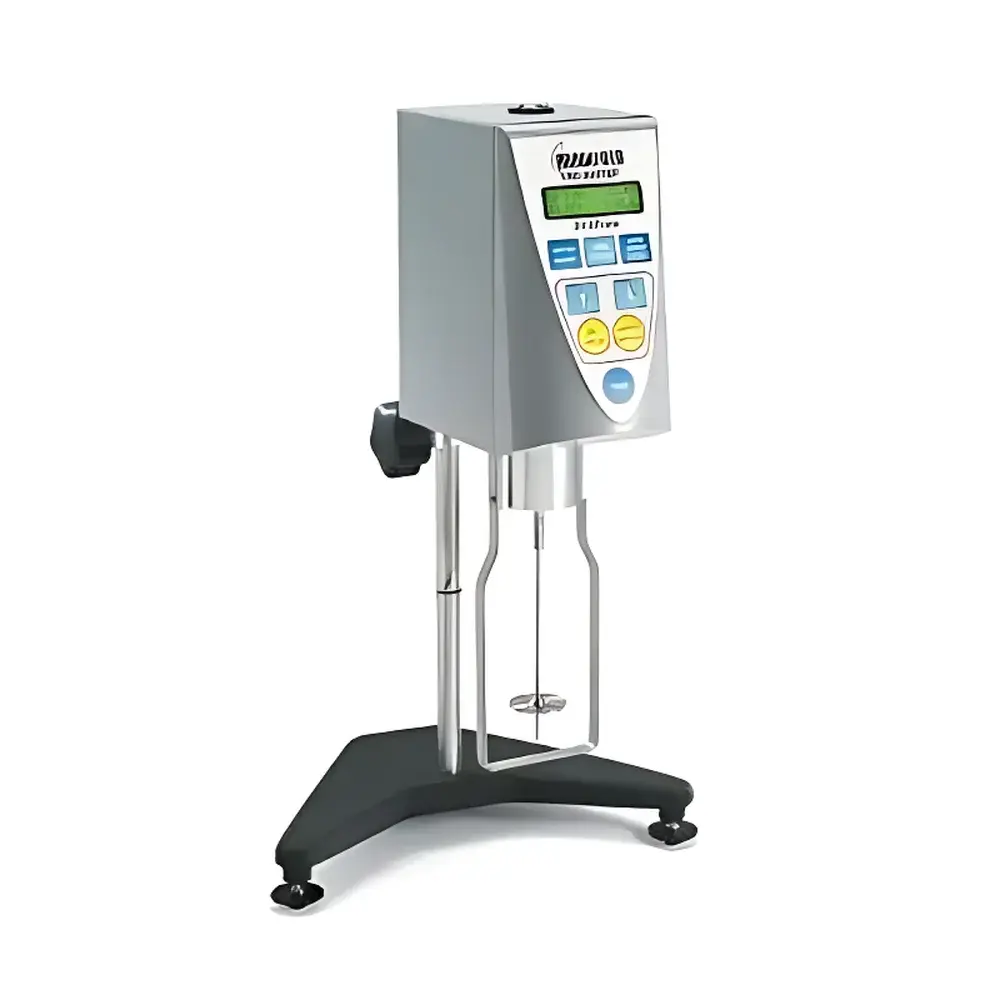
Brookfield RVDV-I Prime Digital Viscometer
| Brand | Brookfield |
|---|---|
| Origin | USA |
| Model | RVDV-I Prime |
| Viscosity Range | 100–13,000,000 cP |
| Speed Range | 0.3–100 rpm |
| Accuracy | ±1% of full-scale reading |
| Repeatability | ±0.2% |
| Temperature Compensation | ±5 °C adjustable |
| Interface | RS-232 serial port |
| Optional | RTD temperature probe (Pt100) |
| Auto-timing function | configurable start/stop torque or time threshold |
Overview
The Brookfield RVDV-I Prime Digital Viscometer is a precision-engineered rotational viscometer designed for routine quality control, process validation, and R&D applications in laboratories and production environments. Based on the well-established Couette flow principle—where torque generated by a rotating spindle immersed in a fluid is directly proportional to its dynamic viscosity—the RVDV-I Prime delivers reliable, repeatable measurements across a broad viscosity spectrum (100 to 13 million cP) using standardized spindles (LV, RV, HA, HB series). Its microprocessor-controlled architecture enables real-time torque sensing and continuous digital display—making it the only model in its class at launch to feature true continuous-sensing capability without sampling intervals or latency. The instrument operates under controlled shear conditions defined by spindle geometry, rotational speed, and sample volume, ensuring compliance with fundamental rheological measurement standards including ASTM D2196, ISO 2555, and USP .
Key Features
- Continuous real-time torque sensing with instantaneous digital viscosity readout—eliminating interpolation or averaging artifacts common in stepped-scan instruments.
- 18 programmable rotational speeds (0.3–100 rpm), enabling optimized shear rate selection for non-Newtonian fluids such as polymer melts, paints, adhesives, and pharmaceutical suspensions.
- Auto-range functionality: pressing the AUTO RANGE key automatically selects the optimal spindle/speed combination to maximize resolution within the measured viscosity range.
- Configurable auto-timing mode: users may define either time-based termination (e.g., stop after 60 s) or torque-based triggering (e.g., record viscosity when torque reaches 85% of full scale).
- Adjustable temperature offset compensation (±5 °C), supporting alignment with external bath or jacketed vessel temperatures when an optional Pt100 RTD probe is installed.
- RS-232 interface compliant with EIA/TIA-232-E specifications, enabling direct connection to PCs, LIMS, or industrial printers for GLP/GMP-compliant data logging and audit trail generation.
- Integrated warning system: visual and audible alerts activate when measured torque falls below 10% or exceeds 100% of the selected range—preventing out-of-range misinterpretation.
Sample Compatibility & Compliance
The RVDV-I Prime accommodates standard Brookfield cylindrical spindles (LV, RV, HA, HB) and supports both small-volume (≥15 mL) and full-bath configurations. It is compatible with Newtonian fluids (e.g., mineral oils, glycerol), pseudoplastic systems (e.g., xanthan gum solutions), dilatant suspensions, and thixotropic gels—provided sample homogeneity and thermal stability are maintained during measurement. The instrument meets CE marking requirements and conforms to IEC 61010-1 for electrical safety in laboratory equipment. When operated with validated software and timestamped RS-232 output, it supports FDA 21 CFR Part 11 compliance for electronic records and signatures in regulated pharmaceutical and biotech settings.
Software & Data Management
While the RVDV-I Prime operates as a standalone instrument, its RS-232 interface allows seamless integration with Brookfield’s optional PC-based software (e.g., Rheo3000 v4.x or older compatible versions). This software enables automated method storage, multi-point time-sweep profiling, yield stress estimation via ramped speed protocols, and export to CSV, Excel, or PDF formats. All data transfers include embedded timestamps, operator ID fields, and instrument serial number metadata—facilitating traceability in ISO/IEC 17025-accredited labs. Audit trails, user access levels, and electronic signature capture can be implemented through third-party LIMS platforms interfacing via ASCII command protocol.
Applications
- QC testing of lubricants, transformer oils, and hydraulic fluids per ASTM D445 and D7042.
- Viscosity grading of asphalt binders and polymer-modified bitumens (AASHTO T315).
- Formulation development of topical pharmaceuticals (creams, ointments) aligned with USP rotational viscosity requirements.
- In-process monitoring of food emulsions (mayonnaise, sauces) and dairy products (yogurt, condensed milk).
- Evaluation of ink rheology for gravure and flexographic printing processes.
- Stability assessment of ceramic slurries and battery electrode coatings prior to drying or calendering.
FAQ
What spindle types are compatible with the RVDV-I Prime?
The instrument accepts all standard Brookfield spindles (LV, RV, HA, HB series) via the universal quick-coupler. Spindle selection must be matched to expected viscosity and sample volume per Brookfield’s published calibration charts.
Is temperature control mandatory for accurate measurements?
Temperature significantly affects viscosity—especially for thermally sensitive materials like resins or biological fluids. While ambient measurements are permissible, use of the optional Pt100 RTD probe and external temperature-controlled bath is strongly recommended for ISO/ASTM-compliant reporting.
Can the RVDV-I Prime perform yield stress estimation?
It does not calculate yield stress natively; however, stepwise speed ramps (e.g., 0.3 → 100 rpm in 10 steps) combined with torque vs. speed curve analysis in post-processing software can support empirical yield point approximation per ASTM D3236.
Does the instrument support GLP audit requirements?
Yes—when paired with validated software, password-protected user accounts, and RS-232 data logging that includes timestamps, operator IDs, and instrument configuration metadata, it fulfills core GLP documentation expectations for raw data integrity.
How often should calibration verification be performed?
Daily verification using NIST-traceable silicone oil standards (e.g., Brookfield Calibration Fluid Set) is recommended before critical measurements. Full recalibration by an accredited service provider is advised annually or after mechanical impact or spindle replacement.



