
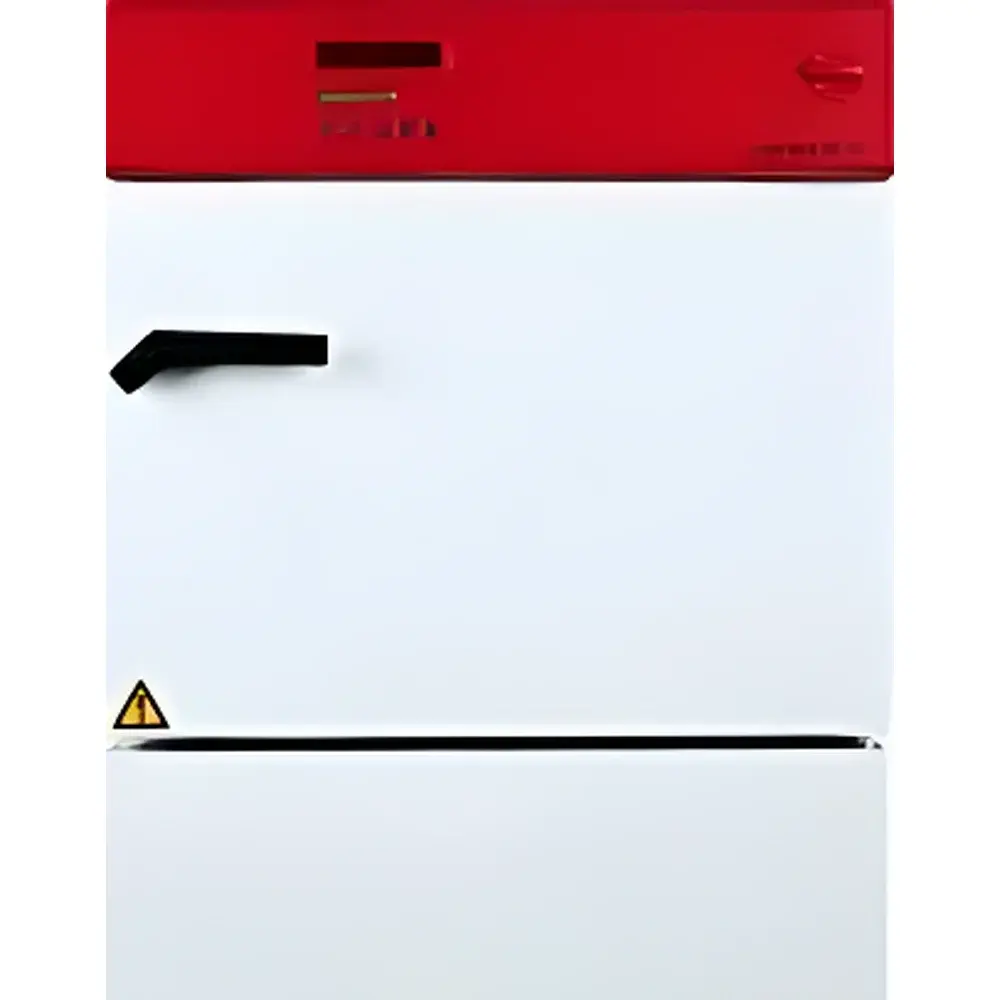
BINDER KB Series Low-Temperature Biochemical Incubator
| Brand | BINDER |
|---|---|
| Origin | Germany |
| Model | KB |
| Temperature Range | −10 °C to 100 °C (KB 23: 0 °C to 100 °C) |
| Temperature Setting Resolution | 0.1 °C |
| Programmable Controller | MP controller with 2×10 or 1×20 segments |
| Segment Duration Range | up to 99:59 h or 999:59 h per segment |
| Fan Speed Control | 0–100% adjustable |
| Independent Safety Thermostat | Class 3.1 (DIN 12880) with visual & audible alarm |
| Communication Interface | RS 422 (APT-COM® compatible) |
| Data Logging Interval | user-adjustable |
Overview
The BINDER KB Series Low-Temperature Biochemical Incubator is an engineered environmental control system designed for precise, stable, and reproducible temperature management across a broad operational range—from sub-zero refrigeration (−10 °C) to high-temperature incubation (100 °C). Unlike conventional incubators limited to ambient or mild heating applications, the KB series integrates DCT® (Direct Cooling Technology) alongside APT.line® preheating chamber technology to ensure uniform thermal distribution, rapid temperature recovery after door openings, and minimized thermal gradients across the entire working volume. This dual-technology architecture enables reliable long-term cultivation of psychrophilic microorganisms, enzyme stability assays at low temperatures, cold-adapted cell line maintenance, and accelerated stability testing under ICH Q1A–Q1E guidelines. The device complies with DIN 12880 for laboratory incubators and meets structural requirements for GLP-compliant environments where traceable, auditable temperature control is essential.
Key Features
- DCT® Direct Cooling Technology: Enables efficient, oil-free refrigeration without compressor cycling noise or thermal overshoot—critical for sensitive biological samples requiring stable sub-zero conditions.
- APT.line® Preheating Chamber: A thermally insulated outer jacket surrounding the inner chamber actively regulates heat influx, reducing internal fluctuations and improving temperature homogeneity (±0.3 °C at 37 °C, typical).
- MP Programmable Controller: Supports two independent 10-segment programs or one extended 20-segment sequence; each segment allows independent setpoint, ramp rate, dwell time, and fan speed assignment.
- Flexible Timing Logic: Includes delay start, delay stop, and temperature-dependent shutdown functions—enabling unattended overnight cooling cycles or conditional termination based on real-time chamber readings.
- Adjustable Forced-Air Circulation: Fan speed (0–100%) is programmable per segment, permitting optimization of convective heat transfer for viscous media, stacked plates, or low-evaporation protocols.
- Dual-Safety Architecture: Primary PID control loop paired with an independent, hardware-based safety thermostat (Class 3.1 per DIN 12880), featuring both visual LED indicators and audible alarm activation upon deviation exceeding user-defined thresholds.
- RS 422 Digital Interface: Native support for APT-COM® software (Windows-based) enabling remote monitoring, data logging, event-triggered alerts, and export of CSV/Excel-compatible datasets compliant with FDA 21 CFR Part 11 audit trail requirements.
Sample Compatibility & Compliance
The KB series accommodates standard microbiological and cell culture formats—including Petri dishes, multiwell plates, Erlenmeyer flasks, roller bottles, and stackable racks—within its stainless-steel interior and tempered glass inner door. All models are CE-marked and conform to EN 61000-6-2 (immunity) and EN 61000-6-4 (emission) standards. Temperature uniformity and stability validation reports are available upon request and align with ISO/IEC 17025-accredited calibration practices. For regulated laboratories, the system supports IQ/OQ documentation packages and integrates into enterprise LIMS via APT-COM®’s OPC UA-compatible data export modules.
Software & Data Management
APT-COM® software provides full bidirectional communication with the incubator’s MP controller. Users can configure complex multi-step profiles, visualize real-time temperature/fan curves, trigger manual overrides, and generate timestamped log files containing setpoint, actual temperature, fan speed, alarm status, and safety thermostat activity. Data exports include automatic metadata tagging (operator ID, instrument serial number, session ID) and support digital signature workflows required under GxP frameworks. Optional RS 232/RS 422 converters enable direct connection to label printers or legacy SCADA systems for hard-copy record retention.
Applications
- Cold-chain validation studies for pharmaceutical intermediates and biologics
- Growth profiling of cold-tolerant bacterial strains (e.g., Pseudomonas fluorescens, Yersinia enterocolitica)
- Enzyme kinetics assays conducted below 10 °C to assess thermostability and catalytic efficiency
- Accelerated degradation testing per ICH Q1A(R3) at controlled sub-ambient temperatures
- Long-term storage of hybridoma cultures and primary neuronal preparations requiring stable 4–8 °C environments
- Environmental simulation for agricultural seed germination under frost-mimicking conditions
FAQ
What is the minimum operating temperature for the KB series, and does it apply to all chamber volumes?
The −10 °C lower limit applies to all KB models except the KB 23 desktop variant, which is rated from 0 °C to 100 °C due to its compact insulation geometry and thermal mass constraints.
Is the MP controller capable of ramp-and-soak programming with variable fan speeds per segment?
Yes—each of the 20 programmable segments supports independent configuration of temperature setpoint, ramp rate (°C/min), dwell duration, and fan speed percentage, enabling highly granular environmental replication.
Does the system meet FDA 21 CFR Part 11 requirements for electronic records and signatures?
When used with APT-COM® v3.5 or later and configured with enabled audit trail logging, user authentication, and electronic signature prompts, the system satisfies core technical controls outlined in Part 11 Subpart B.
Can the incubator be integrated into a centralized building management system (BMS)?
Via optional Modbus TCP gateway adapters or third-party OPC UA servers, the RS 422 interface supports integration into industrial BMS platforms for facility-wide environmental monitoring and alarm aggregation.
Related Products





