
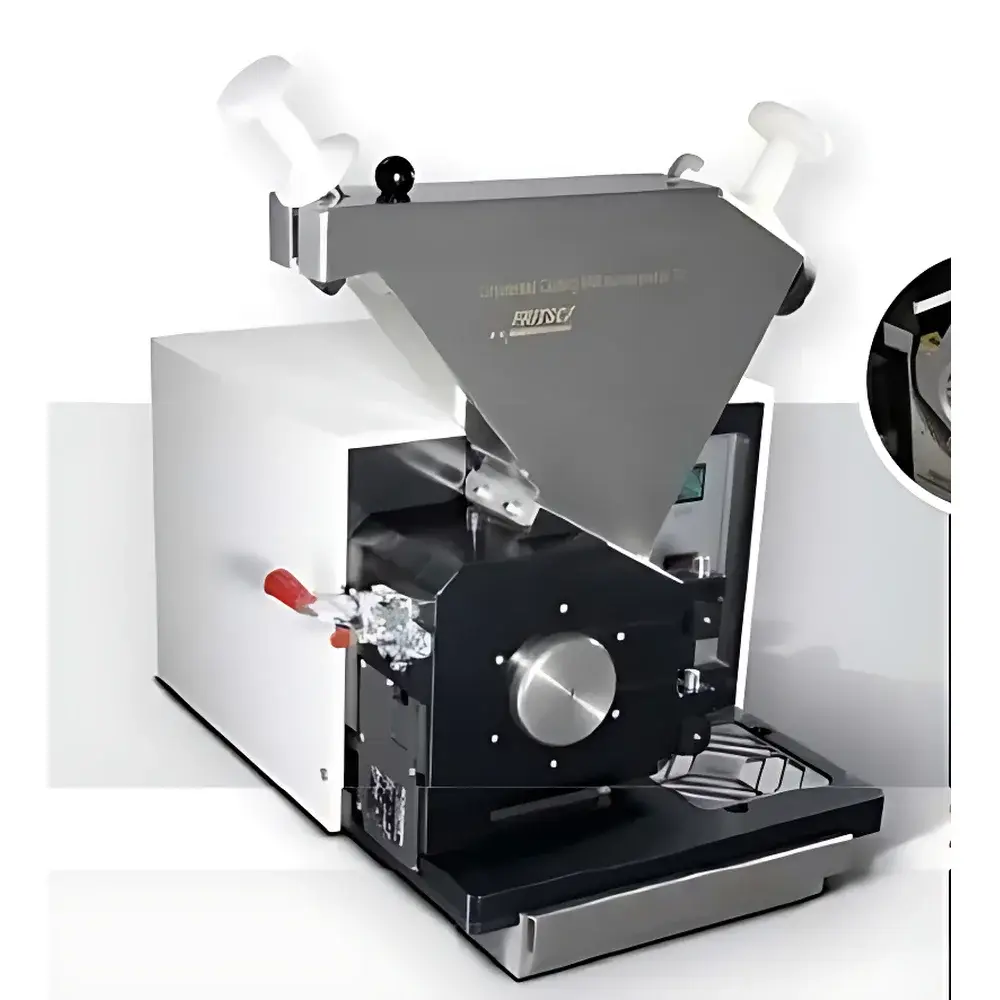
FRITSCH Pulverisette 19 Universal Cutting Mill
| Brand | FRITSCH |
|---|---|
| Origin | Germany |
| Model | Pulverisette 19 |
| Weight (net/gross) | 56 / 86 kg |
| Final particle size range | 0.25–6 mm (dependent on interchangeable sieve insert) |
| Max. feed size | 70 × 80 mm |
| Rotor speed | 2800 rpm |
| Power input | 2000 W |
| Voltage/frequency | 400 V / 3~ / 50–60 Hz |
| Grinding principle | High-speed cutting |
| Rotor & fixed blades material | Tool steel or tungsten carbide |
| Max. throughput | 60 L/h |
| Compliance | CE-marked |
| Warranty | 1 year |
Overview
The FRITSCH Pulverisette 19 Universal Cutting Mill is an industrial-grade, high-precision laboratory cutting mill engineered for reproducible size reduction of soft to medium-hard dry materials. Operating on a robust cutting principle—rather than impact, compression, or shear—the instrument employs a high-speed rotating rotor equipped with sharp, replaceable blades that interact dynamically with three stationary counter-blades mounted in the grinding chamber. This geometry ensures consistent shearing action across heterogeneous feedstocks, minimizing thermal load and preserving sample integrity—particularly critical for temperature-sensitive, fibrous, or elastic materials such as leather, rubber, cellulose-based substrates, and pharmaceutical tablets. Unlike hammer or disc mills, the Pulverisette 19 delivers narrow particle size distributions without significant overgrinding or amorphization, making it suitable for applications where downstream analytical fidelity (e.g., XRD, FTIR, or elemental analysis) depends on structural preservation.
Key Features
- High-reproducibility grinding at fixed rotor speed of 2800 rpm—optimized for rapid throughput and minimal batch-to-batch variability.
- Tool-free, modular design enables rapid exchange of rotors, fixed blade sets, and sieve inserts—reducing changeover time between sample types.
- Externally adjustable cutting gap allows fine-tuning of particle size without disassembly, supporting method development under GLP-compliant workflows.
- Full-access hinged housing and lift-off lid facilitate complete visual inspection and residue-free cleaning of all wetted surfaces—critical for cross-contamination control in regulated environments (e.g., pharmaceutical QC labs).
- Grinding components fabricated from hardened tool steel or wear-resistant tungsten carbide—ensuring long service life even with abrasive feedstocks like coal, bone, or mineralized biomass.
- CE-certified construction with integrated safety interlocks, emergency stop, and overload protection—fully compliant with EN 61000-6-2 (EMC) and EN 61000-6-4 (emission) standards.
Sample Compatibility & Compliance
The Pulverisette 19 accepts feed materials up to 70 × 80 mm in dimension and accommodates diverse physical categories: soft (e.g., dried herbs, tobacco leaves), fibrous (paperboard, cork, straw), brittle (starch granules, malt, pills), elastic (rubber, leather), and moderately abrasive (animal feed, lignocellulosic biomass, peat). It is routinely deployed in laboratories adhering to ISO/IEC 17025, USP , and ASTM D7429 (standard practice for particle size analysis of solid biofuels). Its mechanical design supports GMP-aligned operation when paired with documented cleaning procedures and calibration logs; traceability is enhanced via optional RFID-tagged sieve inserts and rotor identification.
Software & Data Management
While the Pulverisette 19 operates as a standalone electromechanical unit, its process parameters—including run duration, total operating hours, and rotor replacement cycles—are manually logged per batch. For integration into digital lab infrastructure, FRITSCH offers optional data acquisition modules compatible with LabVantage, STARLIMS, and other LIMS platforms via RS-232 or Ethernet (Modbus TCP). All firmware updates comply with IEC 62443-3-3 cybersecurity requirements. Audit trails for maintenance, calibration, and operational deviations can be maintained in accordance with FDA 21 CFR Part 11 when used with validated electronic record systems.
Applications
- Pharmaceutical: Pre-analysis comminution of coated tablets, herbal powders, and excipient blends prior to dissolution testing or content uniformity assays.
- Food & Feed: Homogenization of cereal grains, animal feed pellets, and dried meat products for proximate analysis (crude protein, fiber, ash).
- Environmental: Size reduction of soil organic matter, compost, and non-metallic waste fractions for heavy metal leaching studies (TCLP, SPLP).
- Materials Science: Preparation of polymer shreds, rubber crumb, and composite laminates for SEM-EDS or thermogravimetric characterization.
- Veterinary & Dental Research: Controlled fragmentation of bone, horn, and dental prostheses for histomorphometric or microbiological culture preparation.
FAQ
What types of materials are incompatible with the Pulverisette 19?
Wet, oily, or highly viscous samples—including pastes, gels, or emulsions—are not suitable. The mill is strictly designed for dry, free-flowing feedstocks. Materials with >10% moisture content may clog the sieve insert or cause blade adhesion.
Can the Pulverisette 19 achieve sub-100 µm particle sizes?
No. Its minimum nominal cut-point is 0.25 mm (250 µm), defined by the finest available sieve insert. Sub-millimeter grinding requires complementary equipment such as planetary ball mills or cryogenic mills.
Is the instrument suitable for Good Manufacturing Practice (GMP) environments?
Yes—provided users implement documented cleaning validation protocols, maintain rotor/sieve calibration records, and integrate usage logs into their quality management system (QMS). FRITSCH provides IQ/OQ documentation templates upon request.
How often should the cutting blades be replaced?
Blade lifetime depends on feed hardness and cumulative operating hours. Under typical use with medium-hard feedstocks (e.g., grain, wood chips), tool steel blades last ~200–300 hours; tungsten carbide variants extend this to ~800+ hours. Visual inspection for edge rounding or chipping is recommended every 50 hours.
Does FRITSCH supply certified reference materials (CRMs) for method verification?
FRITSCH does not manufacture CRMs, but the Pulverisette 19 is validated using NIST-traceable particle size standards (e.g., NIST SRM 1990a) during factory acceptance testing. Users may employ certified glass bead or alumina standards for in-house performance qualification.



