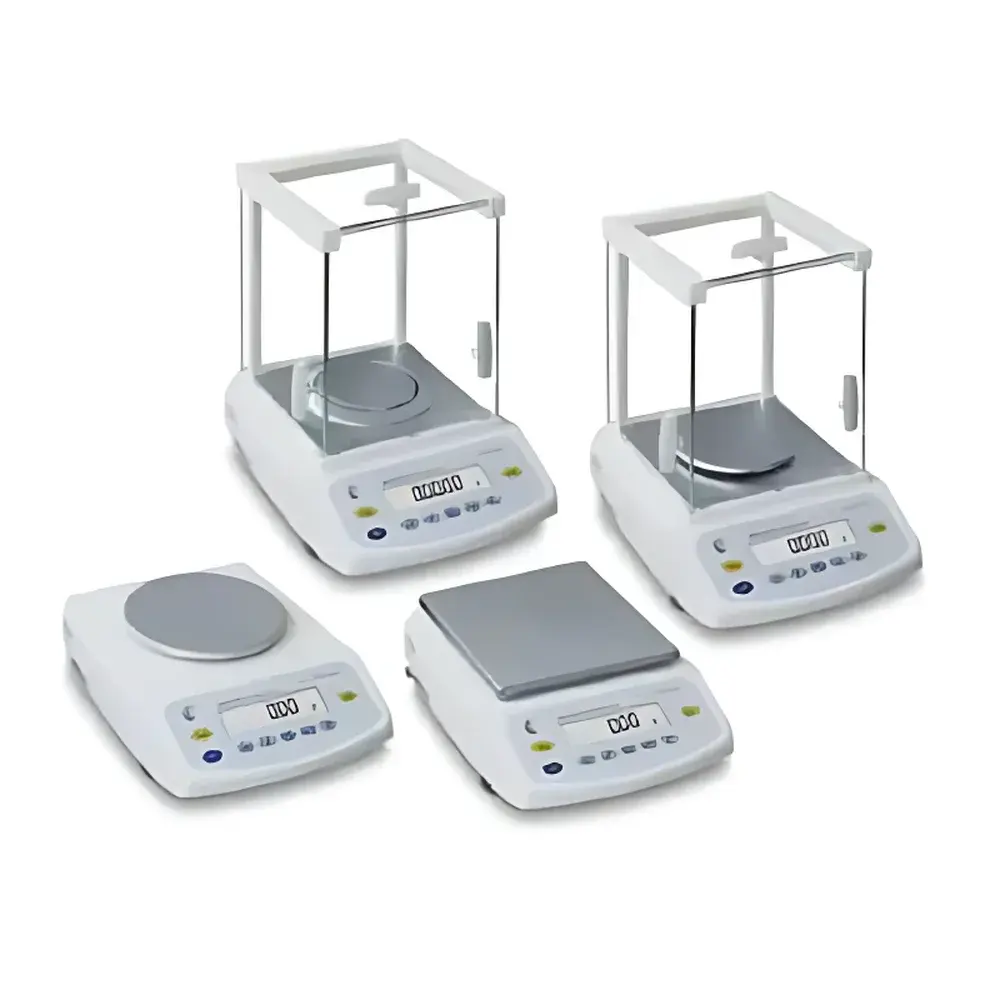
Sartorius BSA2202S-CW Precision Balance
| Brand | Sartorius |
|---|---|
| Origin | Germany |
| Model | BSA2202S-CW |
| Readability | 10 mg |
| Capacity | 2200 g |
| Calibration | Internal motorized calibration |
| Display | Backlit LCD with 15 mm high characters |
| Pan Size | 180 × 180 mm |
| Interface | RS-232C bidirectional |
| Compliance | ISO/IEC 17025, GLP/GMP data integrity support |
| Built-in Applications | Percentage weighing, parts counting, animal/dynamic weighing, unit conversion, arithmetic functions (×, ÷) |
Overview
The Sartorius BSA2202S-CW is a high-performance precision balance engineered for routine laboratory weighing tasks requiring robust repeatability, environmental resilience, and regulatory traceability. Operating on electromagnetic force compensation (EMFC) principle, it delivers stable and drift-resistant measurements even under suboptimal ambient conditions—such as minor air currents, temperature fluctuations, or mechanical vibration—through advanced digital filtering algorithms and real-time internal compensation. With a maximum capacity of 2200 g and readability of 10 mg, the BSA2202S-CW occupies a critical niche between analytical and top-loading balances, supporting volumetric preparation, formulation, sample aliquoting, and quality control workflows in pharmaceutical, chemical, food, and academic laboratories. Its German-engineered construction adheres to stringent manufacturing tolerances and long-term stability benchmarks defined in OIML R 76 and EN 45501, ensuring consistent metrological performance across its service life.
Key Features
- Motorized internal calibration system with integrated weight actuation—initiated via single-key press for rapid, operator-independent verification and adjustment.
- Backlit LCD display featuring 15 mm character height and high-contrast rendering, optimized for legibility under varied lighting conditions including low-illumination cleanrooms or brightly lit QC labs.
- Integrated leveling indicator adjacent to the display—enabling immediate visual confirmation of instrument level without external tools or secondary instrumentation.
- Ergonomic keypad layout with tactile feedback and dedicated function keys; all operations executed via single-touch activation to minimize input error during high-throughput workflows.
- RS-232C bidirectional serial interface standard-equipped—supporting direct communication with Sartorius YDP03-0CE printers or third-party LIMS/ELN systems via ASCII protocol.
- Preloaded application suite compliant with common lab protocols: percentage weighing, net weight summation, dynamic (animal) weighing, unit conversion (g, oz, ct, etc.), and basic arithmetic (multiplication/division).
Sample Compatibility & Compliance
The BSA2202S-CW accommodates samples up to 2200 g on its 180 × 180 mm stainless steel weighing pan—sufficient for beakers, flasks, filtration assemblies, and bulk powder containers. Its open pan geometry facilitates easy cleaning and minimizes static accumulation. The balance supports GLP- and GMP-aligned documentation requirements: all calibration events, adjustment logs, and user-defined parameter changes are timestamped and stored internally. When connected to a Sartorius printer or validated PC-based software (e.g., Sartorius LabX Lite), it generates audit-trail-ready reports containing operator ID, date/time stamps, environmental metadata (if external sensors are linked), and raw measurement values—fully compatible with FDA 21 CFR Part 11 electronic record expectations when deployed with appropriate system validation. It meets ISO/IEC 17025 clause 5.10 requirements for equipment verification records and satisfies key clauses of USP and regarding balance performance verification.
Software & Data Management
While the BSA2202S-CW operates autonomously via its embedded firmware, its RS-232C interface enables seamless integration into broader laboratory informatics ecosystems. It transmits stabilized weight values in real time using standard ASCII format (e.g., “S 2200.123 g”), allowing direct import into Excel, LabWare, STARLIMS, or custom Python/Matlab scripts. Optional USB-to-RS-232 adapters (Sartorius part no. YCC21) permit connection to modern workstations lacking legacy serial ports. For regulated environments, the balance’s built-in memory retains up to 99 calibration history entries—including date, time, deviation before/after adjustment, and operator code (if enabled)—accessible via menu navigation or exportable via printer. No proprietary drivers or cloud dependencies are required for basic data capture, ensuring long-term compatibility and IT infrastructure independence.
Applications
- Pharmaceutical QC: Weighing active pharmaceutical ingredients (APIs) and excipients during tablet formulation and batch release testing.
- Chemical synthesis: Accurate dispensing of reagents and catalysts where ±0.01 g tolerance is acceptable but cost-sensitive alternatives to analytical balances are preferred.
- Food & beverage labs: Moisture content determination via gravimetric loss-on-drying (LOD), ingredient proportioning, and packaging fill-weight checks.
- Academic teaching labs: Student-facing instrumentation offering intuitive operation while maintaining metrological rigor aligned with ISO/IEC 17025 training objectives.
- Environmental testing: Soil/sediment sample preparation prior to ICP-MS or AAS analysis, where gross mass accuracy supersedes microgram-level resolution.
FAQ
Does the BSA2202S-CW support external calibration with user-provided weights?
No—it is designed exclusively for internal motorized calibration using its factory-mounted, temperature-compensated calibration mass. External calibration is neither supported nor recommended per Sartorius service guidelines.
Can the balance store multiple user profiles with distinct language and unit preferences?
Yes—up to five user-configurable settings are retained in non-volatile memory, including language selection (English, German, French, Spanish, Chinese), default units, and application defaults.
Is the RS-232C interface opto-isolated for electrical noise immunity?
The interface complies with EIA/TIA-232-F specifications and includes transient voltage suppression; however, for high-noise industrial environments, Sartorius recommends use of shielded cabling and grounding at the host end.
What is the warm-up time required to achieve full specification accuracy?
The balance reaches operational stability within 30 minutes after power-on under typical lab conditions (20–25 °C, <60% RH); full metrological specification compliance is guaranteed after 60 minutes.
How often should internal calibration be performed?
Sartorius recommends initiating internal calibration at least once per shift in regulated environments, or whenever ambient temperature changes exceed ±2 °C from the last calibration event—automated prompts may be configured via menu settings.