
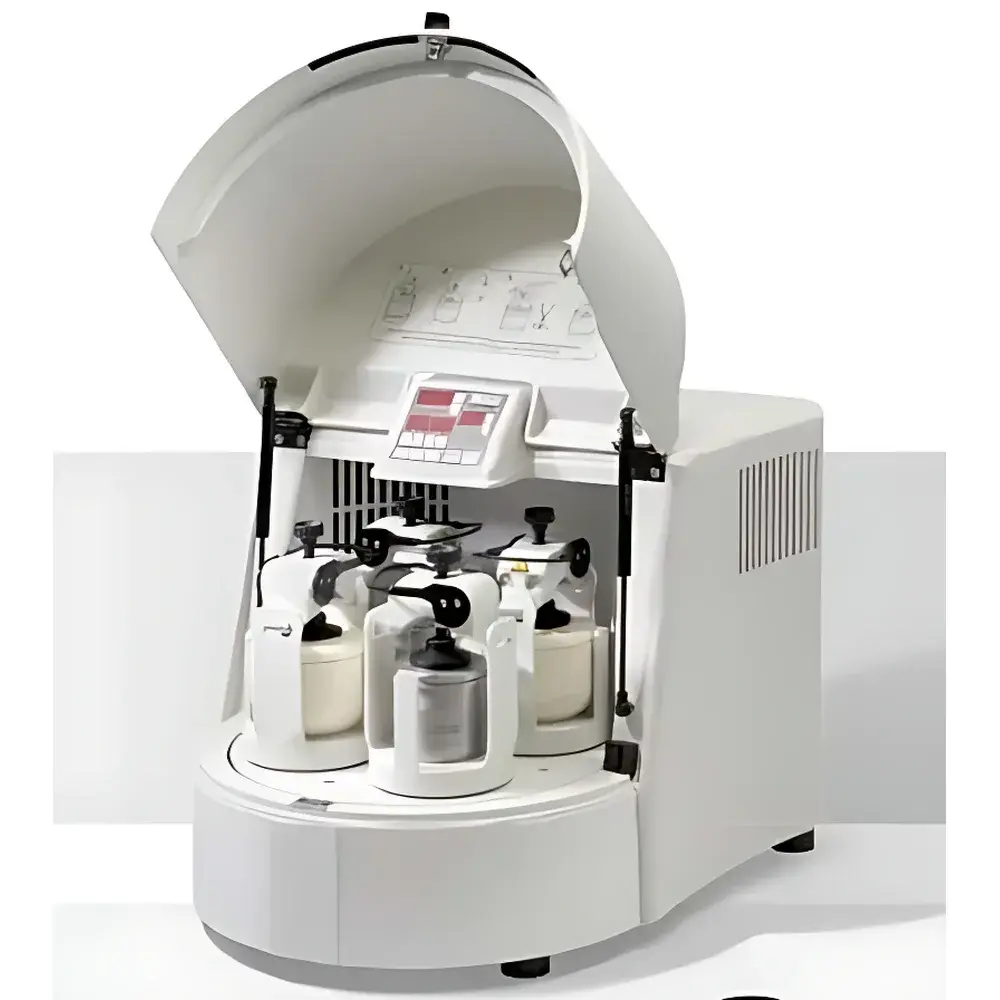
FRITSCH Pulverisette 5 Planetary Micro Mill
| Brand | Fritsch |
|---|---|
| Origin | Germany |
| Model | Pulverisette 5 |
| Instrument Type | Planetary Ball Mill |
| Maximum Sample Volume | 900 mL |
| Final Particle Size | < 1 µm |
| Feed Size (max) | 10 mm |
| Main Disc Speed | 450 rpm |
| Grinding Modes | Dry & Wet |
| Input Power | 1500 W (max), 1300 W (operational) |
| Voltage | 100–120 V / 200–240 V, 50–60 Hz |
| Dimensions (W×D×H) | 58 × 67 × 57 cm |
| Net Weight | 120 kg |
| Gross Weight | 180 kg |
| Control Interface | RS232 |
| Programmable Timing | Yes (second-precision) |
| Simultaneous Grinding | 4 large jars or 8 small jars |
| Jar Sealing | Yes (with O-ring gaskets) |
| Safety Certification | CE-compliant |
| Warranty | 1 year |
Overview
The FRITSCH Pulverisette 5 Planetary Micro Mill is a high-energy, laboratory-scale planetary ball mill engineered for reproducible, controlled comminution of solid, brittle, fibrous, soft, and even moist materials. Operating on the principle of planetary motion, the instrument subjects samples to intense impact and shear forces generated by the centrifugal acceleration of grinding balls within rotating jars mounted on a sun wheel. As the main drive disc rotates at up to 450 rpm, the jars simultaneously revolve in the opposite direction—creating a high-frequency collision regime ideal for achieving sub-micron particle size distributions (< 1 µm). Unlike conventional shaker or vibratory mills, the Pulverisette 5 delivers superior energy transfer efficiency and thermal management via programmable cooling intervals, making it suitable for temperature-sensitive applications such as mechanochemical synthesis, amorphization, and phase transformation studies.
Key Features
- Four-jar planetary configuration enables parallel processing of up to four large-volume grinding jars (e.g., 500 mL stainless steel) or eight smaller jars—enhancing throughput without compromising inter-batch reproducibility.
- Precise digital control of grinding time (programmable down to 1-second increments), rotational speed, and cooling pauses ensures strict adherence to standardized protocols (e.g., ASTM E2909, ISO 13320 for particle size method validation).
- RS232 interface supports bidirectional communication with external PCs for remote parameter upload, real-time monitoring, and audit-trail-capable data logging—fully compatible with GLP/GMP environments requiring FDA 21 CFR Part 11–compliant electronic records.
- Interchangeable jar and ball materials—including agate, stainless steel, tungsten carbide, zirconium oxide, and PTFE—allow contamination-free processing across diverse sample chemistries (e.g., alkali-sensitive ceramics, halogen-rich pharmaceuticals, or reactive metal powders).
- O-ring-sealed jar lids enable inert-atmosphere milling (N₂, Ar) for oxidation-prone alloys or air-sensitive precursors, supporting mechanical alloying and nanocomposite synthesis per ASTM B890 and ISO/IEC 17025 requirements.
- Integrated safety lock system, CE-certified enclosure, and automatic emergency stop ensure compliance with EN 61000-6-2 (EMC) and EN 61000-6-4 (emission) standards for laboratory instrumentation.
Sample Compatibility & Compliance
The Pulverisette 5 accommodates a broad spectrum of sample types: hard (e.g., quartz, silicon carbide), medium-hard (feldspar, limestone), soft (graphite, polymers), brittle (glass frit, pharmaceutical tablets), fibrous (cellulose, carbon fibers), coarse (ore fragments), and moisture-containing (wet pastes, slurries, emulsions). Its dual dry/wet grinding capability—combined with sealed jar options—permits homogenization of suspensions and colloidal dispersions without solvent loss or cross-contamination. The instrument meets key international regulatory benchmarks: ISO 17025-accredited labs routinely validate its performance using certified reference materials (CRMs) for particle size distribution (PSD) analysis; its design supports USP and EP 2.9.32 methods for pharmaceutical granule fineness testing.
Software & Data Management
While the Pulverisette 5 operates autonomously via its front-panel controller, the optional FRITSCH LabSuite software (Windows-compatible) extends functionality through intuitive workflow scripting, multi-step sequence programming (e.g., “grind-cool-grind” cycles), and automated report generation. All parameter sets—including speed profiles, dwell times, and jar identification codes—are timestamped and exportable as CSV or PDF. Audit trails record operator ID, session start/end times, deviations from setpoints, and system error logs—enabling full traceability required under GLP, GMP, and ISO 9001 quality management systems.
Applications
This mill is widely deployed in academic and industrial R&D settings for tasks including: mineralogical sample preparation prior to XRD/XRF analysis; homogenization of ceramic green bodies and battery electrode slurries; production of nanostructured metal oxides for catalysis; reduction of metallurgical assay samples to analytical fineness; mechanochemical synthesis of MOFs and solid electrolytes; and particle size reduction of polymer composites for rheological characterization. Its versatility makes it indispensable in geochemical laboratories (ASTM D4294), cement research (EN 196-6), and nuclear materials handling (IAEA SSG-46 compliant workflows).
FAQ
What jar volumes are supported?
Standard configurations support four 500 mL jars or eight 80 mL jars; custom jar sizes (e.g., 125 mL, 250 mL) are available upon request.
Can the mill operate under inert gas?
Yes—jars equipped with gas-tight sealing caps allow purging with N₂ or Ar for air-sensitive reactions or oxidation prevention.
Is wet grinding possible?
Yes—sealed jars with O-ring gaskets prevent leakage during slurry processing; solvent compatibility must be verified per jar material (e.g., PTFE for aggressive acids).
How is temperature rise managed during extended grinding?
Programmable cooling intervals (up to 99 minutes) interrupt grinding cycles automatically; optional external chillers can be integrated via auxiliary ports.
Does the system support regulatory compliance documentation?
Yes—full IQ/OQ documentation packages, calibration certificates, and 21 CFR Part 11–ready software modules are available for validated lab environments.



