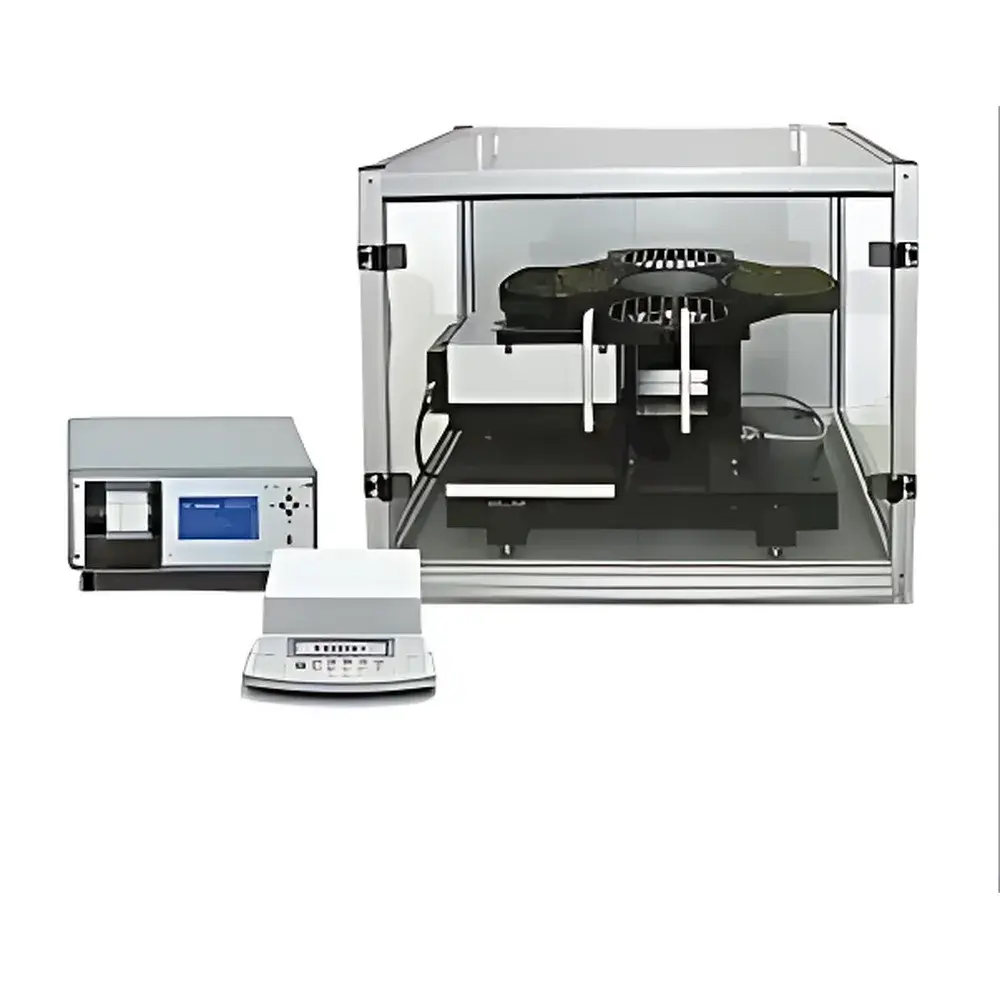
Sartorius QCM-20 Automatic Mass Comparator
| Brand | Sartorius |
|---|---|
| Origin | Germany |
| Model | QCM-20 |
| Capacity | 10–20 kg |
| Accuracy Class Support | E1 and E2 weights |
| Automation Level | Fully automatic mass comparison with integrated loading mechanism |
| Display | Touchscreen, backlit graphical display with multilingual UI (English + 4 others) |
| Data Output | Integrated thermal printer |
| Environmental Adaptation | Adjustable digital filtering for air turbulence, temperature drift, and vibration compensation |
| Thermal Management | Decoupled electronics module to minimize thermal influence on weighing cell |
| Visual Feedback | Linear bar graph indicating real-time load within rated range |
| Compliance | Designed in accordance with OIML R 111, ISO/IEC 17025, and EU Directive 2014/32/EU (MID) |
Overview
The Sartorius QCM-20 Automatic Mass Comparator is a metrology-grade instrument engineered for high-accuracy mass comparison of standard weights in calibration laboratories and national metrology institutes. It operates on the principle of substitution weighing using electromagnetic force compensation (EMFC) technology, delivering traceable, repeatable results under controlled environmental conditions. Designed specifically for the verification and calibration of E1 and E2 class reference weights per OIML R 111, the QCM-20 eliminates manual handling errors by integrating a motorized loading mechanism that positions test and reference masses without physical contact or stacking. Its 10–20 kg capacity range supports both individual weight comparisons and group-wise intercomparisons—enabling full matrix evaluation of weight sets without reconfiguration. The comparator’s mechanical architecture features an isolated weighing chamber, active air-draft suppression, and a thermally decoupled electronics module to mitigate thermal drift—a critical factor in long-duration calibration cycles.
Key Features
- Fully automated mass comparison sequence with programmable load/unload routines for up to 20 kg weights
- Integrated motorized loading arm compliant with OIML R 111 Annex C requirements for non-contact mass transfer
- Backlit graphical touchscreen interface supporting English, French, German, Spanish, and Chinese—configurable per user preference
- Real-time linear bar graph visualization of applied load relative to full-scale capacity, enhancing operator situational awareness
- Adaptive digital filtering algorithms tuned to local environmental parameters—including air turbulence, floor vibration frequency, and ambient temperature gradients
- Thermally isolated electronics housing minimizing heat conduction to the weighing sensor, ensuring stability during extended measurement sessions
- Built-in thermal printer for immediate hardcopy generation of comparison reports, including timestamp, operator ID, and environmental logs
Sample Compatibility & Compliance
The QCM-20 accommodates cylindrical, polygonal, and rectangular standard weights conforming to OIML R 111 geometries, with diameters up to 180 mm and heights up to 220 mm. It supports single-point comparisons, pairwise comparisons, and full-matrix group evaluations (e.g., 1–2–5 series). All internal procedures adhere to ISO/IEC 17025:2017 requirements for calibration laboratories, including documented uncertainty budgets, traceability chains to national standards (e.g., PTB, NIST), and audit-ready procedural records. The system meets the essential requirements of the European Measuring Instruments Directive (2014/32/EU) and is suitable for use in GLP-compliant environments where formal metrological validation is mandated.
Software & Data Management
The QCM-20 runs Sartorius MassCal Suite v3.x firmware, which provides configurable measurement protocols aligned with EURAMET cg-18 and BIPM CCAUV.K1 guidelines. Data acquisition includes synchronized logging of temperature, humidity, barometric pressure, and vibration RMS values at 1 Hz resolution. All measurement sequences generate encrypted binary data files (.qcm) compatible with Sartorius LabX software for post-processing, uncertainty analysis, and certificate generation. Audit trails comply with FDA 21 CFR Part 11 requirements—featuring electronic signatures, immutable timestamps, role-based access control, and full revision history for all configuration changes and report exports.
Applications
- Primary and secondary calibration of E1 and E2 stainless-steel and brass weights in national metrology institutes
- Inter-laboratory comparison studies coordinated under CIPM MRA frameworks
- Periodic verification of working standards in pharmaceutical QC labs operating under GMP Annex 4 and USP
- Uncertainty budget development for mass calibration according to GUM (JCGM 100:2008)
- Validation of mass standards used in analytical balance calibration programs across ISO 9001-certified facilities
- Training platforms for metrologists requiring hands-on experience with automated mass comparison methodology
FAQ
What weight classes can the QCM-20 calibrate?
The QCM-20 is validated for E1 and E2 class weights from 10 g to 20 kg, in accordance with OIML R 111 Edition 2022.
Does the system support remote operation or network integration?
Yes—it features Ethernet and RS-232 interfaces, enabling integration into centralized LabX networks and remote monitoring via secure TLS-encrypted connections.
Is the thermal printer optional or built-in?
A thermal printer is factory-integrated and cannot be omitted; it ensures immediate, tamper-evident reporting compliant with ISO/IEC 17025 clause 7.8.3.
How does the QCM-20 handle air buoyancy corrections?
Buoyancy correction is applied automatically using entered air density (calculated from measured T, P, RH) and material density values stored in the weight database.
Can the system be used for mass calibration under ISO/IEC 17025 accreditation?
Yes—the QCM-20 includes full documentation packages for method validation, equipment qualification (IQ/OQ/PQ), and uncertainty evaluation templates required for accreditation bodies such as UKAS, DAkkS, and A2LA.