OHAUS Adventurer Analytical and Precision Balances
| Brand | OHAUS |
|---|---|
| Origin | USA |
| Distributor Type | Authorized Distributor |
| Import Status | Imported |
| Pricing | Upon Request |
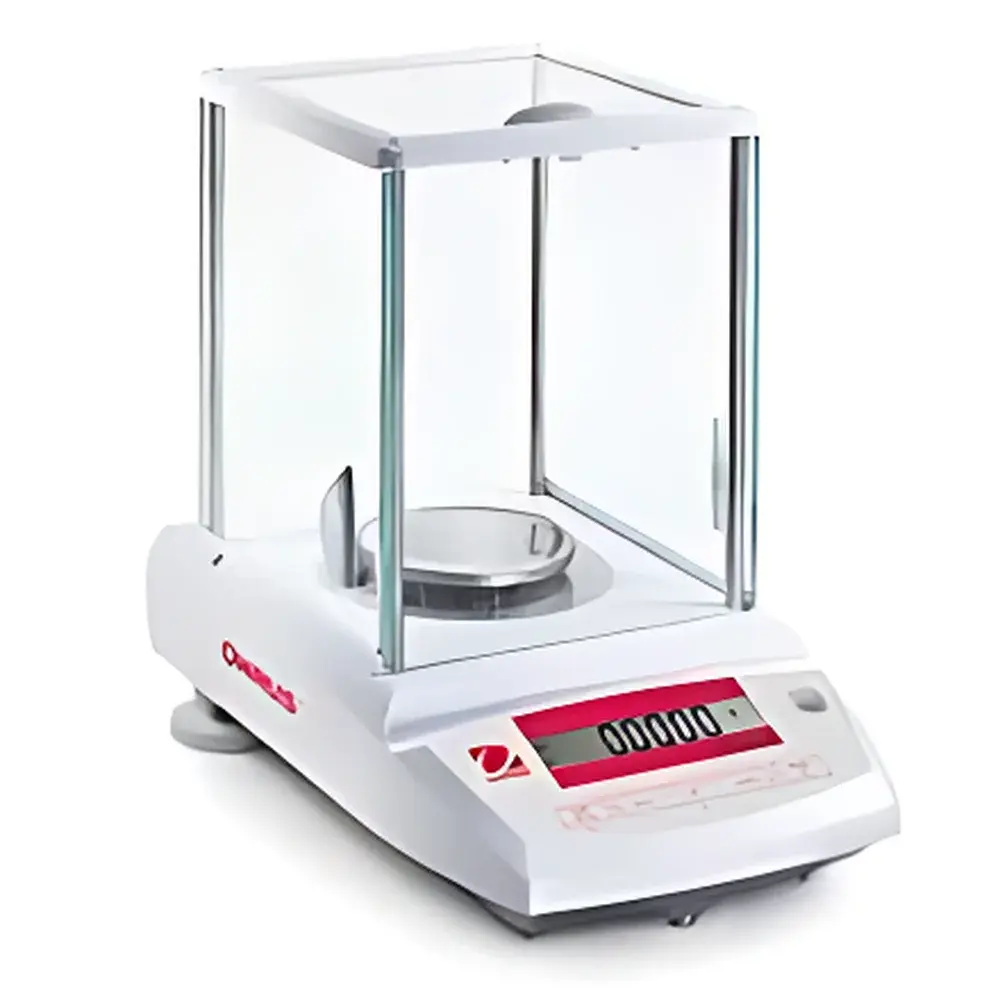
| Display | LCD with high-contrast backlight |
| Interface | RS232 serial port |
| Power Supply | Integrated AC adapter |
| Weighing Pan | Removable stainless steel |
| Draft Shield | Full-glass, three-sliding-door design (for 0.1 mg and 1 mg models) |
| Leveling | Front-mounted bubble level |
| Security | Menu lock and calibration lock |
| Construction | Metal base, ABS housing, stainless steel pan, electrostatic-dissipative side and top sliding doors |
| Optional | Replaceable plastic protective panel cover |
| IP Rating | IP42 (dust-protected, drip-resistant) |
| Compliance | ISO/IEC 17025-compatible operation, NIST-traceable calibration support, GLP/GMP-ready data logging |
Overview
The OHAUS Adventurer series represents a class of high-performance analytical and precision balances engineered for reproducible mass measurement in regulated laboratory, quality control, and research environments. These instruments operate on electromagnetic force compensation (EMFC) technology — a principle wherein the weight-induced displacement of the load receptor is counteracted by a precisely controlled electromagnetic field; the resulting current is linearly proportional to mass and digitally converted into a stable, high-resolution reading. Designed for compliance-critical workflows, the Adventurer platform delivers consistent repeatability (≤ 0.0001 g for 0.1 mg models), low drift (< 0.0002 g/30 min), and temperature-stable performance across typical lab conditions (10–30 °C). Each unit undergoes factory calibration using NIST-traceable standards and supports internal or external adjustment via user-accessible calibration routines.
Key Features
- High-contrast, backlit LCD display with intuitive icon-driven interface — optimized for readability under varied ambient lighting and gloved operation.
- Modular draft shield assembly featuring full-glass construction with three independent sliding doors (standard on 0.1 mg and 1 mg models), minimizing air turbulence while enabling unobstructed access during sample handling.
- Removable stainless steel weighing pan and integrated leveling system with front-mounted bubble vial — facilitating rapid cleaning, maintenance, and positional accuracy verification.
- RS232 serial interface compliant with standard ASCII protocol — enabling direct connection to PCs, printers, or LIMS without proprietary drivers; supports configurable baud rates (9600–115200 bps) and data output formats (e.g., SICS, OIML).
- Robust mechanical architecture: die-cast metal base for vibration damping, impact-resistant ABS housing, and electrostatic-dissipative sliding doors to mitigate charge-related weighing errors.
- User-configurable security settings including menu lock, calibration lock, and password-protected configuration changes — supporting audit readiness per FDA 21 CFR Part 11 and ISO/IEC 17025 requirements.
Sample Compatibility & Compliance
The Adventurer series accommodates diverse sample geometries and environmental demands through scalable capacity and resolution options — from microgram-level analysis (65 g × 0.1 mg) to heavy-duty precision tasks (4200 g × 0.01 g). All models feature stainless steel pans compatible with common solvents and non-corrosive chemicals. The IP42 ingress protection rating ensures operational integrity against dust accumulation and vertical drips, making them suitable for shared lab spaces and QC benches. Certification-related parameters — including verification scale interval (e), maximum permissible error (MPE), and linearity deviation — conform to OIML R 76-1 and NIST Handbook 44 Class I and II specifications. Documentation packages include factory calibration certificates traceable to NIST, as well as optional IQ/OQ protocols for GxP validation.
Software & Data Management
Adventurer balances support seamless integration into digital lab infrastructures. The RS232 interface allows real-time data streaming to third-party software (e.g., LabWare LIMS, Thermo Fisher SampleManager) or custom-built applications using standard SCPI-like command sets. Internal memory stores up to 999 weighing records with timestamps, operator IDs (via optional keypad input), and net/gross/tare tags. For enhanced traceability, optional USB-to-RS232 adapters enable export to CSV or TXT files with GLP-compliant metadata — including date/time stamps, calibration history, and environmental condition logs (when paired with optional temperature/humidity sensors). Audit trail functionality meets baseline requirements for FDA 21 CFR Part 11 when deployed with validated software layers.
Applications
- Pharmaceutical QC: Active pharmaceutical ingredient (API) dispensing, excipient ratio verification, and stability study sample preparation per USP <41> and EP 2.1.3.
- Academic Research: Gravimetric analysis in analytical chemistry labs, catalyst loading quantification, and polymer synthesis yield determination.
- Materials Science: Density determination via buoyancy method, powder flow characterization, and composite formulation batching.
- Food & Beverage Testing: Nutrient labeling compliance (FDA 21 CFR 101), moisture content calculation (ASTM D4442), and portion control validation.
- Environmental Labs: Filter weighing for particulate matter (PM2.5/PM10) analysis per EPA Method IO-4.2 and ISO 12103-1.
FAQ
What is the difference between internal and external calibration?
Internal calibration uses a built-in motorized weight mechanism for automated, temperature-compensated adjustment. External calibration requires manual placement of certified weights and is typically used where regulatory guidelines mandate physical traceability.
Can the Adventurer balance be connected to a networked LIMS?
Yes — via RS232-to-Ethernet gateways or serial server devices, provided the LIMS supports ASCII-based instrument communication protocols and configurable data parsing rules.
Is GLP-compliant printout available without additional software?
Standard RS232 output includes timestamp, net weight, units, and stability indicator; full GLP reports (with operator ID, calibration status, and environmental data) require integration with validated data acquisition software.
How often should routine calibration be performed?
Frequency depends on usage intensity, environmental stability, and risk assessment per ISO/IEC 17025 Clause 6.5; daily zero checks and weekly calibration are common baseline practices in accredited labs.
Are replacement parts such as draft shields and pans available separately?
Yes — OHAUS provides genuine spare components including glass draft shields (part numbers vary by model), stainless steel pans, leveling feet, and protective covers, all documented in the official service manual.