
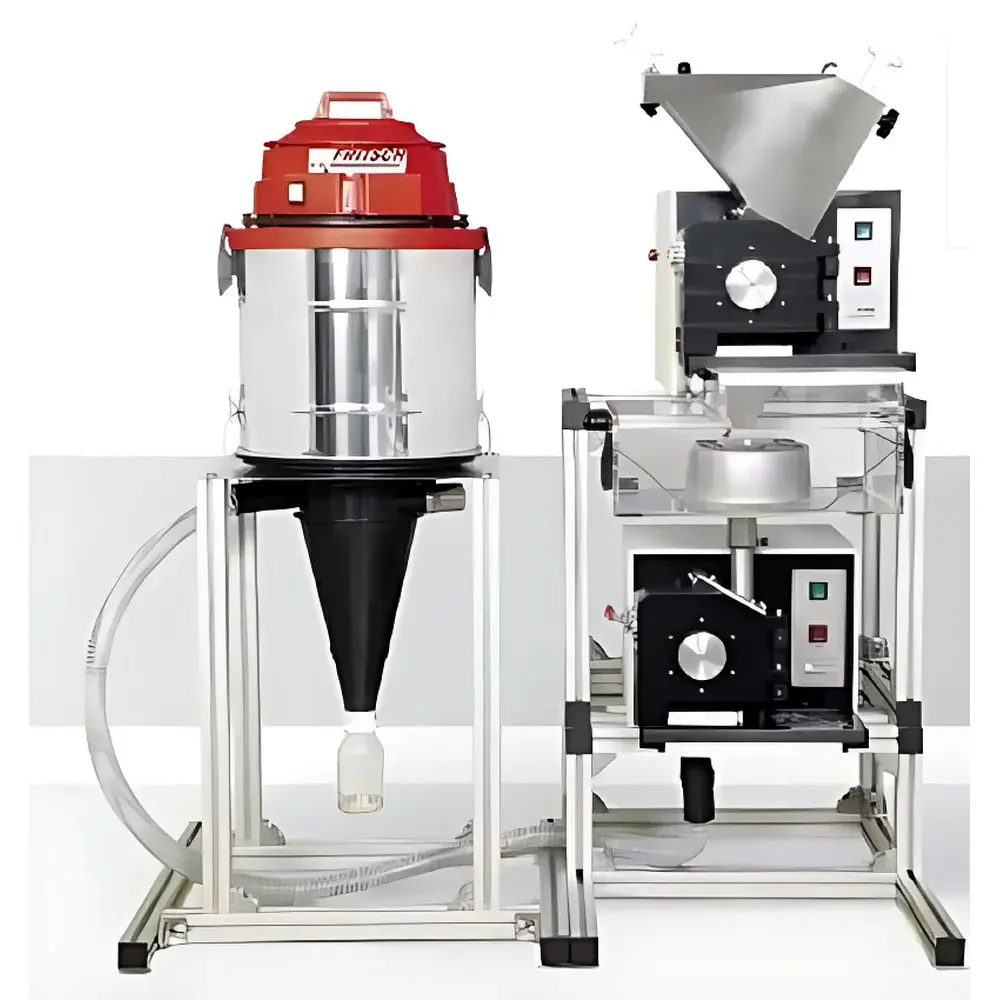
Fritsch Pulverisette 25 & Pulverisette 19 Cutting and Universal Grinding System
| Brand | Fritsch |
|---|---|
| Origin | Germany |
| Model | Pulverisette 25 & Pulverisette 19 |
| Input Voltage | 400 V / 3~ |
| Frequency | 50–60 Hz |
| Input Power | 6340 W |
| Rotor Speed | 2800 rpm |
| Max Feed Size | 120 × 85 mm |
| Throughput | 60 L/h |
| Final Particle Size Range | 0.25–6 mm (dependent on sieve insert) |
| Grinding Media | Stainless Steel, Tungsten Carbide |
| Grinding Principle | Shear Force |
| Dimensions (W×D×H) | 62 × 82 × 145 cm |
| Net Weight | 214 kg |
| Gross Weight | 244 kg |
| Moisture Tolerance | Up to 30% water vapor content |
| Sample Types | Medium-hard, soft, brittle, coarse, fibrous, temperature-sensitive materials |
Overview
The Fritsch Pulverisette 25 & Pulverisette 19 Cutting and Universal Grinding System is a two-stage, high-capacity sample preparation solution engineered for reproducible size reduction of heterogeneous, compositionally complex solid materials. Designed in accordance with DIN ISO 17025 principles for laboratory testing integrity, this system employs mechanical shear force as its primary comminution mechanism—leveraging precisely engineered rotating cutters and adjustable feed dynamics to achieve controlled particle size distribution without thermal degradation or cross-contamination. The integrated tandem configuration enables direct processing of bulk samples up to 30 mm edge length into representative sub-samples <500 µm within five minutes—meeting critical throughput requirements for routine environmental, waste characterization, and energy content analysis workflows. Its architecture supports GLP-compliant operation in accredited laboratories performing standardized methods such as DIN EN 15403 (determination of calorific value), DIN EN 15410 (chlorine content in solid recovered fuels), and ASTM D5865 (gross calorific value of coal and coke).
Key Features
- Two-stage automated grinding process: Pulverisette 25 performs coarse pre-grinding; Pulverisette 19 executes fine-size adjustment and homogenization
- Adjustable feed rate control ensures consistent mass flow and minimizes operator intervention
- Cyclonic separation system collects ground material directly into collection vessels—eliminating manual sieving and reducing handling-induced variability
- Tool-free accessibility for rotor, cutter, and sieve module replacement—enabling rapid reconfiguration between applications
- Integrated ventilation-cooling design maintains stable operating temperatures during extended runs—even with moisture-laden feedstocks (up to 30% water vapor)
- No screen clogging due to optimized airflow path and self-cleaning geometry of the cyclone and discharge channel
- Standard tungsten carbide cutting tools ensure long service life when processing abrasive or hard components commonly found in municipal solid waste, construction debris, and recycling stream fractions
- Modular compatibility with all Fritsch Pulverisette 19 and 25 accessories—including alternative sieve inserts (0.25–6 mm), specialized rotors, and dust-tight feed hoppers
Sample Compatibility & Compliance
This system is validated for use with medium-hard, soft, brittle, coarse, fibrous, and thermally sensitive matrices—including household residual waste, demolition rubble, RDF/SRF fractions, shredded electronic scrap, composted organics, and mixed recyclables from German dual-system collection streams. It complies with structural safety standards per EN 61000-6-2 (EMC immunity) and EN 61000-6-4 (EMC emission), and meets CE machinery directive 2006/42/EC requirements. For regulated environments, the system supports audit-ready documentation protocols when paired with optional Fritsch LabSuite software (see Software & Data Management). While not intrinsically explosion-proof, it may be operated in ATEX Zone 22 environments when equipped with grounded conductive components and appropriate dust extraction.
Software & Data Management
When interfaced with Fritsch LabSuite v3.x (optional), the Pulverisette 25/19 system enables traceable parameter logging—including runtime, feed rate setpoint, motor load history, and ambient temperature. The software supports user-defined method templates aligned with ISO/IEC 17025 documentation frameworks and generates PDF reports compliant with internal QA procedures. Audit trail functionality satisfies FDA 21 CFR Part 11 requirements for electronic records when deployed with role-based access control and digital signature modules. Raw operational data exports to CSV or Excel formats facilitate integration into LIMS platforms or statistical process control (SPC) dashboards used in waste-to-energy certification labs.
Applications
- Routine preparation of heterogeneous waste samples for calorimetric analysis (e.g., gross calorific value per DIN EN 15403)
- Homogenization of mixed construction and demolition debris prior to elemental analysis (Cl, S, heavy metals)
- Production of representative sub-samples from large-volume SRF/RDF batches for compliance testing against EN 15359
- Preparation of composite feedstock for pyrolysis or gasification pilot studies
- Size reduction of contaminated soils and industrial sludges prior to leaching tests (e.g., DIN EN 12457)
- Processing of biomass blends containing fibrous and woody fractions for proximate and ultimate analysis
FAQ
What types of feed materials are compatible with this system?
It handles medium-hard, soft, brittle, coarse, fibrous, and temperature-sensitive solids—including municipal solid waste, construction rubble, shredded plastics, compost, and RDF/SRF mixtures.
Can the system operate continuously under high-moisture conditions?
Yes—designed for feedstocks containing up to 30% water vapor; ventilation-cooling prevents condensation buildup and maintains rotor performance.
Is the final particle size adjustable?
Yes—final size is determined by interchangeable sieve inserts (0.25–6 mm); selection depends on downstream analytical requirements (e.g., 1 mm for calorific value testing, 0.5 mm for chlorine analysis).
How is cross-contamination minimized between sample batches?
The cyclonic separation system eliminates contact between ground product and moving parts; tool-free disassembly allows rapid cleaning of critical zones (rotor chamber, feed throat, cyclone body) without specialized instruments.
Does the system support regulatory compliance for accredited testing labs?
Yes—when used with LabSuite software and documented SOPs, it supports ISO/IEC 17025, GLP, and FDA 21 CFR Part 11 requirements through full parameter traceability and electronic audit trails.



