
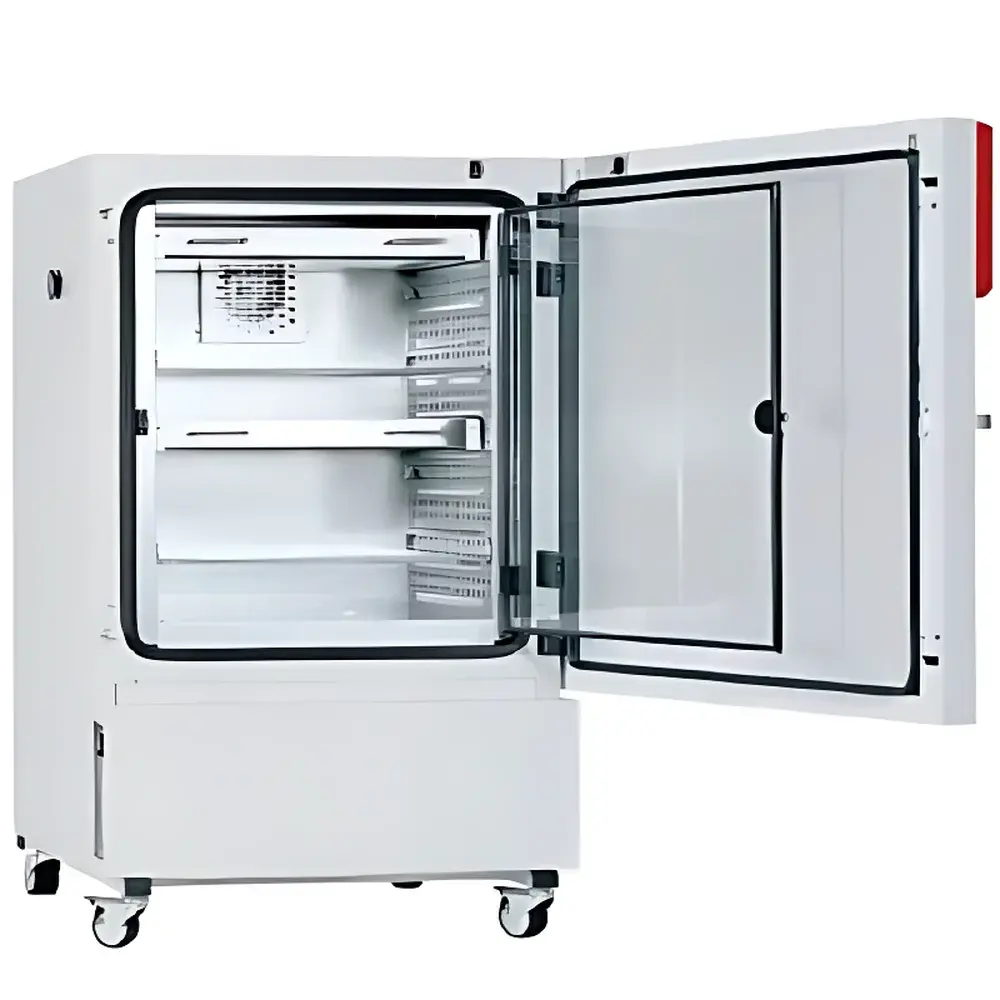
BINDER KBF P / KBF LQC Series Photostability Chambers
| Brand | BINDER |
|---|---|
| Origin | Germany |
| Model Series | KBF P / KBF LQC |
| Temperature Range | 0–70 °C (dark, dry) |
| Humidity Range | 10–80 % r.H. (dark) |
| Temp. Uniformity | ±0.1 °C |
| Humidity Uniformity | ±1.5 % r.H. |
| Light Source | Dual Q1B Synergy Light™ lamp modules (each with 3 white + 2 Q1B fluorescent tubes) |
| Software | APT-COM® for data logging & audit trail |
Overview
The BINDER KBF P and KBF LQC Series Photostability Chambers are precision-engineered environmental test systems designed explicitly for regulatory-compliant photostability testing of pharmaceuticals, biologics, and active pharmaceutical ingredients (APIs) in accordance with the International Council for Harmonisation (ICH) Q1B guideline—specifically Option 2, “Option 2: Exposure to an Overall Illuminance of Not Less Than 1.2 Million Lux Hours and an Ultraviolet Energy of Not Less Than 200 Wh/m².” These chambers integrate tightly controlled temperature, humidity, and spectrally validated artificial daylight illumination within a single, validated chamber architecture. Unlike general-purpose climate chambers, the KBF P and KBF LQC employ BINDER’s proprietary Q1B Synergy Light™ technology—a dual-lamp-module system engineered to replicate the spectral power distribution (SPD) required by ICH Q1B, including critical UV-A (320–400 nm) and visible (400–800 nm) bands. The chamber’s thermal and hygrometric stability—±0.1 °C temperature uniformity and ±1.5 % r.H. humidity control—is maintained concurrently with illumination, enabling simultaneous stress application under pharmacopeial conditions.
Key Features
- ICH Q1B Option 2–compliant illumination system featuring two independent Q1B Synergy Light™ lamp modules, each housing three pure-white fluorescent tubes and two dedicated Q1B-balanced fluorescent tubes for precise UV/visible spectral output.
- Patented 3D photometric measurement system (KBF LQC only): Two spherical isotropic sensors continuously monitor irradiance across the entire chamber volume—separately quantifying visible light (lux) and UV-A energy (Wh/m²)—with real-time display and automated exposure termination upon reaching user-defined thresholds.
- Robust stainless-steel inner chamber with electropolished finish, corrosion-resistant construction, and double-glazed tempered glass door(s) for optical clarity and thermal insulation.
- Advanced PID-controlled refrigeration and steam-humidification system ensuring stable operation across full temperature (0–70 °C) and humidity (10–80 % r.H.) ranges—even during concurrent illumination and humidification cycles.
- Modular shelving configuration: Standard stainless-steel shelves (2 included), expandable up to 5 (KBF 115), 9 (KBF 240), or 16 (KBF 720) positions—optimized for sample tray orientation and airflow uniformity.
- APT-COM® software integration supporting 21 CFR Part 11–compliant electronic records: full audit trail, user access control, parameter change logging, and exportable test reports with timestamped irradiance, temperature, and humidity profiles.
Sample Compatibility & Compliance
The KBF P and KBF LQC accommodate standard pharmaceutical packaging formats—including vials, blister packs, syringes, and stability trays—within configurable internal volumes (115 L, 240 L, or 720 L). All models meet ISO 14644-1 Class 5 cleanroom-compatible air filtration standards and are validated per IQ/OQ protocols aligned with GMP Annex 15 requirements. Chamber performance verification follows ASTM E2709 and USP guidance for photostability apparatus qualification. Full compliance documentation—including spectral irradiance calibration certificates traceable to PTB (Physikalisch-Technische Bundesanstalt, Germany)—is supplied with each unit. The system supports GLP and GDP environments through configurable alarm thresholds, event logging, and hardware interlocks preventing unauthorized parameter overrides.
Software & Data Management
APT-COM® software provides centralized remote monitoring, multi-user role-based access, and automated report generation compliant with FDA 21 CFR Part 11 requirements. It captures time-synchronized datasets for temperature, relative humidity, visible irradiance (lux), and UV-A dose (Wh/m²) at user-defined intervals (down to 1-second resolution). The software enables pre-test exposure time calculation based on target irradiance values, dynamic adjustment of lamp duty cycles, and post-test spectral dose summation. All raw data files are stored in encrypted .csv and .pdf formats with digital signature integrity checks. Audit trails record operator identity, timestamp, parameter changes, alarm events, and manual interventions—ensuring full traceability for regulatory inspections.
Applications
- ICH Q1B photostability studies for new drug applications (NDAs), marketing authorization applications (MAAs), and generic product submissions.
- Forced degradation studies evaluating photochemical degradation pathways of APIs and final dosage forms.
- Comparative light exposure testing across multiple batches or formulations under identical environmental stressors.
- Stability protocol development and validation for long-term, accelerated, and intermediate storage conditions per ICH Q5C.
- Quality control release testing of light-sensitive products such as antibiotics, vitamins, monoclonal antibodies, and ophthalmic solutions.
- Supporting regulatory responses to health authority queries regarding photodegradation mechanisms and shelf-life justification.
FAQ
Does the KBF LQC automatically calculate required exposure duration?
Yes—the integrated 3D photometric system measures real-time irradiance and UV-A dose, compares it against user-defined target values, and calculates remaining exposure time. Upon reaching the threshold, the system terminates illumination automatically.
Is spectral calibration performed at the factory?
Each unit ships with a PTB-traceable spectral irradiance calibration certificate covering 320–800 nm, verified using a calibrated spectroradiometer prior to shipment.
Can the chamber operate at 60 °C with 75 % r.H. while illuminated?
Yes—this is a defined operational mode per ICH Q1B Option 2 and is fully supported across all KBF P and KBF LQC models.
What validation support is provided for GMP environments?
BINDER supplies IQ/OQ documentation templates, DQ support packages, and on-site qualification services—including temperature/humidity mapping and irradiance uniformity mapping per ISO 14644-3.
Is APT-COM® compatible with LIMS and enterprise MES systems?
Yes—via OPC UA and RESTful API interfaces, enabling bidirectional data exchange with major laboratory information management systems and manufacturing execution systems.



