
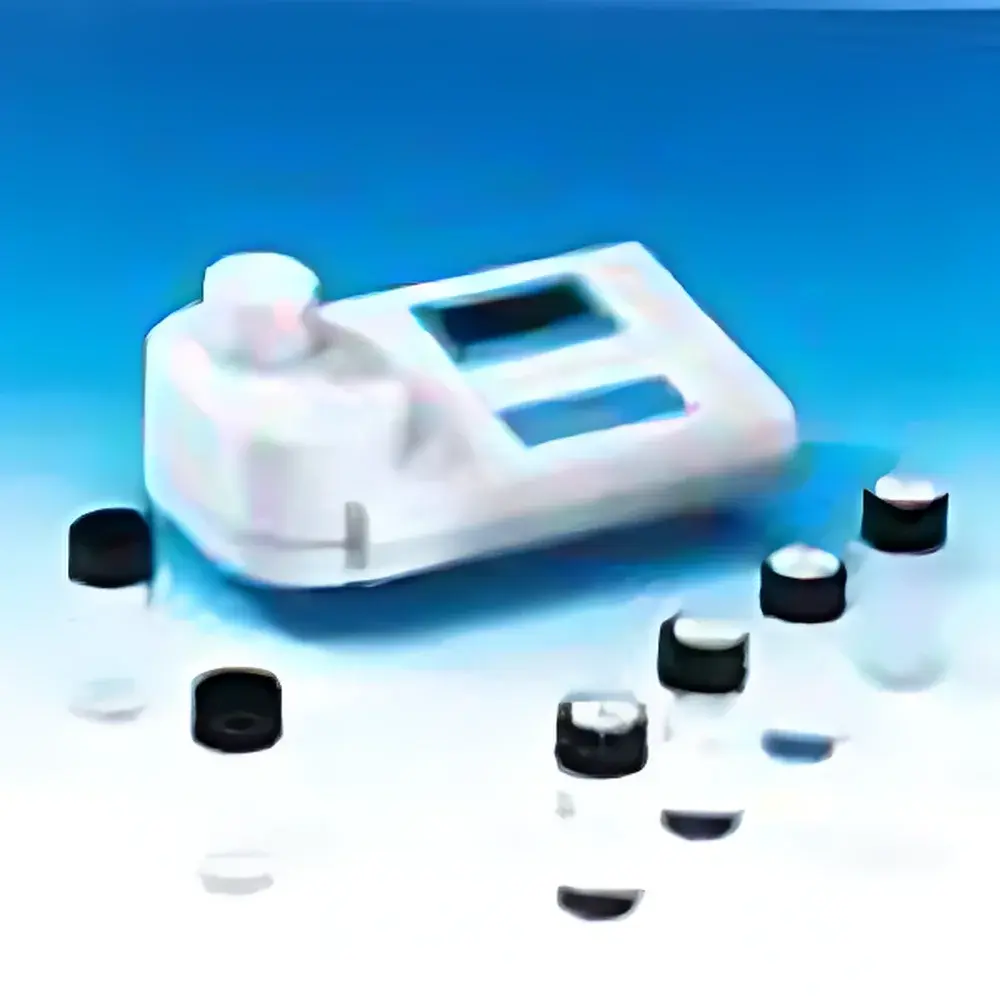
Lovibond ET76020 Advanced Microprocessor Turbidimeter
| Brand | Lovibond (Tintometer) |
|---|---|
| Origin | United Kingdom |
| Model | ET76020 |
| Measurement Range | 0.2–2000 NTU (4 auto-ranging segments) |
| Accuracy | ±0.2 NTU (0.2–2 NTU), ±1 NTU (2–20 NTU), ±5 NTU (20–200 NTU), ±50 NTU (200–2000 NTU) |
| Resolution | 0.1 NTU / 0.1 NTU / 1 NTU / 1 NTU per range |
| Light Source | 875 nm halogen infrared LED |
| Detection Geometry | Dual-detector system (90° scatter + reference detector) |
| Compliance | ISO 7027:2016, DIN EN 50081-1 & EN 50082-2 |
| Operating Environment | 0–40 °C, 30–90 % RH non-condensing |
| Power Supply | 9 V alkaline battery |
| Dimensions | 90 × 110 × 55 mm |
| Weight | 400 g |
| Calibration | Four-point user-selectable (1, 10, 100, 1000 NTU) with factory and user-defined standard support |
| Sample Cell | Waterproof 24 mm glass cuvettes with integrated temperature compensation circuitry |
Overview
The Lovibond ET76020 Advanced Microprocessor Turbidimeter is a precision optical instrument engineered for reliable, field- and laboratory-grade turbidity measurement in accordance with ISO 7027:2016. It employs a stable 875 nm halogen infrared light source—selected to minimize interference from sample coloration and absorbance—combined with a dual-detector optical architecture. This configuration integrates a primary 90° scatter detector and a secondary reference photodetector to dynamically compensate for stray light, lamp drift, and chromatic artifacts. Unlike single-detector systems, this design enables real-time correction of optical path variations, ensuring high reproducibility across diverse sample matrices—from potable water and wastewater effluents to process streams in pharmaceutical manufacturing and beverage production. The instrument’s microprocessor-controlled signal processing applies adaptive gain switching across four logarithmic measurement ranges, eliminating manual range selection while preserving resolution at both low (0.2 NTU) and high (2000 NTU) extremes.
Key Features
- ISO 7027-compliant nephelometric detection using 875 nm infrared illumination to suppress color interference and enhance specificity for suspended particulate scattering
- Dual-sensor optical system with integrated temperature-compensated photodiode circuitry for long-term signal stability and reduced calibration drift
- Four-segment automatic ranging (0.2–2, 2–20, 20–200, 200–2000 NTU) with range-specific resolution (0.1 NTU at low end; 1 NTU at high end) and accuracy traceable to NIST-traceable Lovibond standards
- Four-point calibration capability (1, 10, 100, 1000 NTU) supporting both factory pre-calibrated standards and user-defined reference suspensions (e.g., Formazin, AMCO AEPA, or StablCal)
- Robust portable form factor (90 × 110 × 55 mm; 400 g) with IP65-rated optical chamber and sealed 24 mm glass cuvette interface for field deployment under variable ambient conditions
- Compliance with electromagnetic compatibility standards DIN EN 50081-1 and EN 50082-2, suitable for use in regulated environments including GLP laboratories and municipal water quality monitoring stations
Sample Compatibility & Compliance
The ET76020 is validated for use with aqueous samples containing suspended solids, colloids, emulsions, or microbial flocs—provided they do not exhibit significant fluorescence or strong UV/visible absorption at 875 nm. Its optical design inherently rejects interference from yellow-to-brown coloration common in surface water, treated effluent, and food-grade liquids. The instrument meets ISO 7027:2016 requirements for ratio-based nephelometry and is routinely deployed in applications governed by EPA Method 180.1, ASTM D6508, and WHO Guidelines for Drinking-water Quality. While not intrinsically compliant with FDA 21 CFR Part 11, its audit-ready calibration logs (when paired with optional PC software) support data integrity practices required under GMP Annex 11 and EU GMP Chapter 4 frameworks.
Software & Data Management
Although the ET76020 operates as a standalone instrument, it supports optional Windows-based data logging via RS232 interface (cable sold separately). Exported datasets include timestamp, measurement range, NTU value, calibration status, and operator ID fields—structured for direct import into LIMS or Excel. All calibration events are stored internally with date/time stamps and reference standard IDs, satisfying basic ALCOA+ principles (Attributable, Legible, Contemporaneous, Original, Accurate). Firmware updates and configuration backups can be performed using Lovibond’s proprietary ET Manager desktop utility, which also generates PDF-formatted calibration certificates compliant with ISO/IEC 17025 documentation expectations.
Applications
- Drinking water treatment: raw intake screening, coagulation/flocculation optimization, filter performance verification, and finished water compliance testing
- Wastewater management: primary/secondary clarifier effluent monitoring, membrane bioreactor (MBR) integrity checks, and disinfection validation
- Pharmaceutical water systems: Purified Water (PW) and Water for Injection (WFI) particulate surveillance per USP and EP 2.2.2
- Food & beverage QA/QC: juice clarity assessment, beer haze analysis, dairy homogenization verification, and syrup consistency control
- Environmental field studies: lake and river turbidity profiling, sediment transport modeling, and stormwater runoff characterization
FAQ
Does the ET76020 require annual recalibration by an accredited lab?
No—routine user-performed four-point calibration with certified Lovibond standards satisfies ISO 7027 verification requirements. External recalibration is recommended only after physical impact, exposure to condensation, or deviation exceeding ±0.5 NTU during daily system suitability checks.
Can I use Formazin standards instead of Lovibond-certified calibrants?
Yes, but Formazin exhibits batch-to-batch variability and degrades over time. For regulatory submissions or audit readiness, Lovibond StablCal or AMCO AEPA standards are strongly preferred due to their documented stability and traceability to NIST SRM 2134.
Is the 24 mm cuvette compatible with other Lovibond instruments?
Yes—the same 24 mm round glass cuvettes are used across the ET115, ET2100, and ET76000 series, enabling method harmonization within multi-instrument labs.
What does “temperature compensation” mean in the optical circuit?
The photodiode amplifier includes a thermistor network that adjusts gain in real time to offset thermal drift in LED output and detector responsivity—critical for maintaining ±0.2 NTU accuracy across 0–40 °C operating range.
How often should the 9V battery be replaced during continuous field use?
Under typical intermittent operation (≤20 measurements/day), battery life exceeds 12 months. Continuous logging mode reduces lifespan to ~200 hours; low-battery indicator activates at ≤6.2 V to prevent measurement error.




