
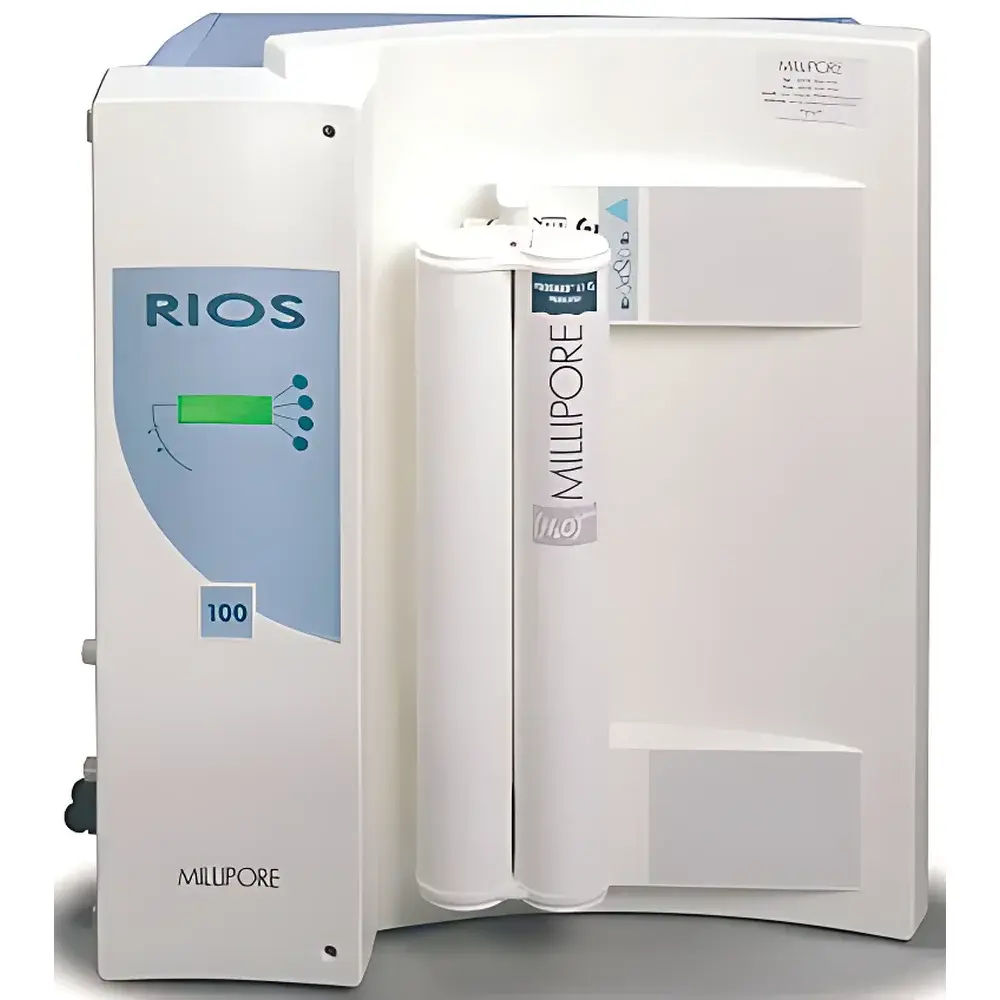
Millipore RiOs 150 Laboratory Water Purification System
| Brand | Millipore |
|---|---|
| Origin | France |
| Model | RiOs 150 |
| Maximum Flow Rate | 150 L/h |
| Conductivity Monitoring | Integrated Real-Time Conductivity Sensor |
| RO Recovery Rate | Up to 70% |
| Organic Rejection (MW > 200 Da) | ≥99% |
| Particle Rejection | ≥99% |
| Bacterial Reduction | <10 CFU/mL |
| UV Lamp | Built-in 185/254 nm |
| Operating Temperature Range | 7–30 °C |
| Dimensions (H×W×D) | 73.4 × 66.2 × 44.1 cm |
| Operating Weight | 38 kg |
Overview
The Millipore RiOs 150 Laboratory Water Purification System is a high-capacity, modular reverse osmosis (RO)-based platform engineered for the reliable, continuous production of Type III laboratory-grade purified water in compliance with ISO 3696:1987 and ASTM D1193-2020 Grade III specifications. Designed for integration into centralized water distribution networks, the RiOs 150 delivers a nominal flow rate of 150 liters per hour—scalable to up to 8,000 L/day—under stable hydraulic and thermal conditions across ambient feed water temperatures ranging from 7 to 30 °C. Its core purification architecture combines multi-stage pretreatment (including sediment filtration, activated carbon adsorption, and optional softening), high-efficiency thin-film composite (TFC) RO membranes with ≥95–99% salt rejection, and post-RO UV irradiation at dual wavelengths (185 nm for TOC oxidation and 254 nm for microbial inactivation). This configuration ensures consistent resistivity ≥0.05 MΩ·cm (≤20 µS/cm), low endotoxin and particle load, and minimal organic contamination—critical prerequisites for downstream use in autoclave feed, glassware rinsing, and as pre-treatment for ultrapure water systems such as Milli-Q® or Super-Q® platforms.
Key Features
- Integrated real-time conductivity monitoring with automatic data logging and alarm thresholds aligned with ISO 3696 and CLSI EP21-A guidelines
- High-recovery RO module optimized for up to 70% water recovery, reducing wastewater volume while maintaining stable permeate quality
- Dual-wavelength UV lamp (185/254 nm) installed in the post-RO loop to suppress microbial regrowth and oxidize low-molecular-weight organics
- Modular, field-replaceable pretreatment cartridges—including graded sediment filters, catalytic carbon, and ion-exchange resins—configured to accommodate variable municipal or well-water feed profiles
- Intuitive touchscreen interface supporting system diagnostics, maintenance scheduling, and event-driven alerts for cartridge saturation, pressure deviation, or UV lamp aging
- Robust stainless-steel and reinforced polymer housing rated IP22; designed for continuous operation in controlled laboratory environments with ambient humidity ≤80% RH non-condensing
Sample Compatibility & Compliance
The RiOs 150 is validated for use with potable municipal water meeting WHO Guidelines for Drinking-water Quality and EU Directive 98/83/EC. It is not intended for direct use with seawater, brackish water (>1,000 ppm TDS), or chemically contaminated industrial effluents without upstream conditioning. The system complies with CE marking requirements under the EU Machinery Directive 2006/42/EC and Electromagnetic Compatibility Directive 2014/30/EU. All wetted materials—including RO membrane housings, UV quartz sleeves, and sensor cells—meet USP Class VI biocompatibility standards. For GLP/GMP-regulated environments, optional audit trail functionality supports 21 CFR Part 11-compliant electronic records when paired with Millipore’s Elix® Connect software suite.
Software & Data Management
The RiOs 150 features embedded firmware with Ethernet and RS-232 connectivity, enabling remote status monitoring and configuration via standard TCP/IP protocols. Logged parameters—including feed/permate conductivity, UV intensity, differential pressures across prefilters and RO membranes, and runtime hours—are timestamped and exportable in CSV format. Optional integration with LabManager™ or third-party LIMS platforms permits automated quality gate enforcement (e.g., blocking dispensing if conductivity exceeds 20 µS/cm). Firmware updates are performed via secure HTTPS download and include cryptographic signature verification to ensure integrity.
Applications
- Feed water supply for Milli-Q® IQ 7000, Milli-Q® Integral, and Super-Q® ultrapure water generation systems
- Primary source for autoclave, steam generator, and washer-disinfector cycles requiring low silica and microbial burden
- Rinsing and final wash steps in analytical glassware cleaning validation protocols (per ASTM E3079-17)
- Buffer and reagent preparation for non-critical cell culture applications where endotoxin levels <0.25 EU/mL are acceptable
- Instrument feed for HPLC mobile phase preparation, spectrophotometer blanking, and general lab sink outlets
FAQ
What feed water quality is required for optimal RiOs 150 performance?
Municipal tap water with total dissolved solids (TDS) ≤500 ppm, free chlorine ≤2 ppm, and turbidity <1 NTU is recommended. Pre-treatment customization is advised for high-iron, high-hardness, or chloramine-treated supplies.
Can the RiOs 150 be connected to a building-wide purified water loop?
Yes—the system includes dedicated inlet/outlet ports, pressure regulation valves, and programmable flow control logic compatible with closed-loop recirculation architectures per ISO 20917:2019.
How often must consumables be replaced?
Pretreatment cartridges require replacement every 6–12 months depending on feed water quality; RO membranes typically last 2–3 years with proper pretreatment and periodic CIP; UV lamps are rated for 9,000 hours of continuous operation.
Does the RiOs 150 support regulatory audit trails for GxP environments?
When configured with Elix® Connect software and enabled audit trail licensing, it provides time-stamped, user-authenticated logs of all critical events, parameter changes, and maintenance actions compliant with FDA 21 CFR Part 11 Annex 11 requirements.
Is service and calibration documentation available for ISO 17025 accreditation?
Yes—Millipore provides factory calibration certificates traceable to NIST standards, preventive maintenance checklists, and IQ/OQ protocol templates upon request for accredited testing laboratories.



