
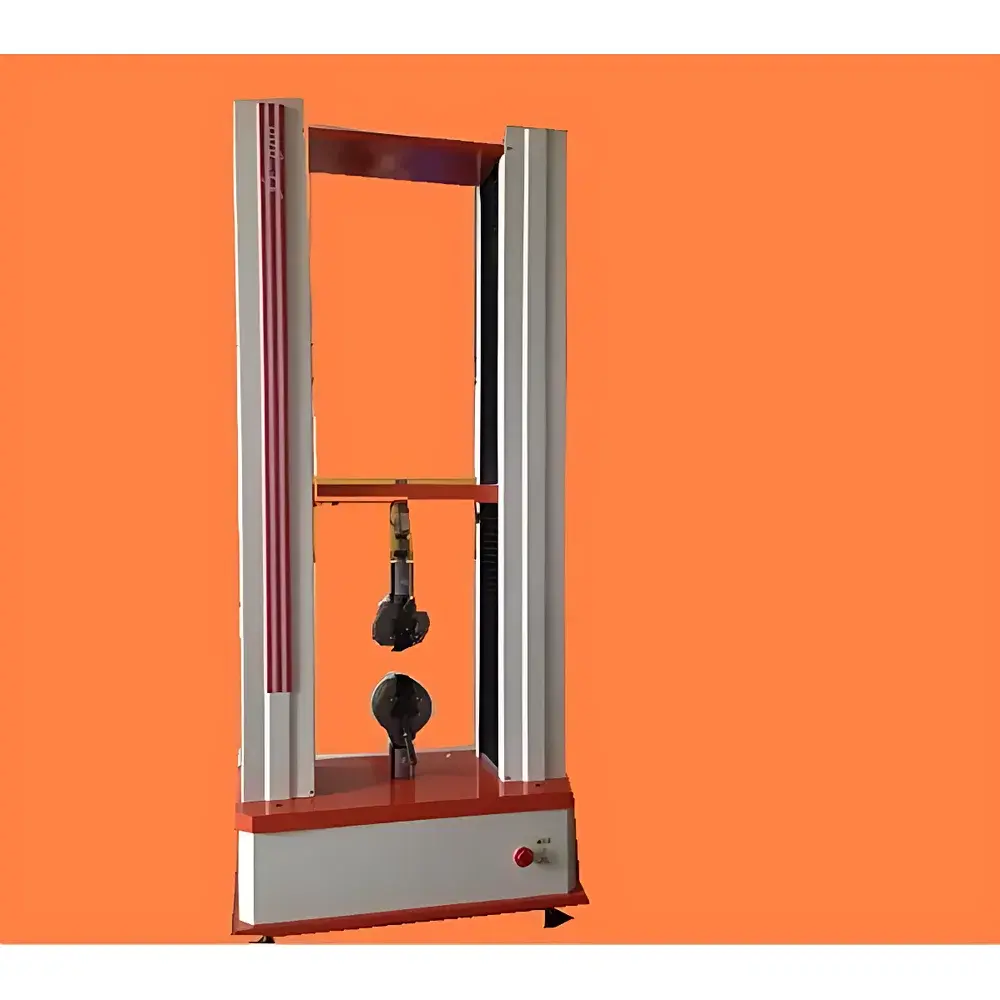
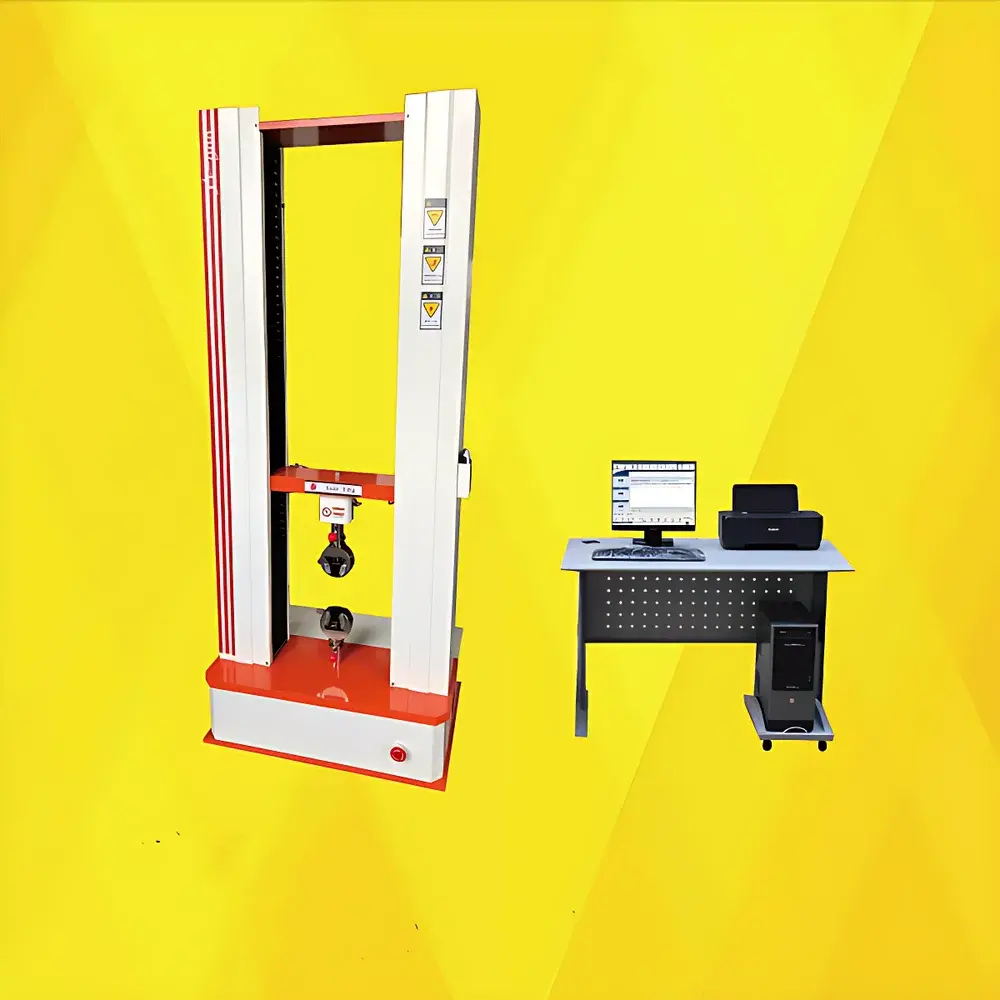
Beiguang Jingyi BG-5KN Advanced Electronic Tensile Testing Machine for Automotive Components
| Brand | Beiguang Jingyi |
|---|---|
| Origin | Beijing, China |
| Manufacturer Type | OEM Manufacturer |
| Model | BG-5KN |
| Max Test Load | 0–5 kN |
| Load Measurement Range | 1/1000 FS |
| Load Accuracy | ≤0.5% |
| Test Stroke | 350 mm |
| Crosshead Travel (without fixtures) | 950 mm |
| Displacement Resolution | 0.001 mm |
| Speed Range | 0.01–500 mm/min |
| Control Mode | Pulse Command |
| Data Interface | RS232 |
| Software Platform | UTM107 + Windows XP-based Test Suite |
| Compliance Standards | GB, ASTM, ISO, DIN, JIS, BS |
| Power Supply | 220 V, 60 Hz |
| Rated Power | 600 W |
Overview
The Beiguang Jingyi BG-5KN Advanced Electronic Tensile Testing Machine is a precision-engineered universal testing system designed specifically for mechanical property evaluation of automotive components and advanced engineering materials. Based on the fundamental principles of uniaxial tensile and compressive mechanics—governed by Hooke’s Law, stress–strain continuum theory, and ASTM E8/E21 standard test methodologies—the instrument delivers high-fidelity force–displacement data under controlled displacement or load-rate conditions. Its rigid dual-column frame, coupled with high-stiffness ABBA ball screws and German NORDIC torque-reduction gearheads, ensures minimal deflection and exceptional axial alignment during dynamic loading cycles. The system meets structural integrity requirements for Tier-1 and Tier-2 automotive suppliers performing validation per ISO 6892-1 (metallic materials), ISO 527-1 (plastics), and SAE J211 (crashworthiness component characterization). It is not intended for destructive certification under IATF 16949 audit without supplementary calibration traceability to NIST or CNAS-accredited laboratories.
Key Features
- High-accuracy load measurement using a 5 kN USA Transcell load cell with ±0.5% full-scale accuracy and 24-bit A/D conversion at 200 Hz sampling rate.
- Seven-range automatic load scaling (×1 to ×100) enabling seamless transition across low-force elastomer testing and high-force metal joint evaluation.
- Pulse-command servo control architecture delivering precise speed regulation from 0.01 to 500 mm/min with real-time feedback correction.
- Optimized crosshead travel of 950 mm (excluding fixtures) and 350 mm test width—configurable for extended stroke or wide-specimen applications.
- High-resolution optical encoder (2500 P/R) with LINE DRIVE differential signaling for robust noise immunity and sub-micron displacement resolution (0.001 mm).
- Comprehensive safety suite: overload emergency stop, mechanical upper/lower limit switches, leakage current cutoff, auto-stop at break detection, and optional wireless remote control.
- Modular hardware architecture supporting future integration of extensometers (contact/non-contact), environmental chambers, or digital image correlation (DIC) subsystems.
Sample Compatibility & Compliance
The BG-5KN accommodates a broad spectrum of specimen geometries and material classes relevant to automotive subsystem validation—including stamped steel brackets, injection-molded polymer housings, composite battery enclosures, rubber bushings, brake hose assemblies, seatbelt webbing, airbag tether cords, and aluminum extrusions. Standard fixtures include wedge-action pneumatic grips and peel test fixtures; custom tooling (e.g., torsion adapters, compression platens, or shear jigs) is available per ISO 148-1 and ASTM D732 specifications. All test protocols are fully compliant with GLP-aligned data integrity requirements: audit trails, electronic signatures, and 21 CFR Part 11–ready software configuration (via optional upgrade). Calibration certificates conform to ISO/IEC 17025 and reference standards traceable to national metrology institutes.
Software & Data Management
The UTM107 test platform runs on a dedicated Windows XP-based environment with real-time multi-curve visualization (load–displacement, stress–strain, load–time, etc.) and Auto-Scale dynamic axis optimization. Users may define up to 12 independent test modes—including constant strain rate, constant load ramp, hold-and-relax, cyclic loading, and multi-step programmed sequences. Built-in formula editors allow customization of derived parameters such as Young’s modulus (E), yield strength (Rp0.2), tensile strength (Rm), elongation at break (A%), and energy absorption (area under curve). Data export supports native .xls, .csv, and .txt formats; all raw datasets include timestamped metadata, operator ID, environmental conditions (if logged), and calibration history. Local storage supports redundant backup across multiple disk partitions; network deployment via LAN-enabled RS232-to-Ethernet bridge is supported.
Applications
This system serves critical QA/QC and R&D functions across automotive supply chains: tensile verification of weld seams per AWS D8.1, peel adhesion assessment of thermal interface materials (TIMs), compression testing of foam headrests (SAE J2776), shear strength evaluation of riveted joints, creep behavior analysis of under-hood plastics (ISO 899-1), and fatigue pre-screening of suspension bushings. It also supports academic research in polymer viscoelasticity, metal plasticity modeling, and multiscale composite failure analysis—particularly when paired with optional video extensometry or acoustic emission modules. Routine use includes incoming inspection of fasteners (ISO 898-1), validation of recycled PP blends for interior trim, and qualification of bio-based thermoplastics for non-structural applications.
FAQ
What standards does the BG-5KN support out-of-the-box?
Preconfigured test templates cover ASTM D638, D790, D1876, ISO 527, ISO 6892-1, GB/T 228.1, and JIS K7113—enabling immediate compliance with common automotive material specifications.
Can the system be upgraded for high-temperature testing?
Yes—through integration with an external environmental chamber (−70°C to +300°C), provided space and power constraints are verified during site survey.
Is third-party calibration documentation included?
A factory calibration certificate traceable to CNAS-accredited standards is supplied; annual recalibration services are available with NIST-traceable reporting.
Does the software meet FDA 21 CFR Part 11 requirements?
The base version supports audit trail logging and user access levels; full Part 11 compliance requires optional GxP module activation and IT infrastructure review.
What is the warranty coverage and service response time?
Standard 12-month parts-and-labor warranty applies; technical support is available via email and remote desktop within 4 business hours; on-site service dispatch is scheduled within 5 working days post-approval.



