
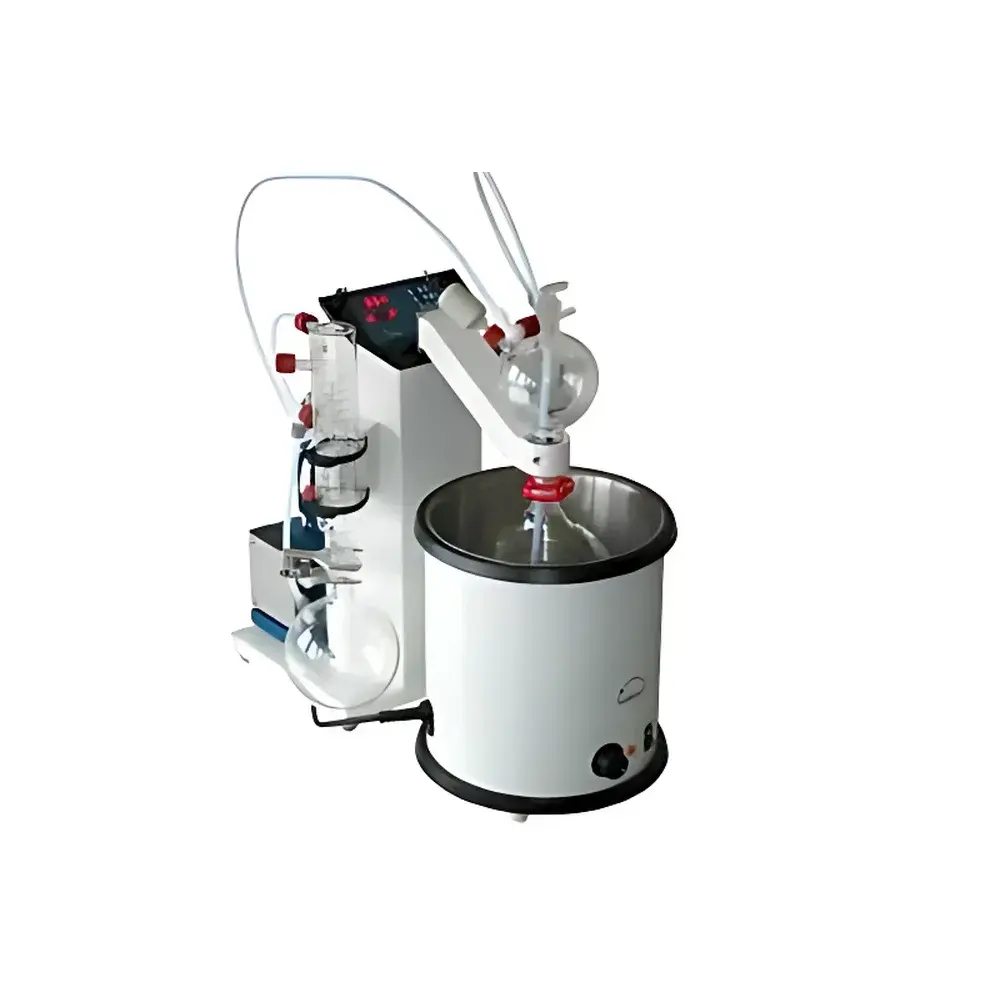
ILMVAC Ilmdest+ Fully Automated Distillation System
| Origin | Germany |
|---|---|
| Manufacturer Type | Authorized Distributor |
| Origin Category | Imported |
| Model | Ilmdest+ |
| Pricing | Upon Request |
| Ultimate Pressure | 15 mbar |
| Air Suction Speed (50/60 Hz) | 2.3 / 2.5 m³/h |
| Dimensions (W × D × H) | 310 × 550 × 550 mm |
| Weight | 26.8 kg |
| Controlled Final Pressure | Yes |
| Suction Rate | 38 L/min |
| Noise Level | 45 dB(A) |
| Power Consumption | 200 W (system only) |
| Exhaust Port | Clamp sleeve Ø8 mm, hose 8/6×1 mm |
| Cooling Water Connection | DN 8 hose, ID 8 mm |
| Collection Flask (pressure side) | 1000 mL (custom volumes available) |
| Water Bath Capacity | 9 L |
| Water Bath Heating Power | 1800 W |
| Water Bath Voltage/Frequency | 230 V, 50/60 Hz |
| Water Bath Dimensions (Ø × H) | 280 × 305 mm |
| Water Bath Weight | 4.5 kg |
Overview
The ILMVAC Ilmdest+ is a fully automated, closed-loop distillation system engineered for precise, operator-independent solvent recovery from complex liquid mixtures. Unlike conventional rotary evaporators or vacuum-assisted distillation units, the Ilmdest+ operates without rotating components—eliminating mechanical wear, seal degradation, and sample foaming risks associated with spinning flasks. Its core architecture integrates a high-efficiency diaphragm vacuum pump, intelligent pressure-controlled boiling point detection, and thermally regulated heating via an optional integrated water bath. The system autonomously identifies and maintains optimal distillation conditions by continuously monitoring vapor pressure dynamics in real time, enabling robust separation of multi-component solvents—including azeotropic or heat-sensitive systems—without manual intervention. Designed and assembled in Germany, the Ilmdest+ complies with CE directives and meets essential safety requirements for laboratory-scale solvent recycling under ISO/IEC 17025-aligned workflows.
Key Features
- Zero-rotation distillation principle: Eliminates mechanical drive systems, reducing maintenance intervals and enhancing long-term reproducibility.
- Self-optimizing boiling point detection: Uses dynamic pressure feedback to identify onset of vaporization and adjust vacuum level accordingly—no preset temperature ramping required.
- Hermetically sealed operation: Ensures 100% solvent recovery efficiency; no atmospheric exposure during distillation or condensation phases.
- Modular thermal control: Optional 9 L water bath (1800 W heating, ±0.5 °C stability) provides uniform, contact-based heating compatible with glassware up to 2 L capacity.
- Low-noise vacuum generation: Diaphragm pump delivers 38 L/min suction rate at 45 dB(A), suitable for shared lab environments requiring acoustic compliance.
- Integrated safety architecture: Includes overpressure relief, dry-run protection, and automatic shutdown on abnormal pressure deviation or thermal excursion.
Sample Compatibility & Compliance
The Ilmdest+ accommodates a broad range of organic solvents (e.g., acetone, ethanol, ethyl acetate, dichloromethane, toluene) and aqueous-organic mixtures. It is not intended for strongly oxidizing, corrosive (e.g., concentrated nitric acid), or polymerizable substances without prior validation. All wetted parts are chemically resistant (PTFE, borosilicate glass, EPDM). The system supports GLP/GMP documentation workflows through optional pressure sensor integration (P/N 112035), enabling traceable pressure logs exportable in CSV format. While not certified for pharmaceutical manufacturing under FDA 21 CFR Part 11 out-of-the-box, its data integrity framework is configurable to meet audit-ready requirements when deployed with validated software protocols.
Software & Data Management
The Ilmdest+ operates via embedded firmware with tactile push-button interface—no external PC or proprietary software required for basic operation. For advanced process logging, the optional pressure sensor feeds analog output to third-party DAQ systems or SCADA platforms compliant with Modbus RTU or 4–20 mA standards. All operational parameters—including elapsed time, final pressure, suction duration, and bath temperature (if equipped)—are stored in non-volatile memory for post-run review. Exported datasets conform to ASTM E2500-17 guidelines for equipment qualification records and support IQ/OQ documentation packages.
Applications
- Solvent recovery in synthetic chemistry labs (e.g., post-reaction workup of Grignard or Suzuki couplings).
- Concentration of natural product extracts without thermal degradation.
- Recycling of HPLC mobile phases containing acetonitrile/water gradients.
- Preparative purification of low-boiling monomers prior to polymerization.
- Teaching laboratories requiring safe, repeatable distillation demonstrations under undergraduate safety protocols.
FAQ
Does the Ilmdest+ require calibration before first use?
No routine calibration is required—the system performs self-diagnostic checks at power-on. However, users should verify pressure sensor accuracy annually using a NIST-traceable reference gauge if used for quantitative reporting.
Can the Ilmdest+ handle viscous or particulate-laden solutions?
It is optimized for clear, low-viscosity liquids (< 500 cP). Suspensions or slurries must be pre-filtered to prevent clogging of the condensate path or pressure sensor port.
Is the water bath compatible with all standard round-bottom flasks?
Yes—the bath accommodates standard ground-glass joint sizes (24/40, 29/32, and 34/45) via adjustable support rings; flask immersion depth is manually set prior to initiation.
What maintenance is required for long-term reliability?
Diaphragm pump oil-free operation eliminates lubricant changes. Annual inspection of PTFE valves, cooling hoses, and O-rings is recommended per ILMVAC’s Maintenance Schedule M-ILMDEST-2023.
How does the Ilmdest+ compare to traditional rotary evaporation in terms of energy efficiency?
With a total system power draw of 200 W (pump only) or 2000 W (pump + bath), it consumes approximately 30–40% less energy than comparable rotary evaporators operating under identical solvent load and recovery targets, primarily due to absence of motor-driven rotation and reduced thermal mass.



